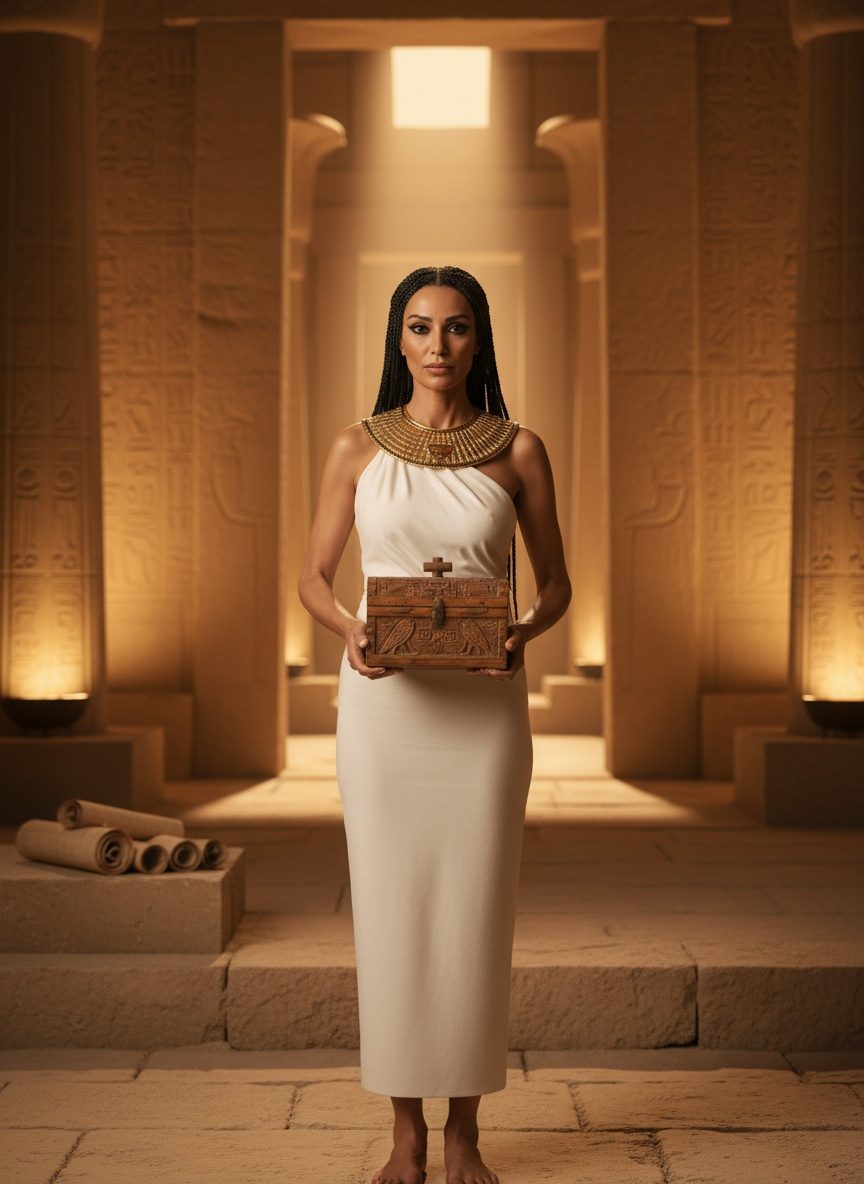
The sun hung low over the horizon, casting long shadows across the sands of the Giza Plateau. The wind gently stirred the palm fronds, whispering secrets of times long past. It was a setting that promised nothing but tranquility. Yet beneath this serene exterior, Peseshet, one of history's pioneering women, stood on the cusp of change — not only for Egypt but for the world. Her presence within the hallowed halls of the pharaoh's domain was an anomaly, a point of curiosity, and a daring statement. She was not there as a servant, nor as a supplicant. Peseshet was there as a healer, holding a title that had not been borne by a woman before her: Lady Overseer of Female Physicians. Her story, nearly lost to the sands of time, speaks of courage and intellect in an age that so often silenced both in women.
The Healing Art in Ancient Egypt
Amid the burgeoning civilization of Ancient Egypt, where the Nile's ebb and flow dictated the rhythms of life, medicine stood as both an art and a science. Earlier than most civilizations, Egypt embraced a sophisticated approach to healing, combining empirical knowledge with spiritual wisdom. The well-being of its people was a matter of great importance, reflected in their extensive papyri filled with medical instructions, treatments, and herbal remedies. Into this rich tapestry stepped Peseshet, weaving her own contributions into the annals of Egyptian medicine.
While many of her contemporaries were relegated to supporting roles, Peseshet carved a niche for herself as a pioneering force in medicine. Her title, Lady Overseer of Female Physicians, was a testament to her remarkable standing and influence. It was a role that required not only medical acumen but also leadership, as she shepherded other women through the rigors of medical practice. The exact nature of her training programs and methods remains obscured by time, but the significance of her position is undeniable. She was a trailblazer, challenging the constraints of her society, ensuring that knowledge, like the Nile, was ever-flowing.
The fact that Peseshet's contributions have been validated by historians and archaeologists alike, reflected in hieroglyphic records, is no small feat. Her life's work, etched in stone, stands as a rare acknowledgment of female intellectual prowess in an era dominated by male achievements. It hints at a world where women were not just adjuncts to history but active participants in shaping it.
Standing Before Pharaoh
To fully appreciate Peseshet's boldness, one must envision the court of the pharaoh — a place awash in the hues of colorful hieroglyphs, perfumed incense swirling in the air, and the palpable weight of divine authority omnipresent. In this sanctified space, a woman stood, not as a queen or a concubine, but as a person of power and intellect. To hold her own in such a setting required more than just skill; it required an unshakable resolve and a deep-seated belief in her capabilities.
Before the pharaoh and his retinue, Peseshet's voice would ring with both knowledge and authority. She advocated for the use of specific treatments, employing not only the known pharmacopoeia of herbs but also the spiritual rites necessary to soothe the soul. Her expertise would have been instrumental in treating ailments of the royal family and high-ranking officials, securing her reputation as a trusted advisor in matters of health.
Peseshet’s presence in this realm illustrates a unique societal nuance in Ancient Egypt. Here, women had opportunities—legally recognized rights to own property, initiate divorce, and engage in commerce. Yet, to ascend to Peseshet's level of influence was extraordinary. It underscores a tacit acknowledgment of her indispensable skills and the trust she garnered from those in power. Her story is a compelling reminder that even in ancient times, talent and determination could sometimes transcend gender barriers.
The Legacy Etched in Stone
As the Nile's waters have long gone but never forgotten, so too was Peseshet’s legacy almost washed away by the passage of millennia. Her name, however, was carved meticulously onto stone tablets and tomb inscriptions, ensuring that echoes of her achievements would resonate long past her time. Unlike the ephemeral papyri, these marks in stone have provided the fragments necessary to piece together her influence alongside the golden sands of Egypt.
Peseshet's impact is not solely confined to her era. Thousands of years before universities like Bologna or Oxford opened their doors, she was advocating the education and certification of female practitioners. Her achievements offer a striking contrast to the constraints that women later endured in the fields of science and medicine. Her story also challenges modern perceptions of ancient history, inviting us to reconsider the roles women have played throughout history.
In a world that often relegates the accomplishments of women to footnotes, Peseshet’s tale is not just a narrative of personal success but a chapter in the long and often overlooked history of women’s contributions to medicine and science. Her resilience and ingenuity shine through the dusty veils of time, reminding us that while history can forget, it can also be remembered and celebrated when we choose to look beyond the surface. Peseshet healed her nation and, in doing so, left an indelible mark on the story of humanity—a story that began when she stood before the pharaoh, prepared to heal anyway.