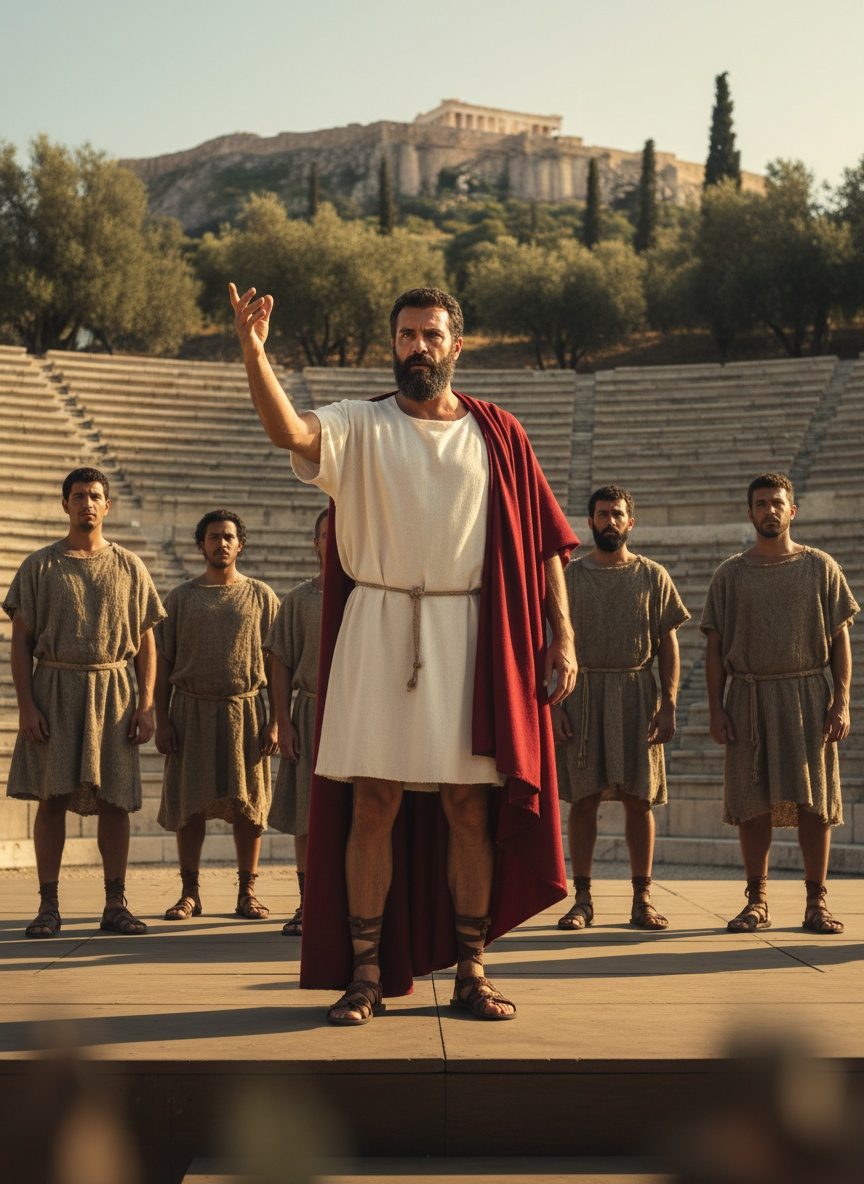
Thespis was not renowned for a powerful voice. Yet, on that fateful day, his words altered the course of history. In 534 BCE, beneath the bright Athenian sky, amidst the fervor of the yearly festival for Dionysus, one audacious act changed performance art forever. The thick air hung heavy with the aromas of offerings and spirited anticipation. Crowds gathered in a semicircular theater, eager to indulge in the cathartic songs of the chorus. It was an arena where music and ritual merged, and stories unfurled in melodious harmony. Then, something unanticipated transpired; Thespis, a mere member of the chorus, made history.
Tradition dictated a chorus in sonorous convergence, narrating tales from Greek mythos. But Thespis dared to shatter convention. As the chorus stilled, he stepped forward. His solitary figure against the backdrop of his fellow performers broke the mold as he introduced a single, distinct voice, venturing into a realm of individual expression. The crowd fell to hushed murmurs before succumbing to silence—an attentive acknowledgment of a new echelon of storytelling. Thespis became Icharios, a character, a persona, a distinct soul stepping out of the collective melody into a solitary spotlight.
The theater evolved at that instant, transforming from chant-driven narration into the art of acting, where a performer could embody a character rather than speak as an anonymous conduit for the muse's stories. This departure marked the inception of the actor, the thespian whose name hails from Thespis himself. From that historic moment, thespians brought their characters to life in ways that words alone could not convey, giving rise to nuanced exploration of the human condition.
Nothing in ancient dramas suggested that it was possible before Thespis. In that era, the theater was fundamentally communal; the chorus represented unity in song—divine supplication through synchronized voices. Yet, Thespis demonstrated that the power of one was equally profound, perhaps even more so. His solitary act of defiance and creativity triggered a revolution in theatrical art, and the implications were far-reaching, inviting others to ponder the vast terrain of theatrical expression.
The swells of ancient Greece, with culturally fertile lands like Athens, already bustling with democratic ideals, philosophy, and burgeoning scientific thought provided fertile ground for such transformative acts. Theater was central to the city-state's cultural identity—a blend of celebration, religion, and community. Through these vigorous festivals, a seemingly innocuous act by Thespis left reverberations felt far beyond the bounds of theater, not merely a narrative change but the birth of the dramatic protagonist.
Imagine the metamorphosis: Characters were freed from the collective chorus to explore their dilemmas, joys, and tragedies deeply in stories transferring the focus to individual passions and myriad emotions. Characters emerged as interlocutors of moral and philosophical questions—introspections on justice, honor, and fate reflective of the society's own shifting tides.
Intriguingly, it also allowed playwrights to evolve, diversifying the presentation of their work. Thespis' innovation laid the groundwork for the legendary playwrights who succeeded him: Aeschylus, Sophocles, and Euripides, among others. With actors embodying tragic heroes and antagonists’ personas, theater became a dynamic composition, each character a catalyst for debate and reflection. Each performance became an intimate dialogue between the stage and society, a microcosm of Athenian life unraveling under the very skies where democracy was born.
The transformation was not merely in technique but in substance. From Thespis' step forward, tragedies flourished, and later comedies brimmed with satire that echoed and shaped the ethos of the Athenian polis. They asked probing questions about destiny, explored divine inequity, and often held mirrors to society's values and contradictions. The individual character expanded the stage's conceptual and emotional territory, inviting audiences to emotionally traverse a spectrum of human experience.
This remarkable audacity marked not just a theatrical innovation but a celebration of individualism that acknowledged and embraced singular voices amidst collective narratives. It was an articulation of an evolving ethos where dialogue, scrutiny, and personal exploration were becoming keystones of civic life. The artistic and cultural ripples from Thespis’ solitary defiance reached far beyond his own epoch, setting a template for storytelling that successive civilizations embraced and adapted—from Shakespeare's globe-spanning tales to modern cinema’s myriad narratives.
As the crowd in Athens eventually erupted in applause that day, few truly comprehended the magnitude of Thespis's act. Yet, fittingly, it stands as one of history’s great archetypal moments—where boldness and creativity collided to forge new potential. Thespis stepped out, not just delivering lines but breathing life into theater’s very fabric. Today, actors, playwrights, and audiences still trace their artistic lineage to that daring moment when a solitary voice broke ranks with tradition under the watchful eyes of the gods. Lessons of bravery in artistic expression, of valuing a single voice, continue to resonate as we explore our identities and craft stories anew.