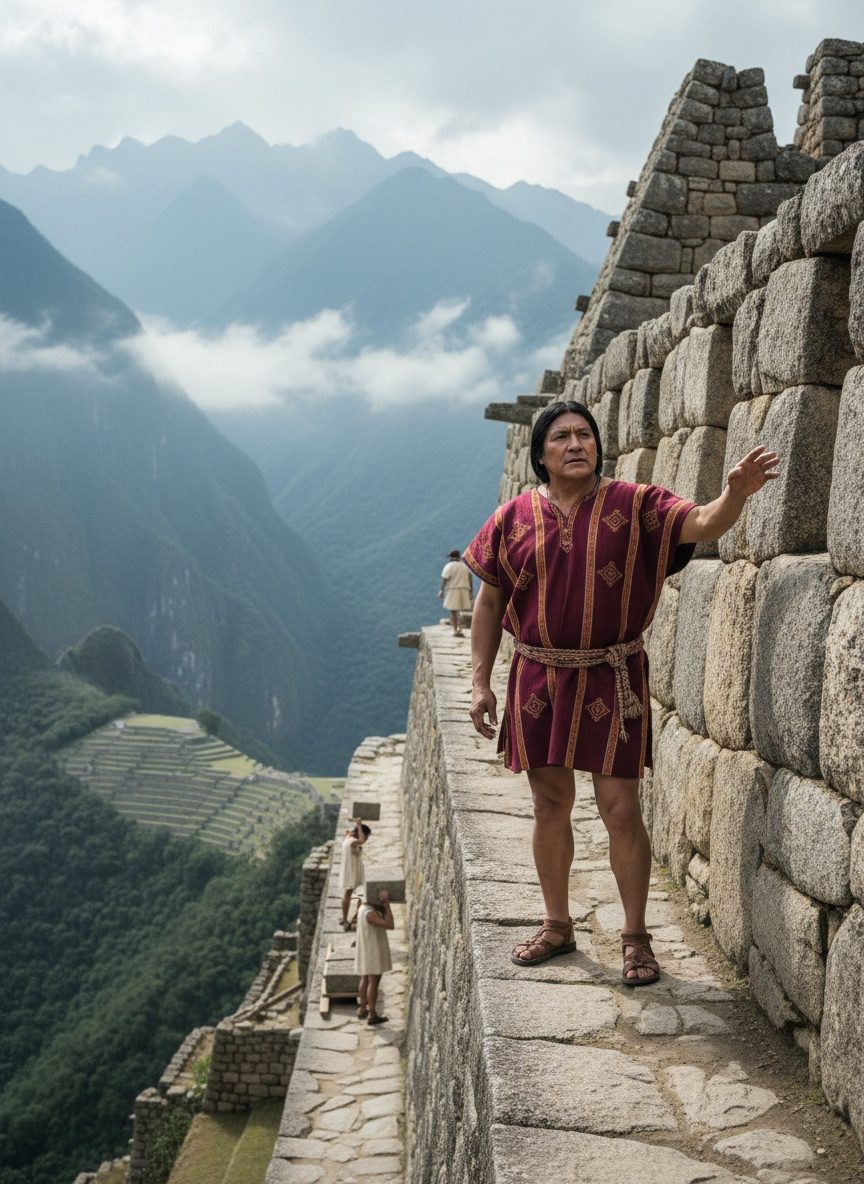
The chisel struck flint against granite, the sound resonating through the mountain air like a distant echo of thunder. Around the stoneworker, the roar of the mighty Urubamba River played a steady symphony as a chorus of lungs exhaled breaths thin but determined, striving towards a nearly impossible task: the erection of a city in the sky. Sweat beaded on sun-browned skin as ten thousand pairs of hands worked in harmony with mountain and spirit, guided by the will of a king known as Pachacuti, the ninth Sapa Inca.
Machu Picchu was a testament to ambition restrained only by the limits of the natural world, crafted onto a ridge nestled between Machu Picchu and Huayna Picchu peaks. The whisper of the Andes sang of secrets, ancient and modern, as Pachacuti envisioned a retreat that would unveil the grandeur of Tawantinsuyu—the splendid Inca dominion sprawling across much of western South America. There, high above the world below, Pachacuti sought to immortalize his divine connection to the earth mother, Pachamama.
With no iron tools, no wheel to ease their burden, and no mortar to clasp the stones, the builders shaped every rock to its neighbor with such precision that the passage of time could not sunder them. Each stone was gently coaxed out of the earth with tools of copper and bronze, the harder stones cleaved with the cunning use of water and wooden wedges. As the sun set, painting the sky in hues as vibrant as the adorned garments of the Inca, shadows transformed the jagged stones into ethereal silhouettes—an ageless tapestry where architecture and nature wove together seamlessly.
Pachacuti, whose name translates to "World Shaker," was no ordinary ruler. With wisdom and boldness, he centralized power, reorganized religion, and redefined governance. Under his leadership, the early quipus—knotted strings conveying detailed information—became sacred knots of empire. Some say Pachacuti himself held a vision atop the mountain, where the air thinned and the veil between worlds was whispered to grow faint. This was where the soul could soar to commune directly with the gods, carrying the essence of the great Sapa Inca through realms of the living and the divine.
Amidst a world veiled in mystery, the Inca builders deciphered the celestial dialogues and responded with a city that mirrored the heavens. The very layout of Machu Picchu was an ode to cosmic order and earthly symmetry. Temples oriented to capture the solstice sun or illuminate sacred niches at equinox contributed to a cosmology as intricate as the looming stone structures themselves. The juxtaposition of stone and sun, the deliberate fashioning of form and light, was an architectural whisper or prayer sent to the cosmos.
Beyond religious prose, Machu Picchu served as a bastion of Inca ingenuity—an ecological harmony adept at harnessing nature's bounty. Terraces cascaded down the mountainsides, a marvel of engineering that drained rainwater while thwarting erosion, sculptures of land serving both purpose and persistence. Yet it was within the precise joinery of its polished stone walls and the irrigation systems threading beneath them that the skill of its builders sang the loudest. Spanning the centuries, the whisper of Pachacuti's command echoes in each stone, held together by their own weight, packed tight enough to resist earthquake and erosion—the mourning of earth’s creasing face.
But why Machu Picchu remains so compelling a mystery is less a conundrum of construction or location, and more one of spirit and silence. Abandoned a mere century after its creation, deserted just as foreign conquerors began a recalibration of a world both known and unknown, it was never found by the conquistadors who craved golden conquest. Hidden from view by its divine perch and surrounded by dense jungle, the sanctuary wilted into whispers until Hiram Bingham brought the city back into the world’s collective consciousness in the early 20th century.
As dawn breaks over Machu Picchu, the telling of one man's architectural dream invokes a contemplation of a culture whose bonds to earth and sky remain enshrined in stone. The energy of Pachamama's embrace seems to linger in the trails around Machu Picchu, reminding those who meander through the Andean heights of the enduring spirit of a civilization that dared to etch its legacy on the very nose of the heavens.
Machu Picchu, though studied and revered, holds true to its air of mystery in its formidable resilience and skyward gravitas. Its artistry transcends the tangible, speaking through time of a culture that understood the universe as an intricate lattice of physical and spiritual being. It beckons us not just to admire its silent elegance but to seek a deeper understanding of how past and present intertwine, how our own fleeting mark becomes part of the ancient constellation of all who have dared to dream lofty dreams. It stands, not merely a monument to what was built, but to what of us remains yet to be woven into the landscapes of time.