The stone-cold embrace of fear gripped Androclus as the familiar chill of the Roman arena settled deeply in his bones. The air was tense, vibrating with the frenzy of thousands, each spectator hungering for the visceral thrill of another man's demise. Dust swirled around him, whipped up by the restless movement of the crowd. Mingled with the din of jeers and revelry, Androclus could hear the low growl that triggered the deep-seated instincts of flight or fight. But there was nowhere to flee. The passage through which he had been thrust into this public trial sealed shut behind him, leaving him exposed, vulnerable beneath the unrelenting sun. Across the sandy expanse, at the far side of the arena, a massive lion appeared, its golden eyes locked onto its supposed prey. The crowd's anticipation swelled to a fever pitch.
It was a spectacle both savage and methodical, orchestrated in Rome's grand arena, where the fates of the condemned were often sealed not by judicial merit but by blood and spectacle. Androclus was a runaway slave, branded as such not just by the scars that marred his back but by the stigma that clung to him like a widow’s veil. It was customary punishment; runaway slaves were set loose against ferocious beasts for the amusement and moral edification of the gathered Romans. Today, it was Androclus's turn to dance with death.
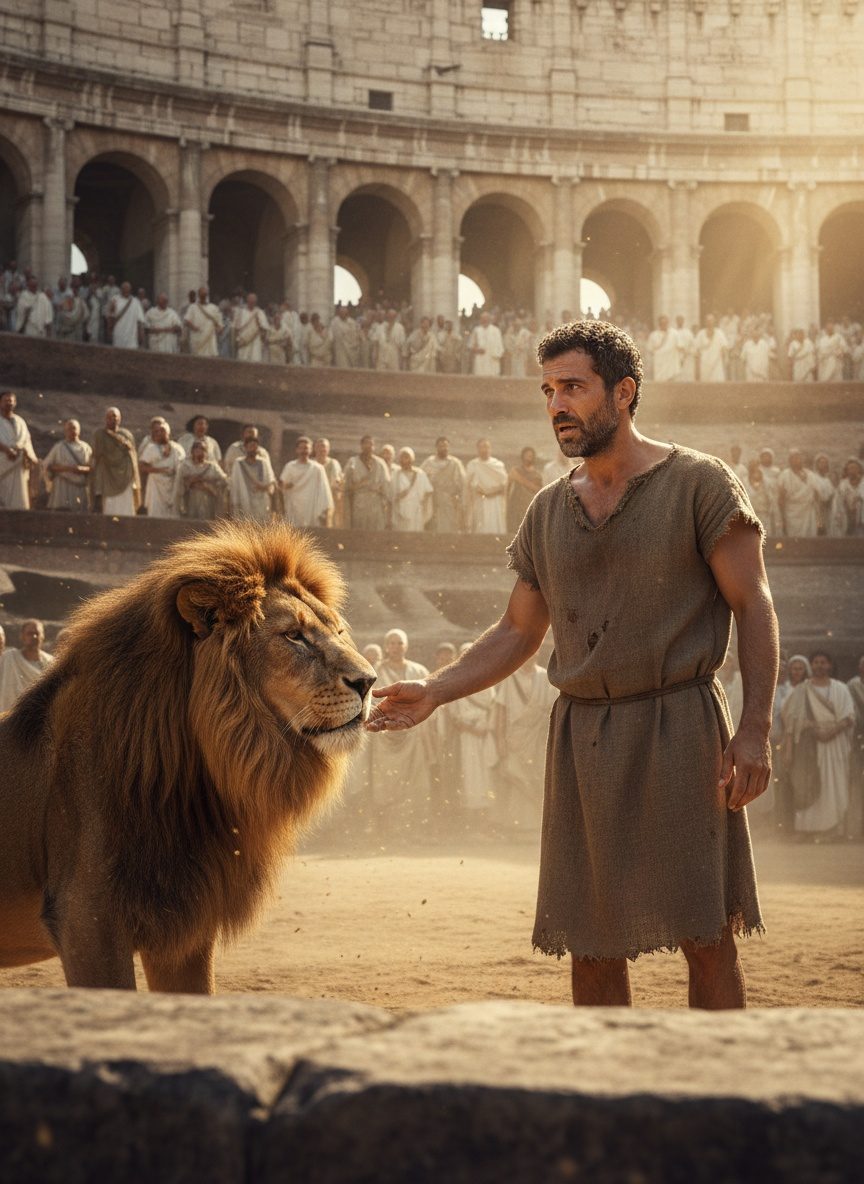
Yet, something unprecedented happened as the lion approached, a moment pregnant with an almost mystical pause. Just as the beast closed in, ready to deliver the coup de grâce, it faltered. The lion's predatory stride slowed until it halted entirely, a few paces from Androclus. He stood transfixed, his breath tethered in disbelief, as the lion, instead of pouncing, dropped to the ground and began purring loudly. It raised one massive paw and rested it gingerly on the runaway's hand. To Androclus, the world melted away; his hands gently touched the lion’s mane, stirring memories of another life-saving encounter in a far-off place.
Years earlier, Androclus had secured his place in the imperial household of a Roman governor stationed in the provinces of North Africa. Deprived of liberty but not of heart, Androclus yearned for a different life, one where the lash of servitude did not dictate his every move. Opportunity presented itself, and, seizing it, he fled into the ubiquitous darkness of the African night. Every rustle became a threat, every whisper carried the weight of betrayal. For weeks, he eluded would-be captors, the desert sun vitriolic in its scrutiny. His sanctuary was a cave, shrouded in the oppressive silence of the wilderness.
It was there, in the solitude and stillness, that he encountered the first taste of real fear. Androclus stumbled upon a lion, struggling haplessly, not with external chains but with a thorn embedded deep within its paw, anger and pain etched in its chiseled visage. He could have retreated, fading back into obscurity, but something tethered him to the spot. A moment of shared vulnerability, perhaps. With gentle persistence, he crouched beside the great creature. Painstakingly, Androclus worked to ease the thorn from the lion's paw, each tug and adjustment echoed by the soft whisper of the desert breeze.
Released from agony, the lion stretched out its paw, almost in gratitude, and returned to the depths of the cave. The two shared an uneasy coexistence, trust forming where once there was only caution. The lion became both protector and companion, guarding the runaway until fortune delivered Androclus back into the grip of his pursuers. But they weren't unkind; they simply saw themselves as the keepers of order, restorers of balance.
These recollections raced through Androclus's mind as he knelt, inexplicably calm, in the center of the arena. The gathered throng, lulled into an uneasy silence by this unexpected intimacy, watched the spectacle with bated breath. The emperor, present for the day's entertainment, was intrigued. How many beguiling tales were born from the sands of this arena, only to dissipate as the sun set? Yet here was a narrative that defied the odds, inexplicably unvarnished by theater or pretense.
Summoning Androclus forward, the emperor demanded the story behind this audacious tableau. As Androclus recounted the improbable series of events, one could feel the remnants of cynicism chipping away from the emperor’s countenance. There is a peculiar power in stories borne of genuine humanity, and Androclus's was undeniably that. The lion, now a serene presence by his side, punctuated his tale with its tranquil demeanor, lending credence that not even the most elaborate training could explain away.
In an act rare and resonant, the emperor, swayed by the gravity of something both simpler and yet greater than justice, forgave Androclus his transgressions. He declared the man free, liberating him from the shackles of his past. Freedom, seasoned by trials both physical and existential, wrapped itself around Androclus, a liberty that neither man nor manifesto could truly bestow. And in a gesture that would ripple through the annals of history, the lion, too, was granted its freedom, a gesture steeped in symbolism as much as compassion.
The crowd, moved in their depths beyond the thirst for mere bloodshed, erupted into applause. It was as if humanity had drawn back the veil masking their primal inclinations, even if just momentarily. The arena, a theater of violence, became a stage for demonstrating the latent capacity for empathy and memory; the mutual recognition shared by Androclus and the lion was absconded within the heart of every individual present.
This story, though tucked away at the periphery of history, remains swathed in significance. It flickers as a reminder of an age where spectacle often drowned out subtlety, and yet, even then, profound connections dared to transcend the confines of silence and shadow. It is easy to overlook this tale as anecdotal, a fable to be relegated to parables of lesser weight. But beneath its surface, we unravel a tapestry interwoven with understanding and redemption. Androclus and his lion remind us that even amidst the roar of the crowd, sometimes the most extraordinary truths are whispered in the silent language of actions remembered and bonds never broken.