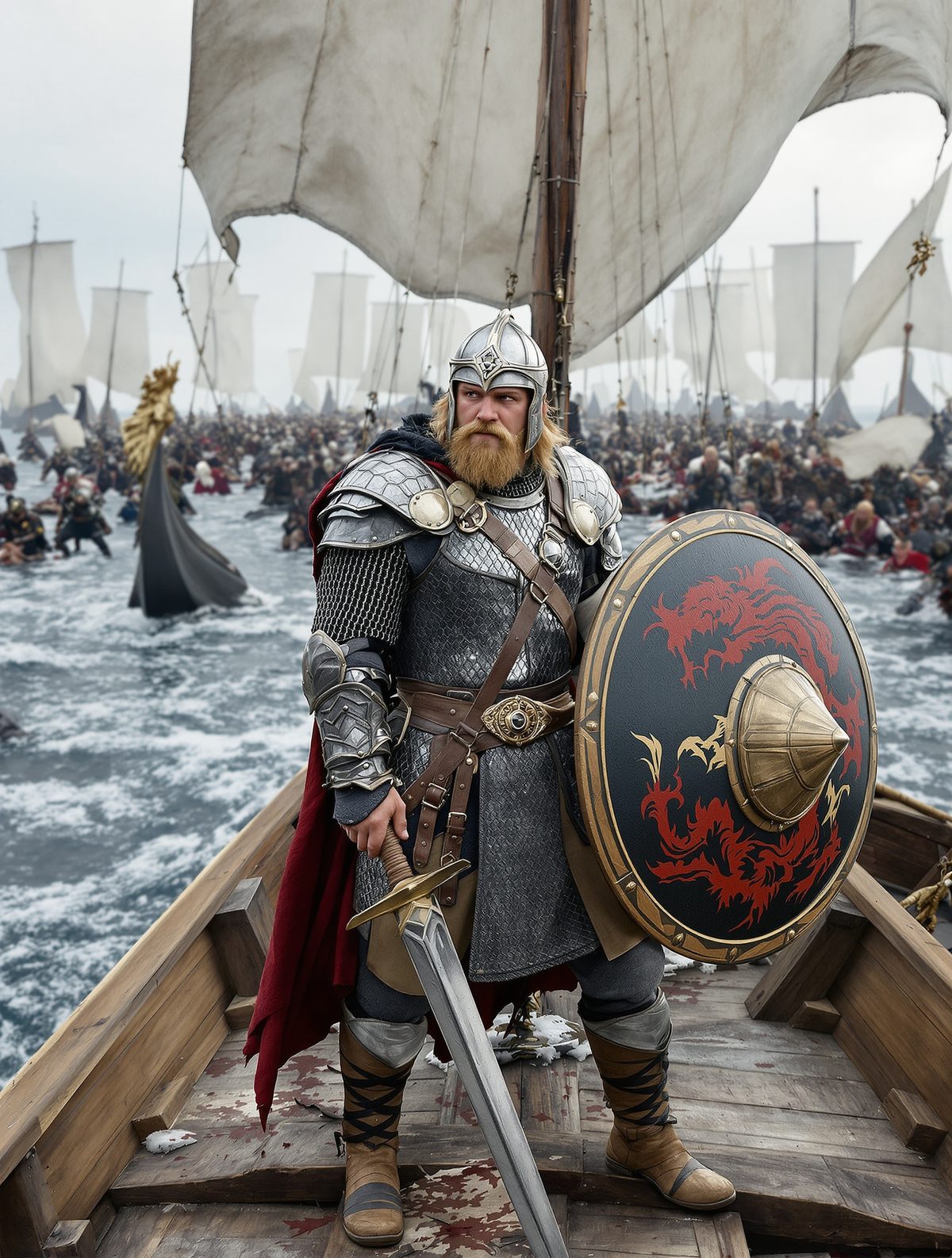
On a fateful September of the year 1000 AD, the calm waters of the Baltic Sea were shattered by the thunderous clash of iron and timber. The air was thick with the acrid smell of sea salt, sweat, and blood. King Olaf Tryggvason, regal and imposing, stood at the prow of the Long Serpent, the most awe-inspiring warship ever conceived in the Norse world. His eyes, as steely as the blade in his hand, surveyed the grim spectacle before him. Surrounded by his enemies, betrayed by his allies, Olaf made a fateful decision that would echo through the ages. In full battle armor, he leapt into the abyss of the North Sea, vanishing without a trace, leaving behind a legacy that would both dazzle and haunt history.
The Ascent of a Viking King
Olaf Tryggvason's story begins long before his mysterious disappearance, amid the tempestuous fjords of Norway. Born towards the end of the Viking Age, Olaf’s lineage was tumultuous; he was the great-grandson of the legendary Harald Fairhair, the first King of Norway. Yet his early life was marked by turbulence and exile, following the murder of his father by the notorious Viking, Hakon the Good.
Orphaned and adrift, Olaf grew up in the courts of Eastern Europe before carving his own path through raids and conquest. His reputation as a fierce warrior and astute leader soon became known across Scandinavia. In 995 AD, Olaf seized the Norwegian throne, determined to unite the unruly Norse chieftains under a single banner and introduce Christianity to his pagan realm. Within five years, Norway was a kingdom renewed under his rule.
But power kindled envy, and Olaf's ambition made him enemies. The kings of Denmark and Sweden, Svend Forkbeard and Olof Skotkonung, alongside the Norwegian earl, Eirik Hakonsson, formed a clandestine alliance to dismantle Olaf's sovereignty, setting the stage for the dramatic rendezvous at Svolder.
The Battle of Betrayals
September 9, 1000 AD, arrived with unassuming placidity. Olaf, aboard the Long Serpent, was accompanied by a modest fleet. As he sailed through the narrow sounds between Denmark and Sweden, the trap was sprung. Outnumbered three-to-one by the combined fleets of his enemies, the Battle of Svolder commenced.
Enemy ships descended upon Olaf with ferocity. His allies had deserted him, falsifying Norway’s political landscape. With no choice but to fight, the Viking king exhibited extraordinary valor. The Long Serpent, with its towering mast and dread-inspiring dragon’s head prow, became a fortress on water. Olaf’s elite warriors, hardened from countless raids, repelled attack after attack.
Yet, as the sun dipped below the horizon, the numbers became overwhelming. One by one, Olaf’s champions fell to the onslaught. The sea became a graveyard of men and ships. In the crux of the battle stood Olaf, undeterred even as hope slipped away with the tide.
The Leap into Legend
As dawn broke the skies with streaks of amber and crimson, the Long Serpent was finally overrun. The enemy, scenting victory, clamored to seize the king for ransom or humiliation. But Olaf Tryggvason, imbued with the resolve of a thousand warriors, would neither surrender nor yield. In the most daring act of Viking lore, he cast himself into the sea, armor gleaming like a beacon of valor.
Witnesses reported seeing him sink beneath the waves, ensconced in the mysteries of the depths, unbound by mortal chains. Some speculated he was swallowed by the sea, others claimed he swam to distant shores, crafting new tales. But the truth of his fate dissolved like sea foam.
This single act immortalized Olaf, transforming a mortal king into a mythos that scarred the consciousness of the Norse epoch.
The Long Serpent and Its Mystique
The Long Serpent itself was an icon, a staggering achievement of maritime engineering. Crafted under Olaf's command, it stretched nearly 150 feet in length, eclipsing all predecessors. It symbolized not merely Olaf's power but the innovative spirit of Norse shipwrights.
Every oar was designed for efficiency in battle; every timber resonated with its own saga. The ship had become an extension of the king’s formidable presence, its demise a testament to the ferocity of the battle. Through poems and sagas, the Long Serpent achieved eternal remembrance, entwining its fate with that of Olaf Tryggvason.
Legacy Lost to the Waves
For centuries, attempts to locate Olaf's final resting place have tantalized historians and adventurers alike. Legend fed off the void of knowledge, cultivating stories of survival, miraculous rescues, and hidden treasures, lost beneath the Baltic's vault.
Olaf’s push towards Christianity, his insistence on a united Norway, and his unwavering warrior ethos left indelible imprints on Scandinavia. He is often remembered as a stark symbol of the Viking spirit, bridging the riveted past of paganism with the nascent dawn of Christian doctrines.
The confluence of fact and fantasy surrounding Olaf Tryggvason continues to captivate our modern sensibility, steeped in the allure of the unknown.
Why Olaf’s Story Still Resonates Today
History, it is said, is written by the victors, but it is the mysteries like Olaf Tryggvason’s disappearance that spark the flame of curiosity and wonder across generations. His tale remains a potent reminder of the fluid intersections between truth and legend, the tangible and the mythical.
In an age where information is abundant yet truth often elusive, Olaf’s story prompts us to question how history shapes identity and how legends are crafted from the lives of real individuals. As we sail into our own uncharted futures, the lessons of Olaf Tryggvason’s legacy encourage resilience, valor, and the burning pursuit of meaning beyond the horizon.