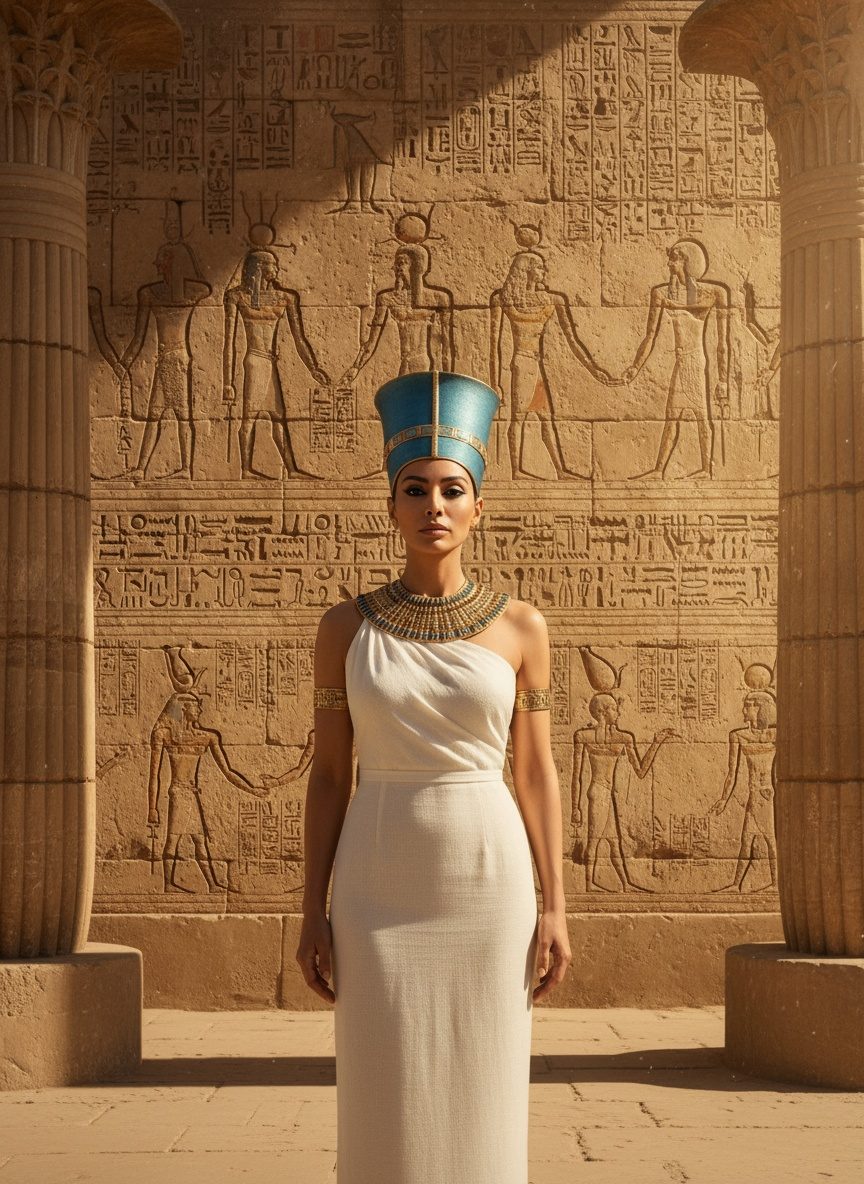
1350 BC. The limestone columns of Karnak glinted under the bright Egyptian sun.
Amidst the colossal pillars and grand temples, Nefertiti emerged not merely as a queen but as a figure of unmatched prominence, challenging the very norms of Egyptian royal representation. In temple carvings, she stood not behind her husband, Pharaoh Akhenaten, but beside him—equal, almost revolutionary in stature. The enigmatic queen, with her elegant elongated neck and a vibrant diadem-crowned head, wielded a power not entrusted to any queen before her.
Born to a time when Egypt was solidifying its position as a hub of prosperity, Nefertiti's rise signaled a departure from the traditional roles assigned to women in the hierarchical ancient society. Allowed rarely more than to be the backdrop to the tales of pharaohs, queens were often shown in subservient poses, supporting roles to the grandeur of the kings. But not Nefertiti. Her depictions were striking—leading religious rituals, engaging in acts of war, and even showing herself smiting Egypt's enemies, a role reserved for the ruler of the land.
The epicenter of this cultural shift was Amarna, the new city built under Akhenaten's reign. Carved into the walls of its temples, the iconography narrated stories of unprecedented equality. Here, Nefertiti did not merely support her husband; she was alongside him in majestic panels depicting the royal couple basking under the rays of Aten, the sun disk introduced as the central deity of this new monotheistic religion. Together, they worshipped Aten enthusiastically, a joint endeavor in what historians consider one of the first instances of religious reform.
What is perhaps less commonly known is how actively Nefertiti was involved in the governance of this changed religious landscape. Such representations serve not only as a testament to her status but as evidence of her integral role in a time of social and theological upheaval. The queen stood beside Akhenaten during grand ceremonies, her posture as commanding as his, wielding ceremonial maces at altars, presiding over offerings, and forming a direct link to their god, Aten.
Despite Nefertiti's prominence, her origins remain a subject of historical debate. Her name, meaning "the beautiful one has come," evokes both mystique and admiration. It suggests that even though she was not born into the Egyptian bloodline as a pharaoh, what mattered was her perceived divinity and alignment with the royal family, enabling her to break through the rigid social structure set for women. She embraced her roles in diplomacy and cultural affairs, potentially serving as her husband’s close advisor—an obscure yet pivotal influence on the pharaoh’s revolutionary policies.
The revolution found its architectural and cultural zenith in Amarna. Here, amid expansive palaces and temple complexes, the royal family was celebrated not just through traditional art but through innovative, almost shockingly realistic portrayals. The queen’s depiction with her husband administering justice and orchestrating the state’s affairs broke the artistic precedents of a millennium. Among students of Egyptology, these artistic novelties inspire debates about her actual polity—a tantalizing suggestion that possibly at some point, Nefertiti governed Egypt either as co-regent or even as a ruling pharaoh.
This undoubtedly stratified order dictated every aspect of Egyptian life. Nefertiti’s prominently shared reign with Akhenaten might hint at a changing narrative, where women could rise beyond mere consort roles and maneuver within the intricate lattice of power. However, the famous upheavals her reign and her husband’s religious reforms instigated were not meant to last. After Akhenaten's reign ended, Egypt quickly returned to its traditional polytheistic roots under subsequent rulers. The glory of Amarna faded, and with it, the groundbreaking roles Nefertiti once embodied seemed to retreat into the whispers of time.
Despite this historical reversion, Nefertiti's story endures, shrouded in questions about her mysterious disappearance from the records. As the shadows of ancient Egypt envelope her final days, modern scholars grapple over her enigmatic end—whether she fell from grace, ruled independently under another name, or vanished due to internal court strife after Akhenaten's radical yet short-lived societal reformation.
For contemporary audiences digesting these stories from millennia past, Nefertiti remains a figure of intrigue and introspection. Her story, inscribed in stone amid monumental temples, provides a glimpse into an era where gender roles momentarily blurred, allowing the emergence of a queen who, with grace, strength, and intellect, captured the imagination of the world then and now. Modern civilizations, in tracing the lineage of gender equality, may look upon her image, poised beside her king, to understand a striking crossroad in ancient history where a woman rose to power, not through force, but with shared sovereign triumph.