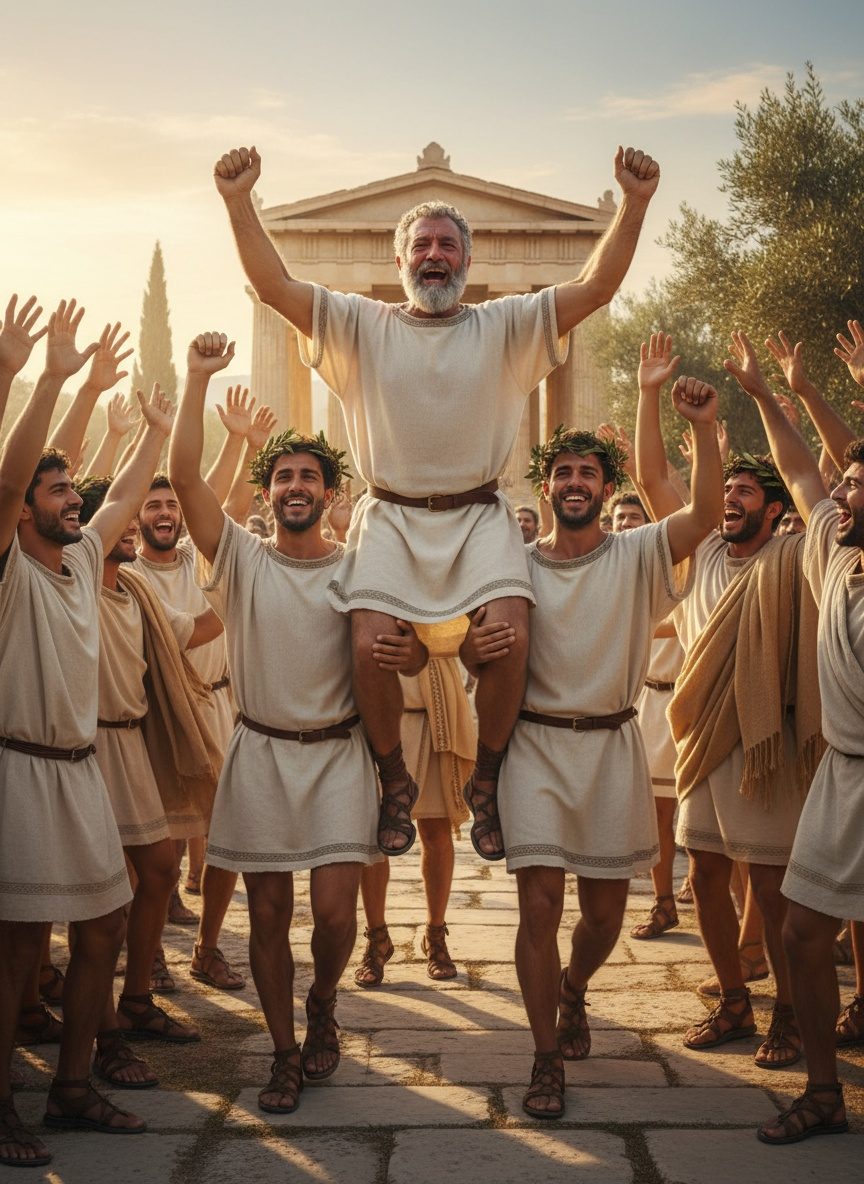
He was a boxer from Rhodes, already crowned victor at Olympia. Yet on that fateful day in 464 BC, Diagoras did not step into the ring himself. Instead, he watched from the sidelines, witnessing a spectacle that would etch his legacy into the annals of history.
The Glory of Diagoras
Diagoras of Rhodes was no stranger to victory — a colossal figure in Ancient Greece, known far and wide for his prowess in the boxing ring. His athletic achievements had already made him a legend in his homeland, where sports were not only a form of entertainment but a vital part of Greek cultural identity. Yet Diagoras found himself at the pinnacle of his pride not through his own triumphs, but through those of his offspring.
As the scorching sun beat down over Olympia in 464 BC, the sanctified grounds were abuzz with the energy of fierce competition and unwavering spectatorship. Diagoras, having already felt the laurels of an Olympic crown himself, stood amongst a crowd as a father rather than a competitor. His gaze rested on his two sons, Damagetos and Akousilaos, who contested for their familial honor, their father's legacy coursing through their veins.
The applause and cheers rose to a fever pitch as both sons claimed victory in their respective contests. The younger generation of Diagoras — Damagetos, in wrestling, and Akousilaos, as a pankratiast — achieved what many had only dreamed of. It was a moment that caught the Ancient Greek world by surprise. How often did one family monopolize the sweat-soaked glory of such sacred games? How frequently did a father watch his sons take after him not just in spirit, but in triumph?
A Celebration of Unparalleled Proportions
In this hallowed space where myth met muscle, the crowd's response was as monumentally Greek as it was loyal to the cult of sporting excellence. A spontaneous celebration erupted as the onlookers surged forward like a chorus rising in unison. The vision of human effort reaching perfect synchronization with the gods seemed to have descended upon Olympia. The masses gathered Diagoras and his victorious sons and hoisted them into the air, as if to elevate them into the realm of heroes. It was a spontaneous act of reverence, rare and vibrant.
Diagoras, positioned amongst the throng now carrying not just the ambitions of his lineage but his corporeal self too, beheld a panorama—one of frenzied admiration and reverence. Rarely was it witnessed in an age when greatness was primarily a solitary experience. The stony figures of past victors immortalized in sculpted form stood silent witnesses to this ephemeral glory. It was an image that would endure, spoken of in hushed tones and boisterous exclamations through the ages yet to unfold.
As if the intrepid souls strove to achieve divine incorporation, the celebration was punctuated by words immediately historic. From within the crowd, a Spartan elder's exclamation sliced through the clamorous air: "Die now, Diagoras. You have nothing left to wish for." This blessing, thinly veiled as morbid counsel, resonated with all those who witnessed it. Diagoras personified the culmination of a father's earthly desires: to witness his sons triumph even where greatness seemed unattainable.
A Tale to Transcend Generations
In this singular moment, Diagoras's life seemed to achieve completeness, an apex to rival any celestial narrative sung by the poets. It wasn't merely his personal conquests that shone but the very essence of familial reverence that seemed to transcend the boundary between mortal flesh and divine acknowledgment. What more could one desire when the pursuits of a lifetime find realization not only in oneself but in the blood that courses in one's progeny?
The story of Diagoras and his sons serves as a tapestry woven with threads of ancient ideals and timeless emotions. It captivates the imagination and communicates the paradigms of pride, fulfilment, and legacy as understood by a civilization millennia removed from our own present reality. Diagoras's journey, culminating in this astonishing day at Olympia, embraced the aspirations of every parent who wished for their children to soar higher and exert greater influence than they themselves had managed.
As we reflect upon his story, we can't help but weigh the significance of achievements that are not solely ours but are part of a larger generational arc. In the amphitheater of history, filled with its countless tales of triumph and toil, the life of Diagoras shines brightly like a constellation in the vast night sky. It challenges us to ponder the nature of victory and legacy, and how perhaps, in the greatest measures of success, the past is integrally bound to the future — a future breathed into life by those who dare to reach the dizzying heights attained by those who came before.