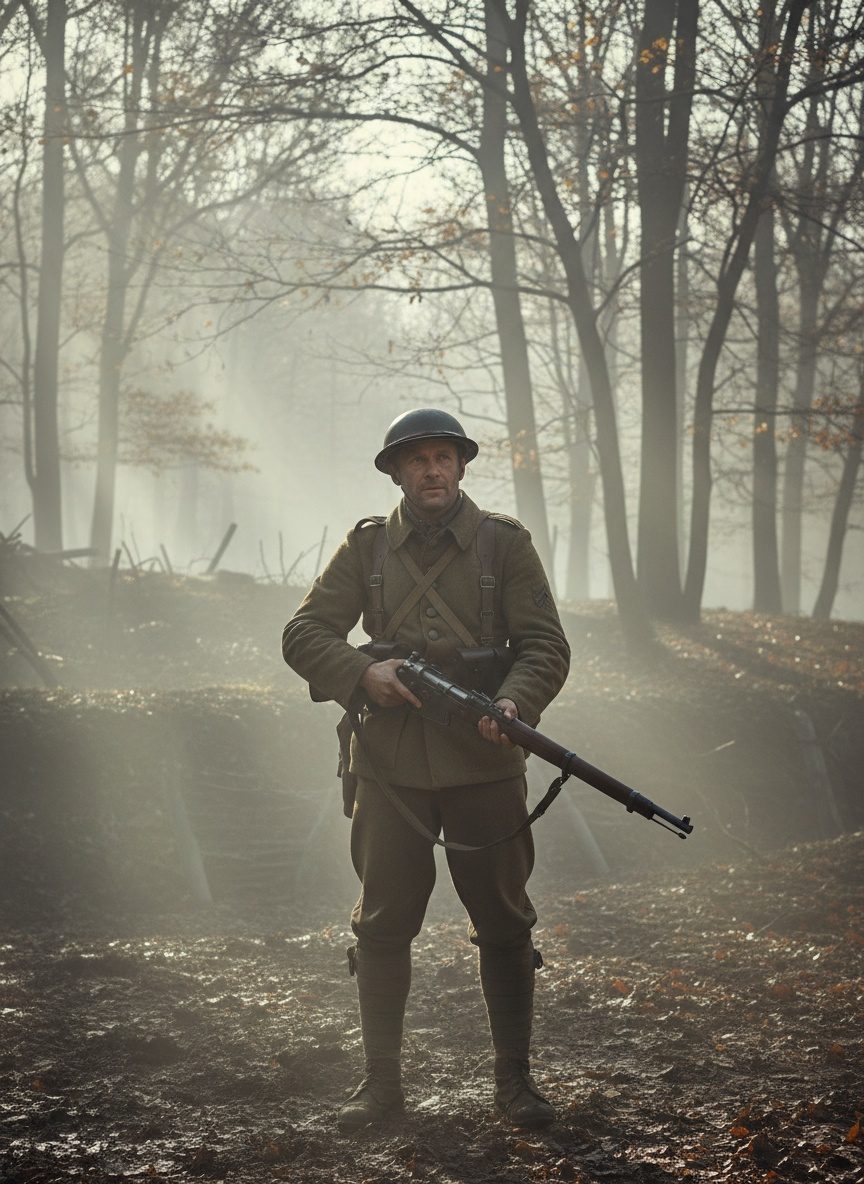
The Argonne Forest in October 1918 was enveloped in an unyielding morning mist, thicker than a farmer's resolve. The dense foliage was a curtain of looming trunks, twisted branches, and fallen leaves that muffled the distant rumble of war. Only the occasional chitter of birds dared to break the foreboding silence. Yet beneath this canopy, concealed in the bracken and shadows, lay a ferocious testament to the horrors of World War I—the unwavering gaze of thirty machine guns, poised and ready to unleash their deadly hail.
Amidst the cacophony of lead clattering against metal, one man stood—though he would have rather been in the embrace of the rolling Tennessee hills that were his home. Alvin York, a man who had carved a life out of the soil, now found himself entrenched in the murky chaos of global conflict. His journey from farmer to reluctant warrior is one of remarkable transformation, not sprung from ambition or valor, but from necessity and survival.
York was a devout man, his roots deeply entwined with the beliefs of his rural upbringing. When the call to arms swept through America, he pinned his hopes on a draft card bearing the simple plea, "Don't want to fight." For York, warfare contradicted the core of his being, a clash against the Christian principles that guided his life. Yet, the gears of war cared little for individual convictions, and the draft pulled him into a world he had desperately wished to avoid.
In the heart of France, amid the fumes of explosive rounds and the cries of men, the Argonne Offensive churned forward, marking the final Allied push of World War I. On that fateful morning in October 1918, York found himself cornered—every officer above him was lost, a grim testament to the brutality of the battlefield. This predicament was where he, along with his remaining comrades, would confront the wrath of thirty machine guns set a mere twenty-five yards away, each gunman determined to decimate any who advanced.
In this crucible of blood and fire, York's instincts as a hunter came to life. The very skills that had fed his family and honed his patience in the forests of Tennessee took form, not in pursuit of deer, but survival amidst the mechanized maw of warfare. With unwavering focus, he pinpointed each pivotal threat amidst chaos, his rifle becoming an extension of his will. The frailty of man against metal melted, as York made rapid calculations, his shots uncannily precise and eerily effective.
Even as his comrades fell or faltered, York's inner turmoil distilled into sheer determination. Compassion for life became a force of necessity, transforming him from a man into a reluctant hero. Inch by violent inch, he pushed forward into the jaws of destiny, eventually capturing an astonishing number of enemy soldiers—enough to form a staggering procession of prisoners, marching solemnly back to the American lines under York's watchful eye.
Such a feat did not go unnoticed. News of York's improbable triumph reverberated back home, where the story spread like wildfire. In a world hungry for heroes, York became emblematic, a symbol of American tenacity and the capacity to rise in direst circumstances. For his valor, he was awarded not just numerous American military honors, but also accolades from foreign nations, each acknowledging the transcendence of his actions beyond the scope of any single battlefield.
Yet, for York, the end of war was not the consummation of his story. Where many might have sought to bask in fame or fortune, York returned to his cherished Tennessee, driven by duties not mandated by the state or army, but by the heart. He dedicated himself to a cause both intimate and profound: the education of the youth dwelling in the Appalachian mountains. With the foundational belief that knowledge was the path to a brighter future, York devoted his life to building schools, instilling in generations the lessons of peace, self-reliance, and the qualities that breed true resilience.
Alvin York’s saga encapsulates more than a storied military achievement; it underscores a broader narrative about conviction, the clash of principles and pragmatism, and rising unwittingly to the pedestal of history. His legacy is not framed only by the medals or the legends spun around his wartime exploits. It is the enduring testament that one person, firmly grounded in his beliefs but tempered by circumstance, can influence the world—not through acts of aggression, but through acts of kindness and education that echo down generations.