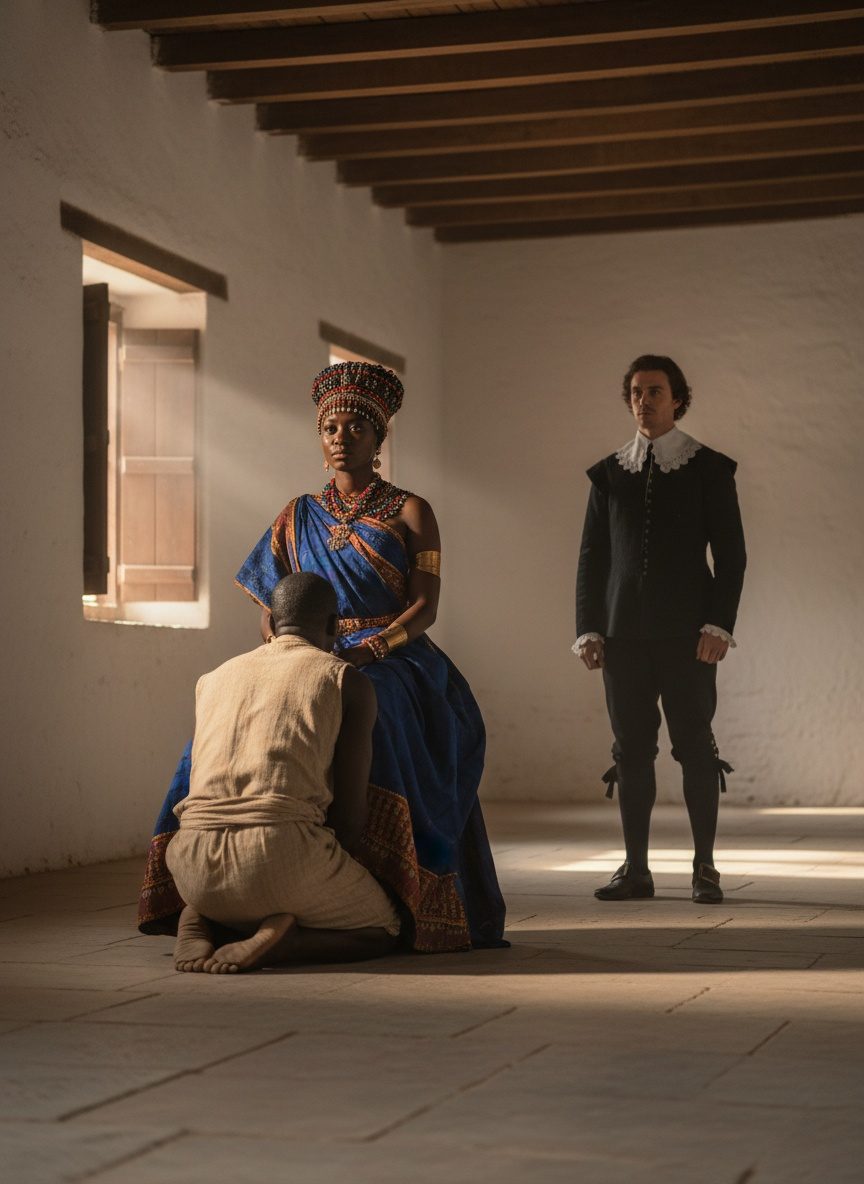
She strode into history not with steel in hand, but with stories of her audacity. Her name was Nzinga, and she was more than a queen; she was a strategist unbowed by the expectations of her era.
The Arrival in Luanda
The year was 1622, and the stakes were high. The Kingdom of Ndongo had long been a thorn in the side of the Portuguese, their ambitions frustrated by a land its people refused to surrender. Into this tense atmosphere stepped Nzinga, the sister of the Ndongo king, sent not just to negotiate peace, but to demand respect. Her every movement was scrutinized, every word weighed — yet it was her defiance in the subtle and overt games of diplomacy that would become legendary.
When Nzinga entered the governor's quarters in Luanda, she was met not with the courtesy due to an envoy but with calculated contempt. No chair awaited her, only the hard ground as if to imply her place was beneath her European counterpart. But Nzinga was not one to be demeaned. With a deliberate air of authority, she gestured to an attendant who knelt, becoming the human throne she required. Seated, she locked eyes with the governor, her gaze unyielding, and began negotiations not as a beggar, but as an equal.
A Sister’s Resolve
Nzinga had learned the craft of diplomacy from her position at the court of her brother, the King of Ndongo. Her education encompassed warfare, politics, and the ways of foreign powers who sought to carve up Africa for their own ends. But her rise was no mere accident of birth; it was the result of shrewd observation and untold resilience. As tensions mounted with the Portuguese, she saw the need for a leader who could weave alliances and turn enemies into reluctant allies.
Nzinga's resolve was not forged in palaces but in battles and betrayals. Her brother's rule was marked by relentless conflict with encroaching Portuguese forces. Each encounter left an imprint on Nzinga, sharpening her perception and tempering her spirit. She emerged not only as a stalwart defender of her people's sovereignty but as a figure who transcended her role as mere diplomat. In that moment of defiance in Luanda, she was both queen and chess master, plotting long-term strategies with each move.
The Art of Negotiation
It was more than Nzinga's resilience at the governor’s meeting that would define her. She had a gift for negotiation that awed even the most seasoned statesmen. She came prepared with detailed knowledge of Portuguese ambitions, keenly aware that brute force alone would not secure the future of Ndongo. Her demands at the negotiating table were not just for treaties, but for terms favoring her people’s autonomy and their right to forge their own destiny.
Nzinga’s skill lay in her ability to anticipate the Portuguese’s moves. She understood the delicate balance of power in Central Africa and used her knowledge to negotiate effectively. Her diplomacy was marked by an intuitive grasp of human psychology, turning adversaries into unexpected allies. The result was not just a peace treaty; it was a testament to her insight and indomitable will. She turned conditions initially meant to subjugate into terms of partnership.
Queen and Tactician
Nzinga’s reign was not simply defined by her sharp mind and fearless spirit; it was distinguished by her innovative tactics. She consistently outmaneuvered her adversaries, employing unconventional strategies in both diplomacy and warfare. Known for brokering alliances which saw mixed forces of Africans and Europeans fighting side by side, she understood the importance of adapting to the art of war as diplomacy altered the landscape.
Her leadership was unparalleled, often riding into battle with her troops, leading by example with the same vigor and ferocity she displayed during negotiations. Nzinga's military campaigns revealed her as more than a mere political leader — she was a warrior queen who refused to bend to colonial might. Her legacy was not just in terms of successful engagements but in how she changed perceptions of power, gender, and leadership in a time when such roles were rigidly defined.
An Unyielding Legacy
Nzinga’s story resonates far beyond her lifetime, speaking to the timeless struggle against oppression and the assertion of sovereignty in places far and wide. The defiant manner in which she claimed her place was a declaration: the African kingdoms, though beset by external forces, were vibrant centers of culture and power in their own right. Her legacy is a witness to the creative, sometimes audacious methods leaders employed to forge futures for their people in the face of overwhelming odds.
In a world where history often remembers only those who wielded the largest armies or wore the grandest crowns, Nzinga stands as a reminder that leadership can take many forms. Her life teaches us that dignity and courage are not bound by circumstance, and that sometimes a throne is what you make of it — even if it is, at times, a man kneeling in solidarity.