Nasir-i Khusraw was a man like any other in the vast medieval Islamic world. Except he penned an extraordinary masterpiece while imprisoned for his beliefs.
The Journey to Cairo
By 1052 AD, Nasir-i Khusraw had become an unwilling traveler in a wayward world. Originally a high-ranking official in Central Asia under the Seljuk rulers, his life took a dramatic turn when he experienced a profound spiritual awakening. This newfound fervor prompted him to abandon his position of influence, leaving behind the familiar saunter of bureaucratic life. He embarked instead on an extensive pilgrimage, venturing across the Islamic world with a pen as his steadfast companion.
The Islamic Golden Age was in full bloom, and Khusraw's journey took him through the bustling silk roads and the scholarly centers of learning. He finally arrived in Cairo, then the heart of the Fatimid Caliphate. But this vibrant kingdom, with its towering minarets and intricate mosaics glittering under the Egyptian sun, held dangers unseen to the casual traveler. The Fatimids were staunch proponents of Isma'ili Shi'ism, a branch of Islam that clashed ideologically with the predominant Sunni theology of Khusraw's homeland.
His moment of arrival coincided with an unwelcome notoriety. Khusraw, already somewhat known for his eloquent writings and sharp intellect, found himself a target. Accusations of heresy quickly mounted against him, a dangerous claim in an era where one's faith was both a political and personal identity. The very words that he crafted so elegantly now threatened his freedom, placing him at odds with the ruling powers eager to silence dissenting voices.
Captive Thoughts and Creative Rebellion
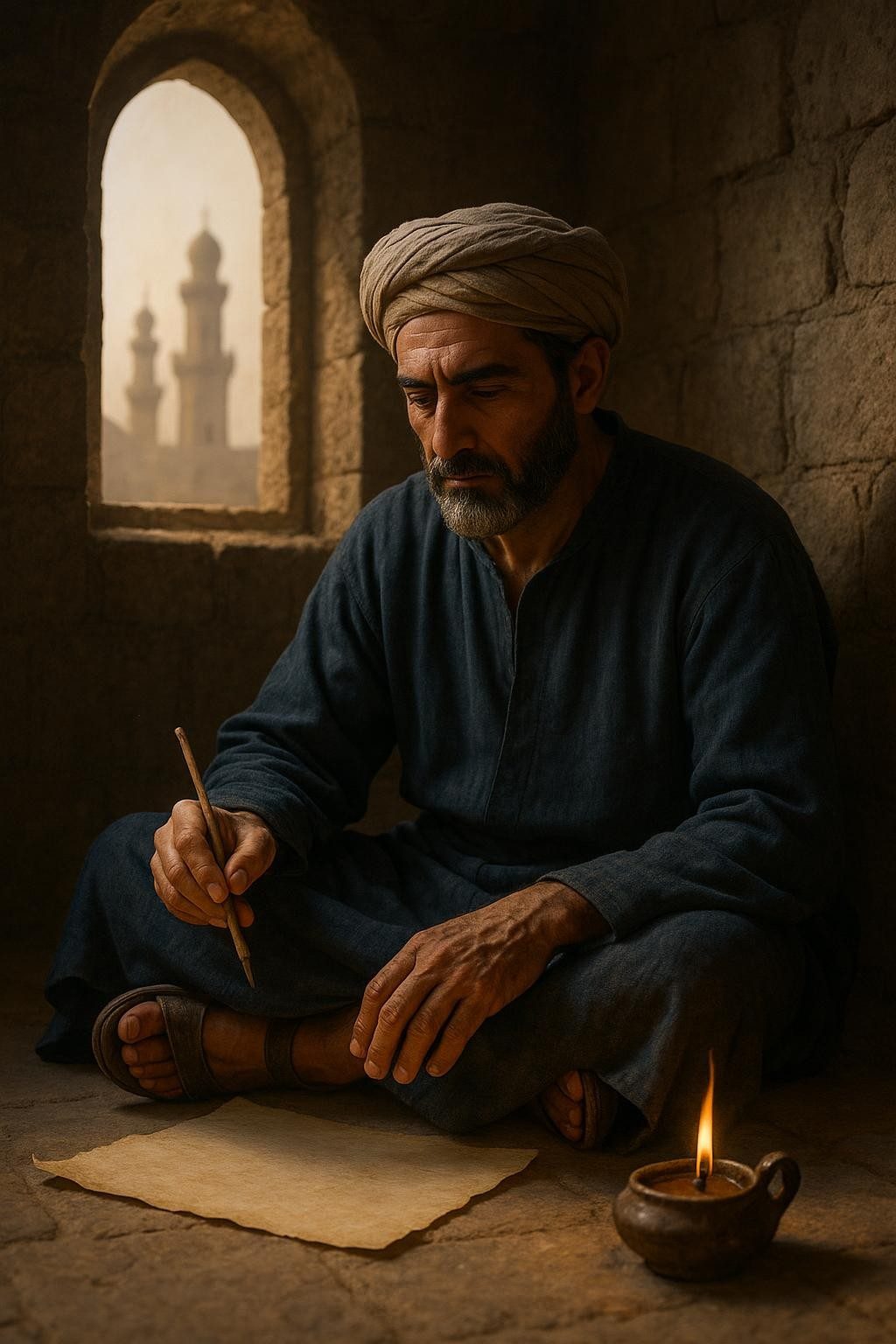
The stone walls of his cell, a stark contrast to the open roads he had traveled, soon became all too familiar. But where some might have viewed such confines as despairing, Khusraw saw them as a catalyst. Denied from formal education and discourse, he turned inward. Isolation sharpened his introspection—it became a crucible for his ideas.
What emerged from this confinement was the *Diwan*, a collection of Persian poetry that proved to defy both time and tyranny. This work was imbued with metaphysical musings, spiritual depth, and the kind of wisdom that could blossom only in adversity. Using allegory and metaphor, Khusraw's verses explored the divine and the human, the ephemeral and the eternal—propounding ideas too subversive for his captors' liking.
Rather than recanting his beliefs under duress, Khusraw's resistance took the form of sublime expression. His words were defiance inked into parchment, constructed to outlast the mortal coil that held him captive. Like a scribe carving truths into stone, he fashioned his legacy, cloistered in shadow but touched by divine inspiration. What made his work singularly beautiful was the reason it thrived. The themes of self-discovery, quest for truth, and perseverance resonated with those facing similar existential battles.
The Enduring Legacy
Eventually, Khusraw's captivity lifted as mysteriously as it began. He was freed, but not unscathed. His works, however, traversed time and space, becoming eternal emissaries of his experience. Khusraw's poetry soon found its way beyond the walls of Cairo, spreading across the vast Persian-speaking territories like the ripples of a stone cast into a silent pond.
In the annals of medieval Islamic literature, the *Diwan* endured as a testament to the power of the written word. Centuries after his death, readers linger on his verses, marveling at their passionate reflection upon life and the cosmic order. They conveyed that the conflict between spiritual seeking and worldly challenges is timeless, and Khusraw's own life became an allegory for this struggle.
Today, Khusraw's journey resonates not because it ended in a gilded court of accolades, but because it echoed the power of resistance through creation. He teaches us that profound change often finds its most eloquent spokesman in the solitary confines of individual thought. In a world where voices are often overlooked or stifled, Khusraw's story serves as a powerful reminder of the enduring impact of the written word. It reaches beyond lifetimes, beyond despair, to inspire the search for wisdom in seeming darkness. This tale of a man whose chains forged the keys to his own destiny is a captivating testament to the transformative power of the human spirit.