The clay tablet was just one of thousands. But it spoke with the certainty of the stars.
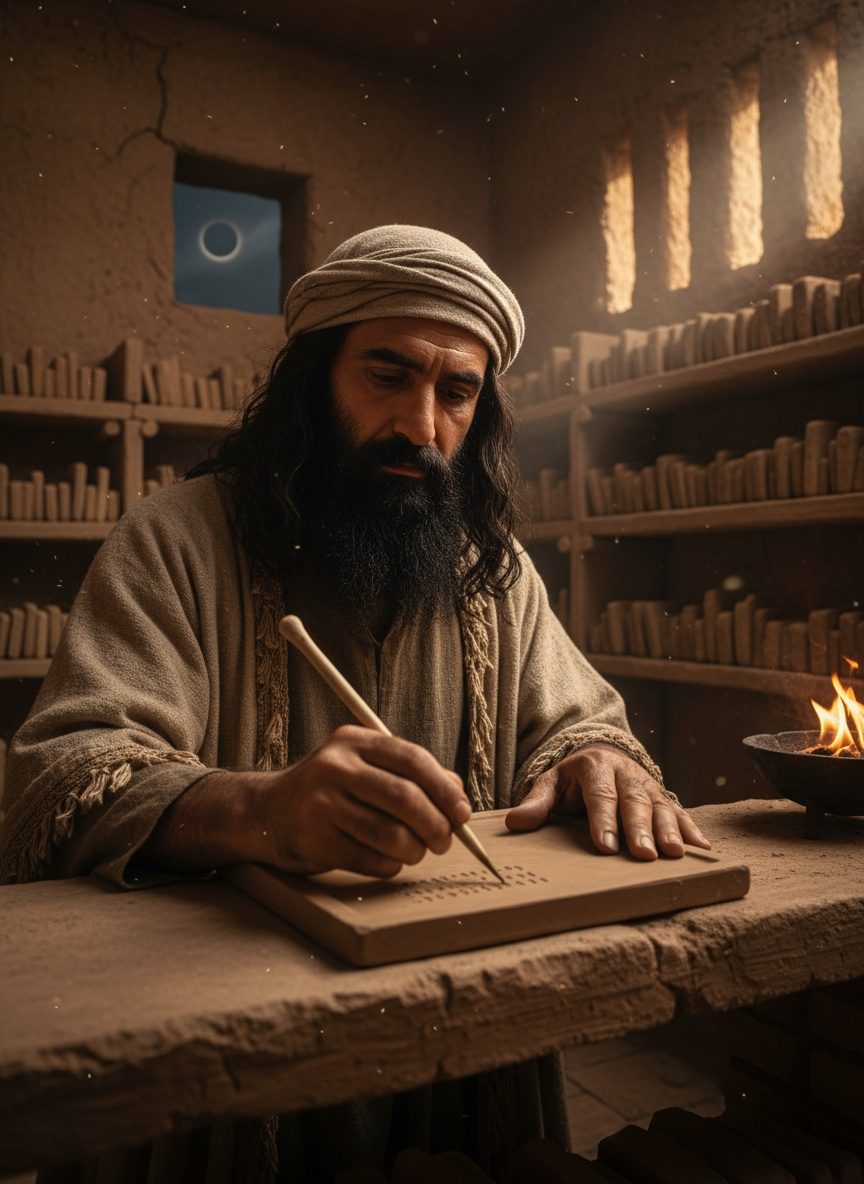
In 1879, the treasure house of the past welcomed a new jewel into its vaults. From the dust and echoing whispers of ancient Nineveh came a clay tablet, innocuous and unassuming, marked with the careful script of long-gone Assyrian astronomers. What it carried was a fragment of the firmament itself—a record of a total solar eclipse, meticulously noted by those ancient sky-watchers who saw times long past unravel in the blink of an eye. The date they recorded was 763 BCE, a stark, precise annotation in the rhythmic narrative of the cosmos.
To anyone else, it might have seemed like just another artifact from the monumental collection of the British Museum. But to the astute eyes of dedicated scholars, it was a keystone, unexpected and profound in its silent elucidation of a historical conundrum often shrouded in conjecture and debate. The date etched onto the clay matched an account in the Second Book of Kings, breathing new life into the often-blurred timeline of biblical events.
Could it be that such a small object could dissolve so much scholarly discord, providing a fixed reference point in the vast sea of ancient history? To peer back so far with such clarity was rare, almost miraculous. Like stars guiding a bewildered traveler, the eclipse noted on this tablet granted historians and theologians alike a beacon, illuminating the murky waters that swept through time and tradition, giving them a date to anchor the complex tapestry of biblical narratives.
Delving back through the centuries, when the lands that bordered the Tigris and Euphrates rivers were home to the powerful Assyrian Empire, we find a world infinitely different yet eerily similar to our own. This empire, renowned for its formidable military and architectural prowess, was equally celebrated for its scholarship and science. At the heart of this intellectual pursuit were the astronomers who worshipped the sky, chronicling the passages of celestial bodies with meticulous care, their baked clay tablets a durable testament to their patient and disciplined study.
Being able to predict an eclipse was a feat of incredible ingenuity, demanding an in-depth understanding of both mathematics and astronomy, long before the conveniences of modern technological aids. The eclipse of 763 BCE was a total solar eclipse, and its significance for those ancient people was profound. It was seen as a moment of transformation and reordering, a hint of divine structure within a universe that was vast and unfathomable.
The record of this celestial event was far more than just an acknowledgment of a brief disturbance in the light of day. It harmonized with an account from the Bible, from the book of 2 Kings 15:29, which speaks of upheaval and change during the reign of Azariah, King of Judah. For centuries, scholars had battled to precisely place such biblical events within the framework of known history, hindered by the challenges of reconciling different calendar systems and irretrievably lost records. Enter the clay tablet, quietly shattering the stalemate with its precise annotation of the lunar event.
The British Museum houses one of the most extensive collections of historical artifacts in the world, an archive of humankind's relentless forward march. Within it, the tablet is a bridge between the seen and the unseen, the known and the unknowable. Its existence implores us to trust in the constancy of the universe, to see the ancient tongues etched upon its surface not as relics, but proclamations of known truths rediscovered.
Why does such an artifact matter? To the casual observer, a dusty old piece of clay might seem mundane, insignificant—just another remnant of the past. Yet the value lies beyond mere physicality; it rests in the narrative it unlocks. The synchrony between the tablet and the biblical account provides a rare point of convergence where historiography and ancient texts meet with precision, allowing us a glimpse into an ancient mind that understood more about the world than we sometimes credit.
A discovery like this poses questions as profound as the answers it provides. It challenges us to reconsider the interconnectedness of ancient civilizations, separated by land and language, yet united under the cosmic canopy. What other alignments between sky and script, science and spirituality, lie hidden, waiting for discovery? The cosmos etched across millennia speaks to us with a promise that more mysteries remain. Perhaps, somewhere amongst unexamined layers of history's palimpsest, similar tablets may wait, speaking of truths as keystone and illuminating as this, ready to align our understanding of the past with the precise architecture of the universe.