He was hailed as a savior, yet lay bedridden, awaiting the vote that could end his life. Miltiades, the celebrated general of Marathon, found himself embroiled in a legal drama he did not expect after his triumph.
The Battle of Marathon: A Godsend for Athens
The year was 490 BC. The Persian Empire, vast and seemingly unstoppable, set its sights on Greece, intent on expanding its dominion across the Aegean. The forces of King Darius were a relentless juggernaut, bent on bringing rebellious Greek city-states like Athens to heel. In this climactic moment, it was Miltiades who stood at the forefront of history, crafting a strategy that would change the fate of Athens forever.
Miltiades was no stranger to the Persians. Once a subject of the Persian king in the Thracian Chersonese, he had witnessed the power and might of the empire. Yet, it was his intimate knowledge of their weaknesses that became Athens' greatest asset. When the Persian fleet landed at Marathon, a coastal plain east of Athens, a tenet of Greek military strategy hung in the balance—the freedom of their city, which was vulnerable to assault.
Miltiades devised a bold plan. Realizing the risks of traditional confrontation with the numerically superior Persian infantry, he capitalized on Greek strengths. He thinned the center of his formation and reinforced the wings, allowing encirclement of Persian forces. The ensuing clash was a triumph of tactical genius against overwhelming odds. On that fateful day, Athens was spared destruction, and Miltiades became a celebrated hero.
The Shadow of Success: Political Rivals and Unforeseen Scandals
Returning from the battlefield as a hero did not afford Miltiades the safety he anticipated. Political rivalries in ancient Athens simmered beneath the surface, ready to boil over at opportune moments. The democratic landscape of the city was rife with factions and shifting alliances, where today’s hero could swiftly become tomorrow’s scapegoat.
Miltiades, for all his wartime prowess, was not immune to the machinations of politics. His subsequent military expedition to Paros, meant to secure and expand Athenian influence in the Aegean, faltered disastrously due to miscalculations and unforeseen resistance. The failure provided ammunition for his detractors—his ambitious plans had cost Athens dearly, both in resources and in morale.
Seizing this opportunity, his political adversaries lodged formal accusations against him, accusing him of betraying the city’s trust and misusing its resources. The city’s gratitude had quickly turned into suspicion. The charge of treason was a serious one, and democracy’s dark side began to emerge as allies were swift to turn against him.
The Trial: Democracy's Ruthless Judgment
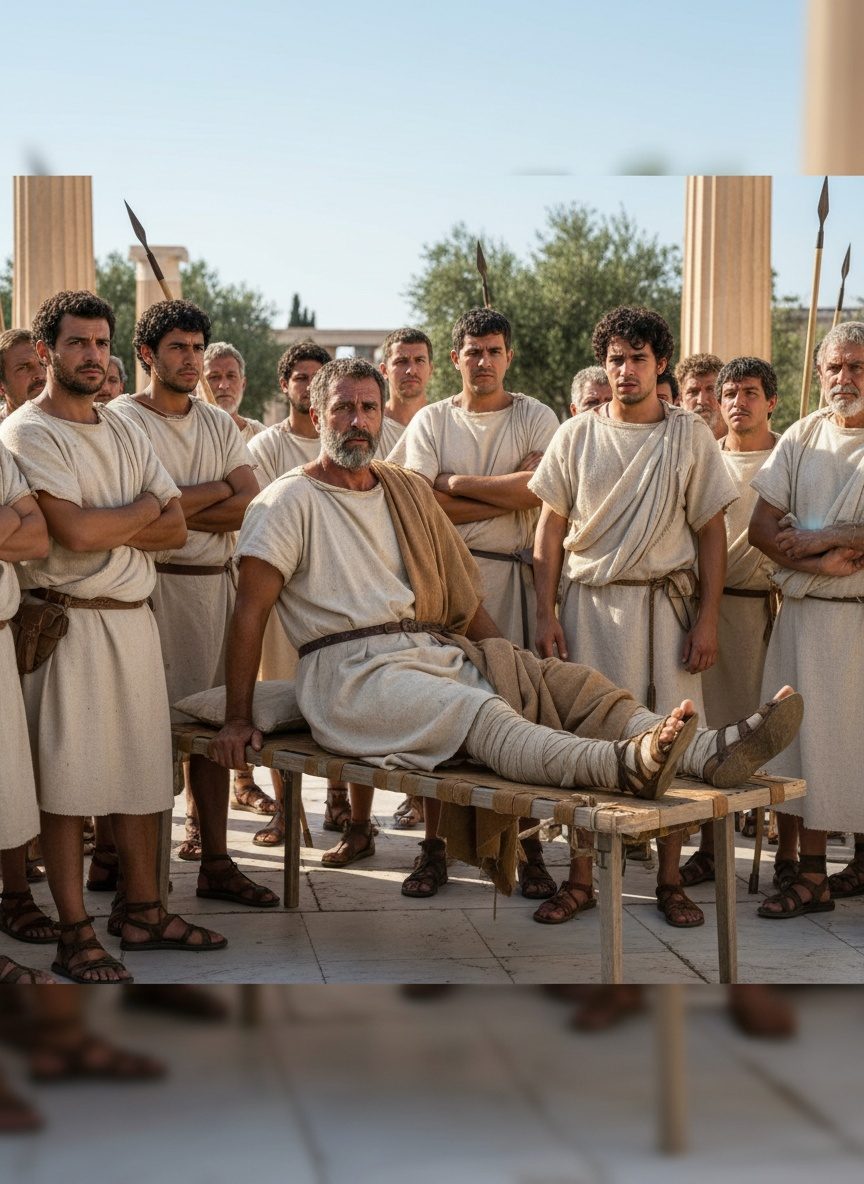
As tensions peaked, Miltiades found himself grievously wounded, lying on a stretcher, unable to attend his trial on his own strength. The wound he suffered had taken a toll both physically and symbolically—it was as if the gods themselves planned to humble the man who dared to defy an empire. However, this frailty did not provide adequate respite from the ruthless nature of Athenian justice.
In the packed assembly halls of Athens, citizens gathered for what would become a turning point in the city’s political fabric. The court was no mere formality; it was a battlefield of rhetoric and resolve. With fervent speeches, his accusers implored the populace to consider his failure at Paros as proof of his incompetence or even deliberate malfeasance.
Miltiades' defense was earnest but feeble, reflective of his physical state. Pleading for clemency, he invoked his contributions during Marathon, a victory that still resonated in the consciousness of the Athenian people. The question loomed—could they condemn their own savior so soon after celebrating him? Yet, the vote proceeded, each token cast marking the fate of a hero laid low by fortune’s cruel whims.
A Wounded Hero: A Legacy of Complexity
The democratic process, unforgiving as it was, did not spare Miltiades. While he was not sentenced to death, the decision to fine him an immense amount was a blow both in terms of prestige and resources. Debilitated by his wounds, he succumbed to his injuries shortly thereafter, leaving behind a story woven with triumph, tragedy, and the caprics of popular opinion.
The tale of Miltiades is a narrative of contrasts—a reminder of the fine line between glory and disgrace. It forces one to consider the nature of democracy itself when weighed against individual deeds. What does it mean when a system founded on justice swiftly turns upon one of its own architects? This tale isn't just a testament to the historical details of Ancient Greece but a reflection on the human condition, echoing across ages, illustrating how quickly fortunes can turn in any time and society.