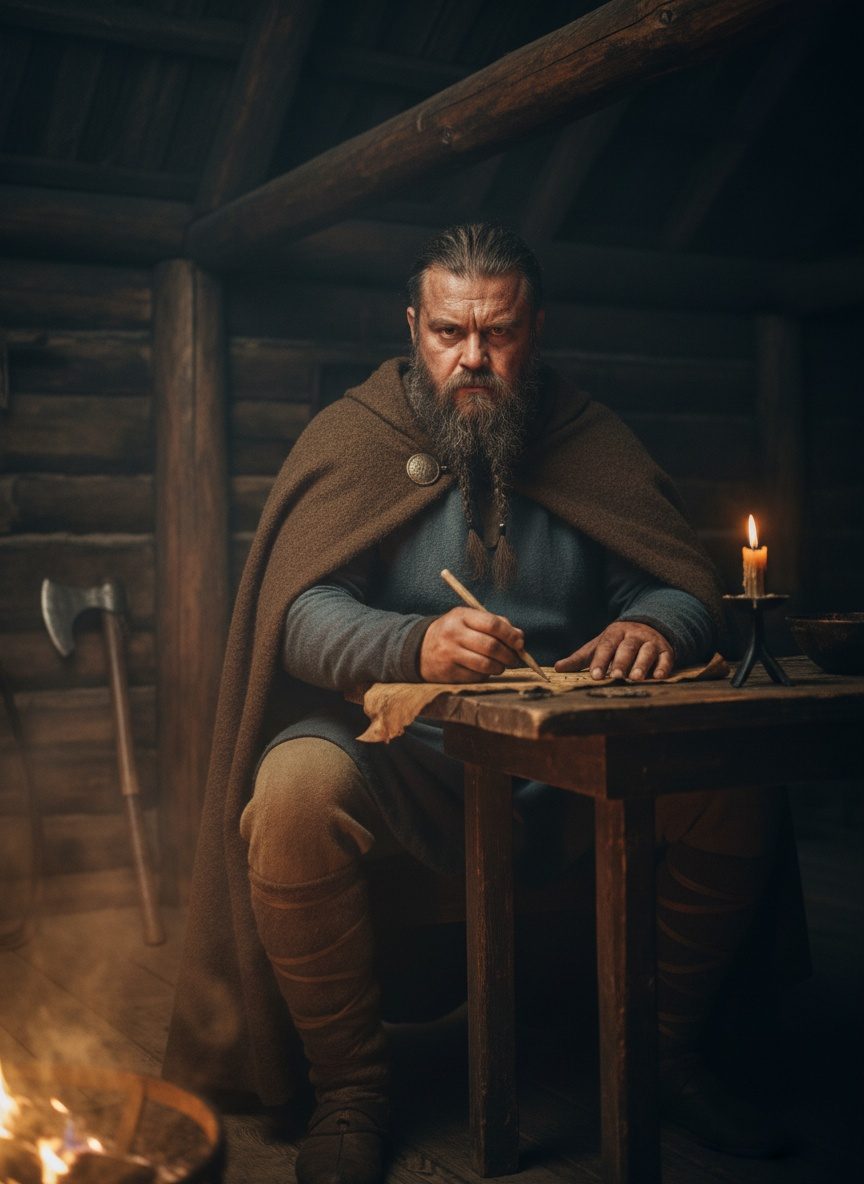
A cold wind whipped through the stone corridors of York's grim keep as Egil Skallagrímsson's footsteps echoed against the dungeon walls. The clinking of chains marked his every movement, each step a grim march toward the dawn when his fate was to be sealed by the sharp edge of an axe. He was led into a dim chamber, the flickering torchlight casting a jagged dance upon the rough-hewn walls. It was here, in the cold embrace of captivity, that Egil—a man as renowned for his poetry as his prowess on the battlefield—sought the solace and strength of the written word.
The story of Egil Skallagrímsson is woven tightly into the tapestry of Viking legend—an unruly saga of blood vengeance, art, and survival. Born into a world where brawn often took precedence over brain, Egil had carved a fearsome reputation across the Viking world. He was a paradox: as skilled with a quill as he was with a sword, and both attributes had landed him both fame and infamy. To many, he was a hero. To Eirik Bloodaxe, the notorious king of Norway and briefly England, he was a potent threat to authority—a threat that now sat shackled and waiting for the executioner's swing.
The enmity between Egil and King Eirik Bloodaxe ran deeper than mere royal disfavor. It was personal. Egil had once slain a son of Eirik, a blow that cut deeper than any insult or slight. An old score was about to be settled, executed in the full, unambiguous tradition of blood for blood. Yet, in the quiet moments of this night, Egil’s mind did not dwell solely on his impending doom; instead, it reached for the solace of his native art—poetry.
Now, seated before flickering flames, Egil began to spin the threads of his redemption with words. Known for his skaldic poetry, which was interwoven with intricate meter and kennings, the poet-warrior poured out his soul in verse, creating a drápa—an intricate and highly esteemed form of Viking poetry. Each carefully crafted stanza held the power not only to appease a king's wrath but to weave a narrative where ax and pen became one.
The legend holds that Egil’s verses contained not only swells of poignant regret and the fervent loyalty owed to a king but also a cunning allusion to his prowess and the blind folly in wasting such an ally. The cold, practical logic of a Viking mind could not overlook the potential in a warrior poet, even one as rebellious and untamed as Egil. Poetry, in this era, held a place of reverence; it was a vehicle of memory and power. Kings themselves bore the titles of sagas; the bards who penned these were held in high esteem. Perhaps Eirik found admiration in this testament or fear in its passionate truth—a tale sung across the North, lauding a king's mercy.
As dawn touched the horizon with its first gray fingers of light, Egil put down his pen, his fate lying delicately in the balance. The morning brought him before Eirik Bloodaxe, not for execution but for judgment. It was a volatile moment, the chill air heavy with suspense as the king considered Egil's gift—a gift of poetry saturated with wisdom and cleverness, such as only a skald could produce. In a remarkable twist of fate, Eirik Bloodaxe, swayed by the depth and extraordinariness of Egil’s craft, chose life over death for the skald.
With this act, Egil was not only saved from the edge of the axe but immortalized in the annals of history as a testament to the power of words. The act exemplifies what poets and writers of every era have intuited—the right words, strung together in the right way, can transform hearts and transcend empires. In the world of Vikings, the oral tradition was sacrosanct, and to be part of it was to breathe within history a continuous, living testament.
This story matters not only for its dramatic tension and its startling resolution but also as a vivid illustration of an era where civilization walked hand in hand with chaos. The Viking world, with all its brutal physical triumphs and piercing cultural insights, holds lessons never conveyed in the sterile lists of battles or dry chronicles of dates. It serves as a beacon for the eternal power struggle between might and mind, a reminder that even in the harshest of worlds, intellect and art carry a profound, sometimes life-affirming power.
Today, Egil Skallagrímsson's legacy endures in the narrative of the Viking spirit—a fierce, unyielding force tempered by the lyrical grace of poetry. As the ink dries on his saga, Egil's words echo through time, touching the hearts of those who recognize that the pen, indeed, sometimes holds more might than the sword.