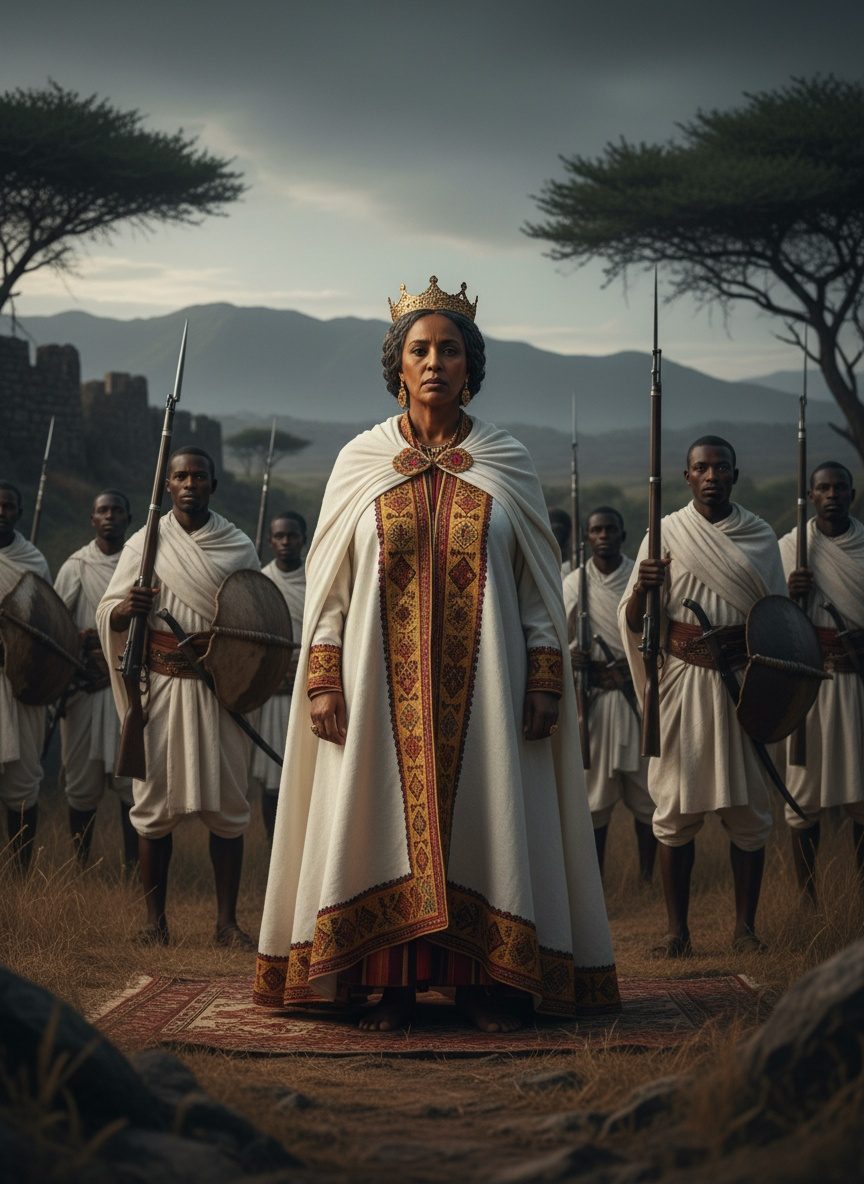
The air was thick with anticipation as Empress Taytu Betul stood firm, her eyes scanning the horizon where the sharp escarpments of Adwa loomed. The sounds of thousands of soldiers, their movements synchronized to the beat of war drums, reverberated through the Ethiopian highlands. These were not just soldiers; they were defenders of a legacy, each one bearing the weight of an ancient nation on their shoulders. In the midst of this pre-battle fervor, Emperor Menelik II paced with deliberate resolve, his mind set on a single truth whispered by his formidable Empress: negotiate no surrender. Ethiopia would stand and face the encroaching storm.
The Rising Thunder: Prelude to Battle
As Italy made its imperial moves across Africa, the scene was set for a confrontation that few could predict would end in anything other than colonial subjugation. The scramble for Africa in the late 19th century had positioned Europe as a dominant threat to the continent, with Italy eager to carve out its portion from the Horn of Africa. This land, with its rich heritage and strategic position, was meant to become another jewel in Italy's emerging colonial crown. Yet, what they envisioned as an easy conquest quickly turned into a formidable challenge.
Menelik II, astute as he was, understood the gravity of the situation. His determination was matched by a deep-seated trust in his people and land, a trust embodied by his wife, Empress Taytu Betul. Known for her intelligence and military astuteness, Taytu was a formidable advisor, bringing not only strategic insight but a symbolic rallying cry that fortified the nation's resolve. Her words, urging Menelik to pursue no negotiations, were a clarion call to arms for an empire known for its historical resilience against foreign invaders.
The armies under Menelik were not just fighters; they were a mosaic of Ethiopia's diverse tapestry, united with a singular will to maintain their nation's sovereignty. Reinforcements streamed into the Ethiopian camp, swelling the ranks to over 100,000, each warrior drawn from a patchwork of tribes and communities, speaking different languages but sharing the same indomitable spirit. Skills ranging from proficient marksmanship to traditional combat techniques were blended into a formidable fighting force, honed on the rough and rugged terrain that was their own.
The Anvil of Adwa: Clash of Empires
The dawn of March 1st heralded the cacophony of war. As the sun crested the hills of Adwa, it illuminated a battlefield where courage and conviction would soon eclipse fear. Italian forces, numbering approximately 17,000, were well-equipped with modern arms, a stark contrast to Ethiopia's traditionally armed warriors. Yet, what Ethiopia lacked in advanced weaponry, it compensated for with tactical ingenuity and an intimate knowledge of their home terrain.
The topography of Adwa, with its jagged mountains and steep valleys, became an Ethiopian ally as much as any armed regiment. Menelik and Taytu, leveraging the landscape's complexity, orchestrated a meticulous and strategic envelopment of the Italian forces. The Italian advance was stalled by a well-coordinated series of assaults—a feat of military acumen that would echo through strategists' halls for years to come.
This was not merely a clash of arms but a confrontation woven into the very essence of Ethiopia’s identity. As battle cries pierced the early morning air, the fields of Adwa were painted in vivid contrasts of red and gold—the colors of war and imperial defiance. Ethiopian forces, fortified by their faith and leadership, surged in waves, their advance a testament to unity and purpose that no European power had anticipated. Underestimating their enemy, the Italians became entangled in a whirlwind of fierce attacks, their ranks breaking under relentless pressure that bore the weight not just of men and metal, but of an entire nation’s enduring resolve.
A Nation Unbowed: Victory and Vindication
When the cannons of Adwa fell silent, the smoke that hung over the battlegrounds cleared to reveal an outcome that stunned the world. The cries of victory that rose from Ethiopian troops were not just the sound of triumph in battle; they were the echoes of a historical narrative rewritten. Italy, like so many before it, had gravely underestimated the will of an ancient kingdom that stood unbroken by the sweep of colonial ambition.
The repercussions of this victory rippled far beyond the African continent. For Europe, this defeat was a sobering reminder that military might was not invulnerable. For colonized peoples across Africa, the Ethiopian victory was a beacon of hope and possibility, a powerful assertion of self-determination and unyielding spirit. The significance of Adwa was far-reaching, a pulse of defiance and pride that resonated among all those oppressed under colonial rule.
In the aftermath, history would remember Adwa not merely as a battle but as a defining moment of pan-African consciousness. Emperor Menelik and Empress Taytu became icons of a struggle that transcended borders and time, embodying a legacy of courage that could not be bound by chains nor diminished by distance. Their story, a vivid tapestry of resilience and resolve, unfolds as a narrative that continues to inspire. For Ethiopia, and for all who seek to learn from its timeless lessons, Adwa remains a powerful reminder: the strength of one's convictions can defy even the most formidable of empires.