The air hung thick and damp over the rugged landscape of York in 948 AD, a city huddled beneath steely clouds that promised rain. The mist curled around the stone walls, whispering of forgotten battles and power lost and seized. Amidst the dawn chill, the city was not silent; the restless stirring of armored men and the low murmur of the river Ouse echoed faintly, like a heartbeat beneath the earth. For Egil Skallagrimsson, Viking skald and warrior, this was a time not of conquest but of desperation. Captured by his bitter nemesis, King Eirik Bloodaxe, death loomed over him as surely as the returning tide. But Egil possessed a weapon of his own, one not forged from metal, but crafted from words — a single poem, and a single night to weave it.
The Viking societies revered their skalds, the bards whose tongues could carve deeds into legend. Egil, son of Skallagrim, was no ordinary skald. He was a beast on the battlefield, a man of immense stature with a temperament as fierce as the winter seas. His face was marred by many battles, a living saga of the violence and valor that defined his age. Yet, it was in the tempestuous symphony of his poetry that his truest strength lay, each verse a testament to the wit and cunning of a people often defined only by their swords.
Captured during Viking raids that embroiled the cities of the British Isles in terror, Egil's presence in York was fraught with danger. King Eirik Bloodaxe, notorious for his ruthlessness and fabled for his blood-soaked rise to power, looked upon Egil with the cold indifference of a man who had already decided his fate. No matter the might of Egil's past victories or the sagas sung in his name, here in Eirik's stronghold, his life hung as precariously as dew upon a blade of grass.
The night stretched out, endless and oppressive, the kind that makes a man reckon with his soul. Egil, given parchment and ink, sat under guard in a dim and draughty cell. Each breath brought the cold, biting air into his lungs, each scrape of quill on paper mapping his struggle between life and oblivion. In Norse tradition, words held power, not merely as tales but as gifts to the gods. And so, Egil began to write his *drápur*, a poem crafted with the precision of a smith forging a key. This poem, intended to sway a king, held within it every thread of his genius, every note of his defiance, and every spark of his desperate hope.
The story of Egil's captivity and his ensuing poetic endeavor captivates not merely for its drama, but for the vivid insights it offers into a world both brutal and sophisticated. What history often overlooks in the sweeping tapestries of conquest are these moments of artistry, when a man's survival hinges not on his sword but on his soul's ability to speak truths veiled in verse. With each stanza, Egil harnessed the raw energy of his lineage, conjuring the ghosts of his forefathers and the gods themselves to stand at his side.
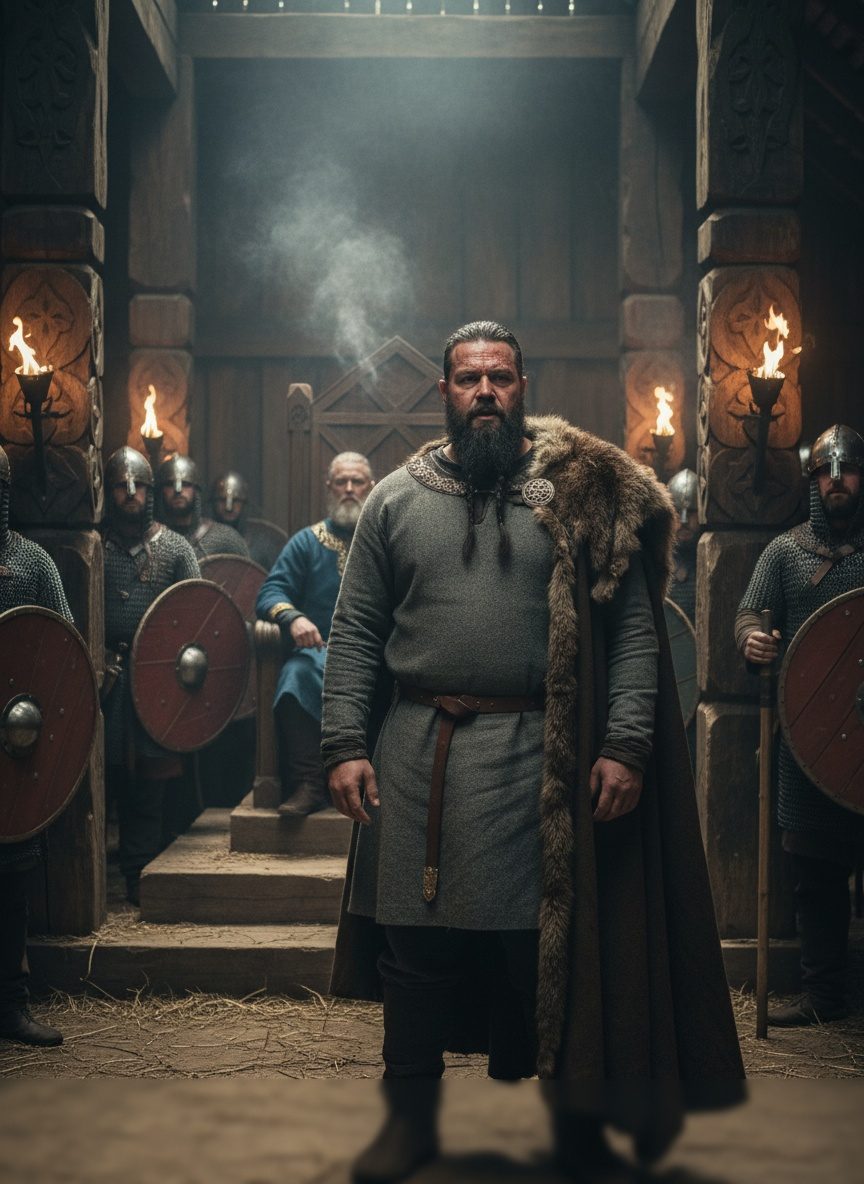
Morning broke upon York, shedding its grey veil for the solemn gold of dawn. As the light crept into the city, it welcomed a new day as well as a new test for Egil. He was led from his confinement to stand before Eirik Bloodaxe, his poem the solitary shield against the executioner's axe. The atmosphere was tense, a veritable gathering of storm clouds embodied in steel and stares. All looked to Egil, the chamber echoing with an expectation as palpable as the sword-blades clinking softly at men’s sides.
Egil recited his verses with the raw, edge-of-extinction energy only known to one who stares death in the face and defies its finality. His voice rose to cut through the air, a regrettable silence descending as Eirik and his court found themselves ensnared by the skald’s crafted weavings of word and melody. The poem, structured with intricate kenning and hypnotic alliteration, spoke of heroism, honor, and the inexorable bond between a leader and his skald. It was a call to memory and legacy, a tapestry of valor as much as a plea for mercy.
King Eirik, too, was a product of their age, where honor and reputation intertwined indelibly with rule. As Egil’s words unfurled, they did more than implore; they evoked shared traditions and an appreciation of artistry as respected as the battlefield's glory. It is said — by myth and maddened whispers — that the fierce king, hardened to the pleas of many men before, found himself moved by the skald’s performance, his resolve unlocking in the labyrinth of verse.
The execution was stayed. In Egil's lines, something ineffable had touched not merely Eirik’s mind but possibly his very heart, a rare reprieve written into a saga that would outlive them both. For Egil Skallagrimsson, the success of his poem was not only salvation but testament to the profound power of the skald’s art. And in this small, remarkable victory within the larger tapestry of Norse legend, emerges a stark truth — even when civilization seems enraptured by carnage and conquest, it is culture and creativity that affirm who we are.
Egil’s deliverance illustrates the transformative power of art and narrative. Just as his sagas would later resonate through history, they remind us today that amidst the impermanence of empires, it is often the poets who transcend the constraints of time with voices imbued with both sorrows and triumphs. Skalds, with their gifts, held sway over hearts and minds, proving that neither crowns nor armies, but rather words, can be the true architects of history's legacy.