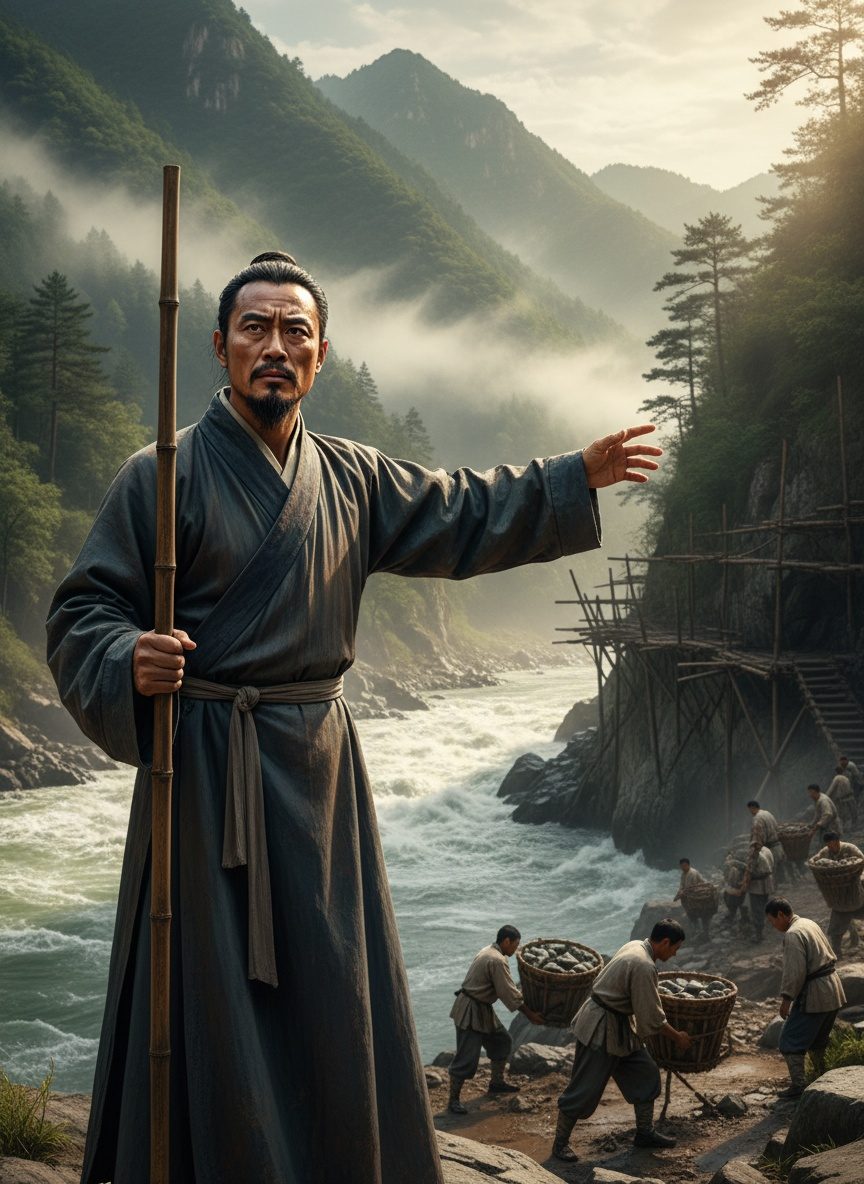
The valley shimmered in the golden light of a setting sun, the Min River snaking its way through the emerald hills of Shu. This serene landscape belied the violence wrought year after year when the rains poured relentlessly from the heavens, turning the gentle river into a roaring beast. The Min’s waters, wild and unfettered, surged with terrifying force, consuming the land and claiming the lives of those who dared to dwell near its banks. In 256 BC, as yet another flood threatened to lay waste to the fertile plains, one man stepped forward, determined to tame this ancient menace.
Li Bing, the governor of Shu, surveyed the scene before him. Beyond the immediate destruction, he saw potential—a way to transform not just the landscape but the very fate of his people. The concept was audacious in its simplicity: a system that would not merely combat the flood but harness it, using the river’s own might to irrigate the lands, ensuring prosperity instead of peril. Yet, without the comforts of modern technology, Li Bing faced an unprecedented challenge. The tools at his disposal were rudimentary: wood, stone, and a myriad of laborers driven by a mix of duty and desperation.
Yet, Li Bing’s mind was a sharp as a blade. With no concrete or steel to ensure stability, innovation was key. He envisioned a series of channels and levees, precise and carefully calculated, that would divert the river's fury into a gentle embrace, nourishing rather than destroying. The very plan itself demanded a daunting feat—splitting the river's flow by carving through a mountain: the Yulei Mountain. The grains of sand and pebbles from the mountain would not just be excavated. They would form the foundation upon which entire generations would depend.
The enormity of the task required patience and persistence. While modern builders might employ dynamite and earth movers, Li Bing's crew wielded basic tools. They relied on fire and water erosion techniques to crack the rock, chisels and hammers to chip away methodically, and bamboo chains to ferry the debris. It took years of labor, and the scars of their efforts became a testament to human resolve etched into the landscape.
Among the most ingenious elements of Li Bing’s design was the Fish Mouth Levee. This clever diversion split the river into two channels: the Inner River, which fed the irrigation canals, and the Outer River, which continued its natural course, mitigating flood risks. To further ensure regulated water flow, Li Bing introduced the Flying Sand Weir, reducing silt accumulation during the dry season while letting floodwaters channel safely away.
This monumental enterprise demanded both strategic coordination and a deep understanding of the river’s behavior through changing seasons—a marvel of foresight and technique. Over time, the local population came to assist with this formidable task, spurred by both necessity and Li Bing’s authoritative goodwill.
Even as the Dujiangyan Irrigation System began taking shape, one challenge after another emerged, each met with Li Bing’s unwavering determination. The river’s temperament changed with the seasons, demanding constant vigilance. Calculations and observations had to be continually revised, and the governor proved relentlessly industrious, learning from both success and failure. With each passing year, his expertise in hydraulic engineering deepened, setting new standards for the ages.
In the years that followed the completion of Li Bing’s vision, the fertile lands of Shu unfurled, gold and green, vital and nurturing. What once had been a fledgling territory, subject to the river’s whims, blossomed into a cornucopia of abundance. Agriculture flourished under the benefits of consistent irrigation, offering sustenance to thousands and transforming the region into the granary of the state of Qin. The project not only quelled the river's chaos but also laid the groundwork for social and economic stability, weaving prosperity into the fabric of everyday life, a prosperity that stretched far beyond the boundaries of the project’s initial conception.
While Li Bing’s hands may never have touched blueprints or plans as we know them, his understanding of natural materials and topographical dynamics was unparalleled. Taught by experience and inspired by relentless optimism, Li Bing’s accomplishment stands not as a reminder of mere ingenuity but as a testament to human potential to coexist with nature, mastering and meldings its power for the greater good.
Today, as we look upon the Dujiangyan Irrigation System, its channels and levees are more than just stone and earth. They are a chronicle of what can be achieved when we respect yet challenge the elements, driven by the enduring principles of sustainability and foresight—principles so crucial in an age where we grapple with both ancient forces and modern obstacles. The channels continue to run, fed by both man and memory, serving as a testament to the legacy of a governor who dared to carve destiny out of the very bedrock of the earth.