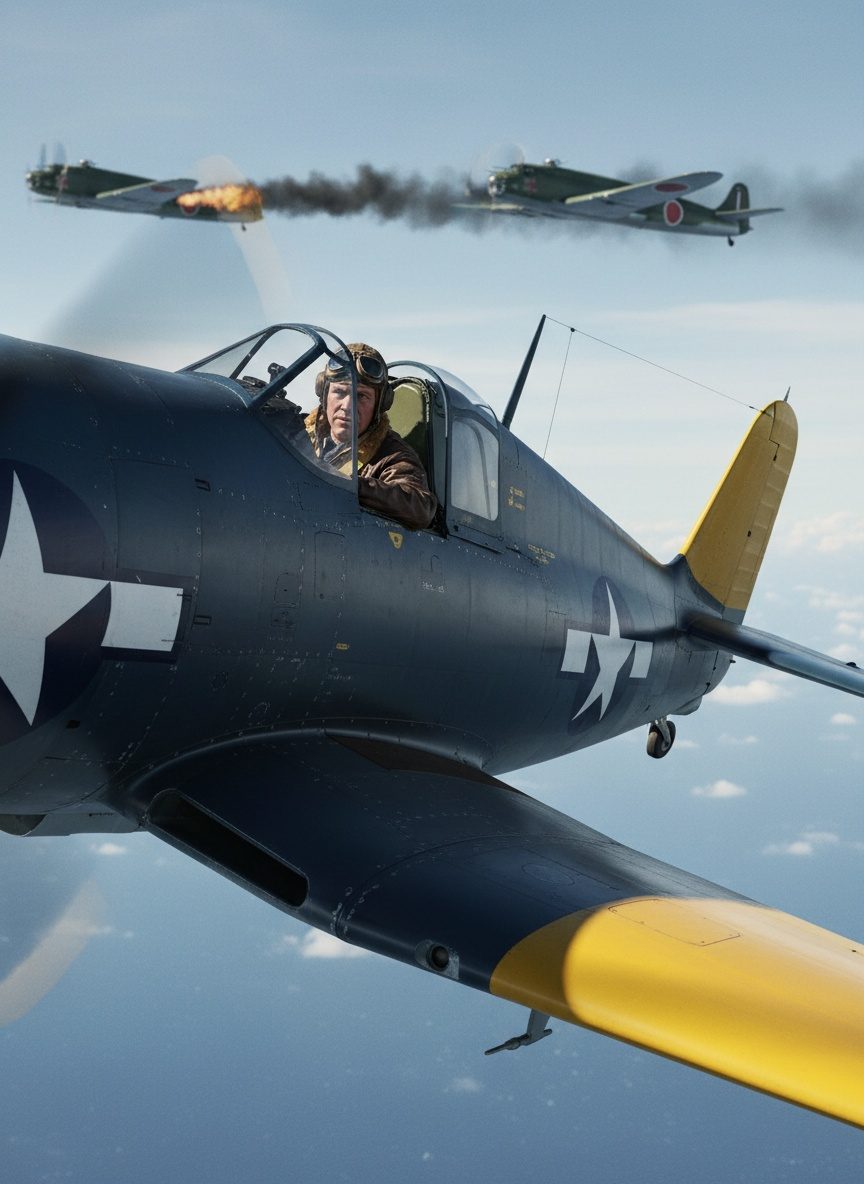
Tracer bullets lit up the cloudless sky like fiery ribbons, slicing through the tense, smoke-filled air. Lt. Edward "Butch" O'Hare steered his Grumman F4F Wildcat with unwavering focus, his eyes locked on the glittering silhouettes of nine enemy bombers looming ahead. With every nerve attuned to the deadly ballet of aerial combat, he had mere minutes to act—or face devastation below.
The Lone Defender
As the Pacific sun cast its blazing rays over the USS Lexington, nothing seemed amiss in the vast ocean's endless horizon. Yet, a deadly threat lurked in those pristine skies—nine well-trained Japanese bombers homed in on their target with a ruthless efficiency. They were executing a meticulous pincer movement, aiming to shatter the stoic resolve of the American fleet.
Back on the Lexington, the amiable chatter of sailors was drowned by the sudden blare of alarms. Every available pilot had already taken to the sky, engaging in aerial dogfights that would decide the fate of the mighty aircraft carrier beneath them. Except for one solitary Wildcat, pilotless and seemingly forgotten amidst the chaos.
Realizing the grave peril, Lt. O'Hare seized this fleeting opportunity to defend his battered comrades. With no wingman to cover his six, he ascended alone, armed with four machine guns and precious few rounds to spare—just enough to make every shot count. Few could have predicted the fearless resolve and unmatched skill he would display against overwhelming odds.
The Dance of Death
At 1,500 feet, O'Hare's heart beat in harmony with the rhythmic roar of his aircraft's engine. The Wildcats' rhythmic purr transformed into a predatory snarl as O'Hare thundered towards the squadron of bombers, his aircraft a solitary predator against a formidable flock of prey.
The Japanese crews, initially oblivious to his presence, maintained their lethal course. Shortly, their space was invaded by the lively bark of O'Hare's 50-caliber guns. With surgical precision, he sprayed deadly arcs through their formation, unraveling it like a frayed tapestry.
In just a heartbeat, one bomber was engulfed in smoke, another disappearing in a confetti of debris, rain staining the ocean far below. O'Hare banked and rolled, a tight choreography that transformed him into both shield and sword, defending the helpless carrier below.
The odds were astronomically stacked against him—yet, where most would falter, O'Hare embraced the challenge. With 60 rounds per aircraft, every burst had to have purpose, and each movement was a masterstroke in wartime artistry.
A Symphony of Survival
O'Hare's bird could not sing forever; fuel dwindled with every maneuver, and ammunition ebbed like sand through a timepiece. Every squeeze of the trigger brought him closer to an unarmed glide, even as the hostile formation persisted.
Four bombers plummeted before his guns fell silent, the damaged fifth spiraling away as its pilot fought to regain control. In the few moments it took for this clash of metal titans, he had performed what seemed beyond human capacity. His fellow pilots, far off in skirmishes of their own, would later regard his actions with incredulous admiration.
O'Hare's fuel gauge now blinked insistently. With most of his ammunition spent, he returned to the Lexington accompanied by the phantasmal specters of his fallen foes, his Wildcat pockmarked with evidence of the encounter he had just survived.
Heroes in the Shadows
As the aircraft carrier's deck welcomed him back with open expanses, a new narrative was already being forged in the hearts of those who witnessed his solitary defense. With no radio confirmation, his fellow aviators could only piece together the astonishing account from the fervent exclamations of mission observers.
His triumph was both a personal victory and a collective emblem of the tenacious spirit with which America would meet its adversaries. O'Hare, with his audacious spirit and unyielding valor, emerged not only as an ace pilot but as the embodiment of hope in uncertain times.
The accolades came swiftly, though O'Hare wore them with a modesty becoming a true warrior. The Medal of Honor awarded to him read of courage and indomitable spirit, yet the quiet moments on the ship's deck told stories of brotherhood tempered in the crucible of war.
A Gritty Legacy
The tale of Lt. Edward O'Hare doesn't linger in textbooks or dominate school lessons, yet it resonates in the memories of those who dare to question the quiet undercurrents of history. His spirit, forged in the furious skies above the Pacific, serves not only as inspiration but as a reminder of the power of individual resolve in moments of profound adversity.
In an era where machines and strategies often dictated the course of warfare, O'Hare's impromptu showdown reflects the chaos and unpredictability that defined World War II. Frontline stories like his remind us that history's broad strokes often conceal the intricate brushwork of personal valor. As his Wildcat soared back to the Lexington that fateful February day, O'Hare's unexpected solo crusade was etched into the annals of wartime legends—a testament to what a single, determined individual can accomplish against all odds.