King Lalibela carved a new Jerusalem out of the African earth. He did it a thousand years ago, in a place most will never see.
A Vision From the Highlands
High in the Ethiopian Highlands, amidst towering cliffs and verdant valleys, King Lalibela experienced a vision that would change the landscape of his kingdom forever. An angel, so the story goes, led him through celestial realms, revealing a paradise that resonated with divine splendor. His heart was set on creating a replica of Jerusalem—a new holy city etched into the fabric of the earth for his people, who could never make the perilous pilgrimage to the original Holy Land. Instead, their feet would tread sacred ground closer to home.
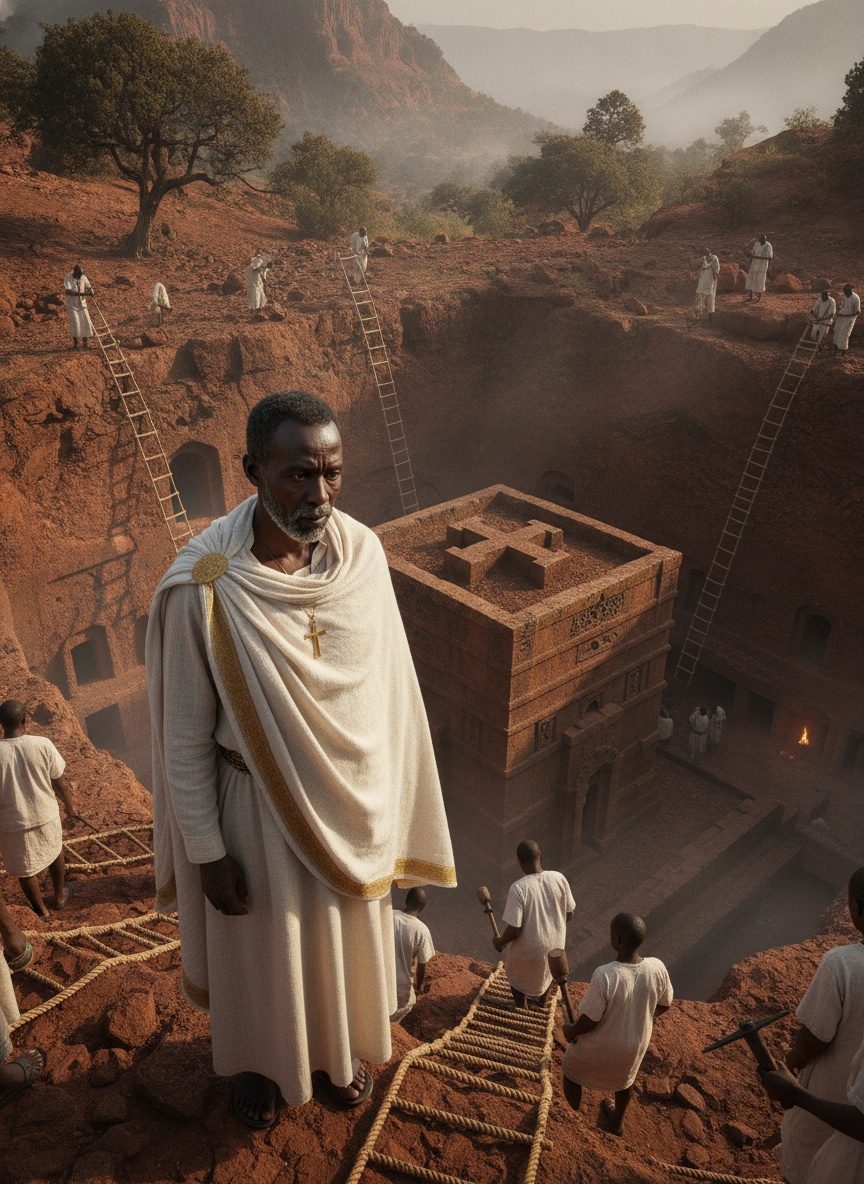
The formidable task Lalibela envisioned seemed almost Herculean. He did not plan for lofty spires or towering cathedrals to kiss the sky; instead, his gaze turned downward, into the bedrock beneath the earth. Here, he would craft his churches in negative, chiseled from top to bottom until their forms rose from the empty spaces left behind. Eleven monolithic churches took shape under the relentless determination of hundreds, perhaps thousands, of craftsmen and laborers. Hewn from volcanic tuff, these structures materialized over decades ceaselessly, day by day, guided by both divine inspiration and sheer human will.
Like sculptors working the clay of a master potter, each craftsman wielded his chisel and hammer with precision. The soft yet resilient rock gradually revealed biblical stories and Ethiopian crosses carved into its walls, telling tales of faith, redemption, and miracles to those who entered. For every visitor who descended into the labyrinthine maze, the very air quivered with echoes of chants, the sweet scent of incense wafted from burning censers, imbuing the environment with a sacred permanence.
The Churches Below
The masterpiece of Lalibela’s vision is arguably best embodied in the Church of St. George, or Bete Giyorgis. Like its siblings, it emerged not under open skies but by digging a precinct deep into the ground—chiseling out a cruciform structure with precision that today still astonishes engineers and architects alike. Murmurs in the soft light speak of an architectural feat more akin to magic than mankind, yet it was real. It is still real. St. George’s perfection, symmetry, and the endurance through centuries command a reverence from all who stand in its shadow.
But each of the eleven churches holds its distinctive story, connection, and symbolism. Named to mirror Jerusalem’s biblical places—Bete Medhane Alem, Bete Maryam, Bete Golgotha—every stone plays its part in recounting the ecclesiastical lore woven into their design. Pilgrims wandering between them traverse paths both spiritual and literal: tunnels and trenches link these subterranean marvels. Footfalls echo in cool corridors of rock, their monotonous rhythm underscored by the perpetual liturgy echoing across epochs.
Imagine the blood and sweat absorbed in those ancient walls, the whispers of laborers long passed, who chipped stone with rock-hewn tools to resurrect their faith in a time when reaching Jerusalem was little more than a dream. It speaks volumes of a king's influence when their legacy stretches beyond architecture into the divine order of life itself. The Churches of Lalibela are thus more than just religious edifices; they are a testament to a kingdom's commitment to faith and community, an eternal hymn to devotion sung in stone.
A Legacy Carved in Stone
As years became centuries, the mystical allure of Lalibela's creation only grew. These monolithic churches survived the elements and invaders alike, standing proof against time's relentless march. They call to curious historians, passionate pilgrims, and the spiritually connected from across the globe, captivating with mystery as cryptic as the methods of their creation. Such is the lasting power of Lalibela’s rock-carved revelation—remnants of a bygone era that haven't just endured but thrived, safeguarded by the Ethiopian Orthodox Church and cherished by the local community for whom these churches are a living heritage.
Now intertwined with the heart of Ethiopia, Lalibela's churches draw not just the devout but also historians and architects who marvel at their intricate carvings and structural complexity. Stories pass between generations, blending myth and fact as seamlessly as the stonework blends into the landscape. It seems a fitting testament to a dream borne of faith—a dream of heaven carved into the earth—able to transcend not only the physical divides of the Ethiopian landscape but also connect people across the tangible and the ethereal.
As we find ourselves pulled towards thrilling modern narratives, the enduring majesty of Lalibela's churches invites reflection. They urge us to ponder humanity's insatiable thirst for connection beyond physical realms and serve as a reminder that while stones may erode, the dreams they house can grow even more enduring over time. In these one-thousand-year-old edifices, we're confronted with the simplicity yet complexity of belief—a narrative that reminds us that the most extraordinary dreams can plant their roots in the heart of the ordinary earth.