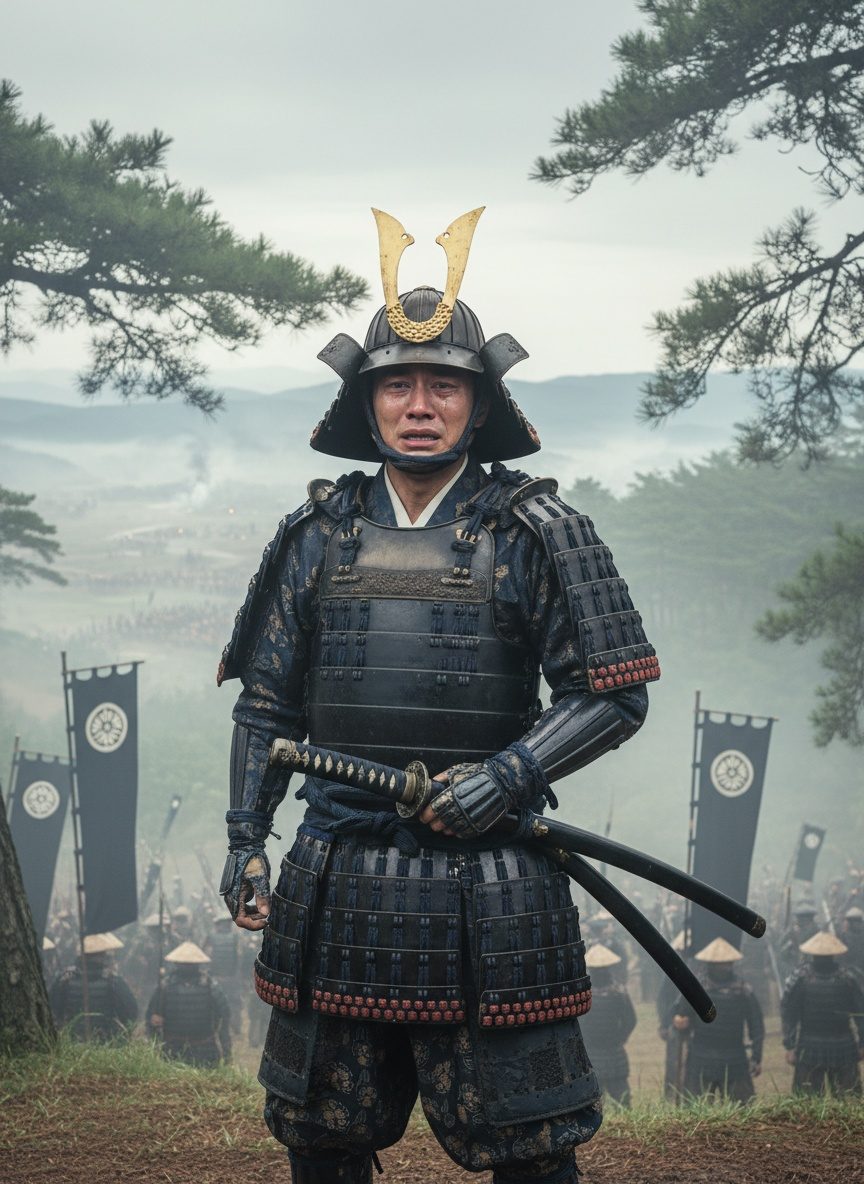
He was twenty-three years old. He had never led an army into battle before that morning. Kobayakawa Hideaki was a young samurai of noble birth, caught at the center of a political maelstrom. On that fateful morning in October 1600, the air around him held an eerie stillness, pierced only by the muted sounds of rustling banners and whispered prayers. Before him lay an expanse of rolling hills and valleys, shrouded in a thick, ominous fog that seemed to echo the uncertainty cloaking the land. While two great forces of Japan were locked in a tense standoff below, Hideaki sat upon a hill, surrounded by fifteen thousand expectant soldiers, all awaiting the command that would seal the fate of nations.
The Battle of Sekigahara was more than a mere military engagement; it was a clash of destinies that would determine the shape of Japan for centuries to come. Tokugawa Ieyasu and Ishida Mitsunari, the stalwarts of ambition and power, stood at the helm of opposing forces each dreaming of supremacy over the fragmented archipelago. The stakes could not have been higher, for victory would open the gate to unparalleled authority and the dream of unifying Japan under a single rule. On that misted battlefield, the fragile balance of power teetered precariously, held in the hands of a single man whose loyalty would soon be questioned by both allies and enemies alike.
Kobayakawa Hideaki, a youth born into privilege yet burdened with the weight of grand expectations, now found himself at the crossroads of history. He possessed no battle scars, no venerable trophies to boast of, and yet the future hinged upon his every breath. Throughout the sleepless night prior, he had tussled with his own doubts and fears, torn between duty and a burgeoning sense of self-preservation. The rain soaked down upon the earth, creating rivulets of mud that mirrored the uncertainties troubling his soul. As dawn broke, the mist refused to lift, casting a cloak of ambiguity over what should have been a day of clear-cut allegiances and valorous intent.
One could scarcely imagine the turmoil that raged within his heart. Raised under the careful eye of the Toyotomi clan and now at the mercy of their enemies' manipulations, Hideaki's reality was a labyrinth of conflicting loyalties. Promises spoken in the flickering candlelight of secret meetings held little weight against the immediacy of steel and blood. His mind was a tempest of what-ifs and assurances, tangled knots of loyalty fraying at the edges. To betray was to live; to stand resolute was to fall. Caught amid shifting alliances and courtly intrigues, the young general wrestled with decisions far beyond his tender years.
The tension hung heavy in the air as the first cries of battle rose from the fog, piercing the unnatural quiet. A cacophony of clashing steel and the cries of men engulfed the plain below, swelling into a crescendo of chaos from which no retreat was possible. Hideaki's soldiers remained motionless atop their perch, specters within the fog as they awaited the signal that would decide their fate. Time stretched and warped around them, an eternity compressed into mere moments. Amidst that suspended dread, Hideaki found himself isolated, wrestling with the specters of betrayal and obligation. Silent tears traced paths across his cheeks, indistinguishable from the cascading rain.
But when the decisive moment arrived, it was with neither grand speech nor fervent rallying call. Quietly, with the confidence of a man resigned to his course, Hideaki finally gave the order that shattered the tenuous equilibrium of the battlefield. The very allies who had trusted him found themselves engulfed by his forces, now surging forward with a purpose approximating fury. For in war, allegiance is but a flicker in the firestorm of survival, where grand designs of power often play second fiddle to the primal instinct for self-preservation.
Within the span of less than an hour, the tide turned, and with it, the destiny of a nation. The ensuing storm of battle left no uncertainty: Ieyasu emerged triumphant. Through Hideaki's fateful decision, Tokugawa Ieyasu was able to secure victory, paving the way to establish the Tokugawa shogunate. Unbeknownst to Hideaki, his switch in allegiance would seal the fate of Japan, shaping the course of its history for the next two and a half centuries. Yet there, amidst the blood and toil of battle, remained the questions echoing in his heart – questions none could answer with certainty.
In the aftermath of Sekigahara, the young samurai who had betrayed his accursed allies faded into obscurity. The historians of later years would paint him as a traitor, too capricious and indecisive to stake a claim on posterity's more favorable narratives. Perhaps it was grief that swayed his heart, or perhaps it was the crushing weight of destiny that forced his hand. Whatever the case, the tale of Kobayakawa Hideaki remains as haunting as the fog upon that fateful field: a testament to the silent yet powerful role individuals play in the orchestration of history.
For it is in the chaos of battle and the quietude of its aftermath that one finds not grand designs or heroes carved in stone, but rather the simple choices of men caught in the breathless pause between life and death. Hideaki's grief-laden betrayal reminds us of the fragility of ambition and the profound consequences wrought by a single tear. In the stories they never taught you in school, it is often those forgotten tears, invisible yet omnipotent, that truly shape the course of human events.