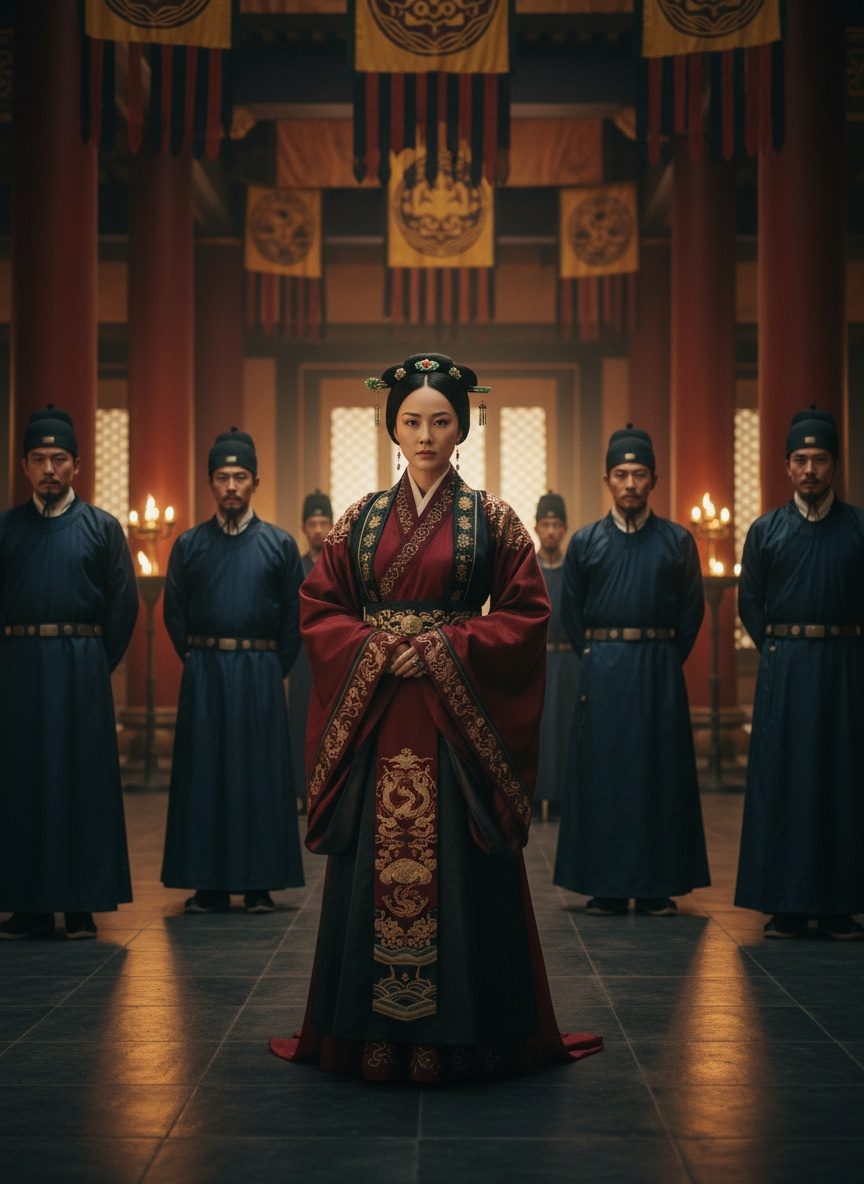
180 BC. The flickering torchlight cast long, wavering shadows across the great hall of the imperial palace.
The Woman Who Ruled in a Man's World
The Han Dynasty, after a period of upheaval, was beginning to settle into its place as one of China's first great empires. Yet, the path to imperial stability was anything but smooth. The corridors of power were filled with men who had fought and bled to forge the empire, yet atop this fiercely masculine hierarchy sat Lü Zhi, better known as Empress Dowager Lü.
Born in a time where women were often relegated to the shadows, Lü Zhi's rise was as remarkable as it was unprecedented. She was married to Liu Bang, the founder of the Han Dynasty. When he passed away, the intricate power struggles at court intensified. Lü Zhi had only her cunning and determination, but these proved more than enough. For years, as her son Emperor Hui took the throne, she deftly navigated the treacheries of court intrigue with aplomb, maintaining a grip on power that few could challenge.
Her reputation was formidable. Stories of her cruelty and decisiveness were whispered in the palace halls, serving both as warning and testament to her authority. Lü Zhi was known for her unyielding nature and her relentless pursuit of control, traits that would soon be tested as never before.
A Court in Tumult
After the death of Emperor Hui, the question of succession loomed ominously over the Han court. A vacuum such as this could invite chaos—or revolution. The military generals, men of influence and ambition, gathered to decide who might next take the throne. Each had their own candidates, their own visions for the future of the empire, yet none could agree.
In this charged atmosphere, Lü Zhi entered the court alone—a widow among men, with no army or allies visibly at her side. Yet she carried with her the weight of experience and the authority earned through long years of political maneuvering. As the assembly pressed with voices loud and argumentative, it was her voice, sharp and clear, that cut through the din.
The murmurs of dissent quieted under her steely gaze. The generals, men used to commanding and bending the world to their will, found themselves unnerved by her calm authority. Lü Zhi, with neither weapon nor army, serenely stood her ground. Her decision was unwavering: she alone would decide who would wear the imperial crown.
This bold declaration was more than mere bravado; it was a calculated move. By asserting her authority directly in the face of the military mightiest, Lü Zhi demonstrated that her grasp on power was not just rooted in lineage but in a will as unbreakable as iron.
Choosing the Future
Empress Dowager Lü had outmaneuvered countless opponents to be where she stood. Her choice for the next emperor was not made lightly. In selecting the heir, she did not simply secure immediate authority but aimed to enshrine a lasting legacy. Yet, her decision was not without controversy or resistance. Her choice was seen by many as a means to ensure her continued influence, a move to consolidate power within her family.
The strength of Lü Zhi's resolve was paramount. Despite the generals’ not-too-subtle objections, she laid out her vision for the empire—a vision that didn’t necessarily align with theirs but which would steer the Han Dynasty toward stability. It was a masterclass in realpolitik, executed with the precision and foresight that had come to define her rule.
In those tense moments in the imperial court, a woman without conventional means of power imposed her will over men who possessed the armies and their allegiance. Her decision echoed through the halls and onto the fields of China, setting the stage for the next era in a dynasty whose foundations she had helped lay. What might have spiraled into chaos was deftly managed; the empire would not falter under her watch.
Lü Zhi's defiance transcends mere historical footnotes. It serves as a vivid reminder of the intricate dance of power—a dance in which the most unlikely partners might sometimes lead. In the annals of history, it underscores a truth often hidden from schoolbooks: that history is not merely the domain of the celebrated warrior or the titled king, but also of the determined woman who faced down armies with nothing but her unyielding spirit.