In an era where power and influence often resided in the realm of men, Cornelia Africana did something extraordinary. She refused a throne and instead chose a schoolroom. This decision would reverberate throughout Rome, shaping the destiny of an empire.
A Jewel Beyond Price
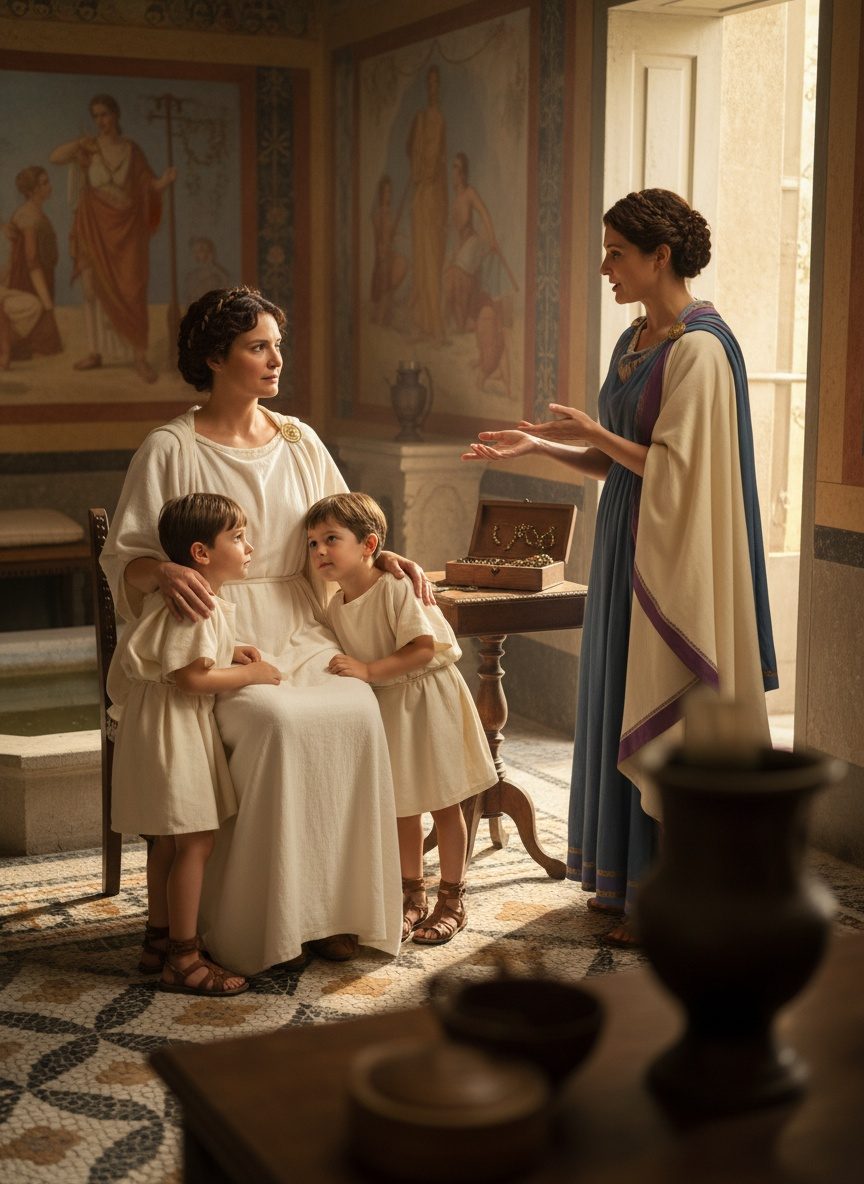
Rome in 160 BCE was not the welcoming, bustling metropolis that some might imagine. It was a city at the heart of a republic in transition, rife with political intrigue and social upheaval. Yet, in this tumultuous landscape, one woman stood out: Cornelia Africana. As the daughter of the famed general Scipio Africanus, Cornelia was no stranger to prominence and privilege. However, when an affluent Caecilian matron, renowned for displaying her wealth through lavish pearls and rubies, asked Cornelia to unveil her treasures, she did not summon jewelers or proudly open a polished chest. Instead, Cornelia beckoned to her two sons, Gaius and Tiberius Gracchus. "These are my jewels," she declared, pointing to her boys with pride and conviction.
This statement, often retold in whispers and now immortalized in history, signified far more than familial affection. It underscored her revolutionary vision — the belief that the true prosperity of a family lay not in its material wealth but in the cultivation and education of its youth. Cornelia's choice to prioritize her children over wealth stunned Roman society and laid the groundwork for legacy that would echo throughout the annals of time.
The Schoolroom as a Battlefield
It is easy to assume that Roman noblewomen were confined to the shadows of their husbands' and fathers' achievements. Yet Cornelia's life told a different story. Widowed young after her husband Tiberius Gracchus the Elder's untimely death, Cornelia faced the world with two sons to nurture and a society quick to propose remarriage as a reasonable solution. Her refusal of a marriage proposal from Ptolemy VIII, a king himself, was not a mere personal preference. It was a statement of autonomy, a declaration that her focus would remain on guiding her young sons.
In her home, Cornelia created an intellectual haven. Leading scholars, philosophers, and political minds of the time gathered under her roof, sharing insights and debating on history, government, and ethics. By transforming her dwelling into an academy, Cornelia instilled in her sons the principles necessary to shape their consciousness and, ultimately, their politics. She taught them not just the art of rhetoric and philosophy but the responsibilities one holds toward others, weaving the foundation of servant leadership into the fabric of their upbringing.
Shaping Rome's Unraveling Threads
The Gracchi brothers, as Cornelia's sons came to be known, were destined to sew the fabric of Roman history in bold new patterns. Their careers, underscored by the moral teachings and civic ethos imparted by their mother, veered toward reform and justice. As popular tribunes, Tiberius and Gaius Gracchus spearheaded significant social and economic reforms aimed at addressing the burgeoning class disparities within Rome. Tiberius tackled land redistribution, seeking to revive the faltering agrarian class by reallocating the expansive estates claimed by the elite. Meanwhile, Gaius sought comprehensive social reforms, from subsidizing grain to enfranchising Roman allies, ensuring justice for all.
Their efforts catapulted them into the maelstrom of political strife, sparking fierce opposition from the Senate and reshaping Rome's socio-political landscape. Cornelia witnessed her sons' public life swell with both triumphs and tribulations. While ultimately both met untimely ends, the seeds they had sowed—nourished by Cornelia’s wisdom—forever impacted the course of Roman history. The Gracchi reforms left an indelible mark that would echo through the era of the Roman Republic, igniting movements that sought to bridge divides between the impoverished masses and the affluent elite.
A Mother's Legacy Beyond Rome
Cornelia Africana's choices, daring and outspoken as they were, poised her as not only a matron but a matriarch in the truest sense—a guide, a nurturer, and a warrior of intellect. Her life's work extended beyond her immediate familial efforts; it painted a broader picture of womanhood seldom celebrated in antiquity. The education and philosophical environment she curated resonated across centuries as an emblematic gesture of the strength in a mother's role, one that has as much potential to influence the annals of history as the exploits of generals and the decrees of emperors.
In Cornelia, we discover a woman who defied convention, embodying the idea that the most precious wealth lies within the legacy left by nurturing future generations. Her story presents a timeless lesson, one still relevant in a world where education and upbringing are paramount. Cornelia Africana was a visionary who, through her sons, altered the very trajectory of Rome, and with it, our understanding of a mother's might in shaping history. Through her own bold rejection of worldly allure, she crafted the foundation from which empires could rise, reminding us that often, the jewels that shine brightest are those forged in the crucible of love and intellect.