690 AD. Dust from the desert rose like a veil against the horizon.
The Arab Advance and a Resilient Queen
By the end of the 7th century, the Arab forces were a formidable wave sweeping across North Africa. Their purpose was clear and unstoppable, fueled by religious fervor and strategic acumen. Kingdom after kingdom fell, absorbed into the rapidly expanding Islamic world with astonishing speed. Yet, in what is today known as Algeria, high in the rugged terrain of the Aurès Mountains, a different story unfolded. This was the heartland of the Berbers, fiercely independent tribes whose history intertwined with the land as deeply as the roots of the stubborn acacia trees.
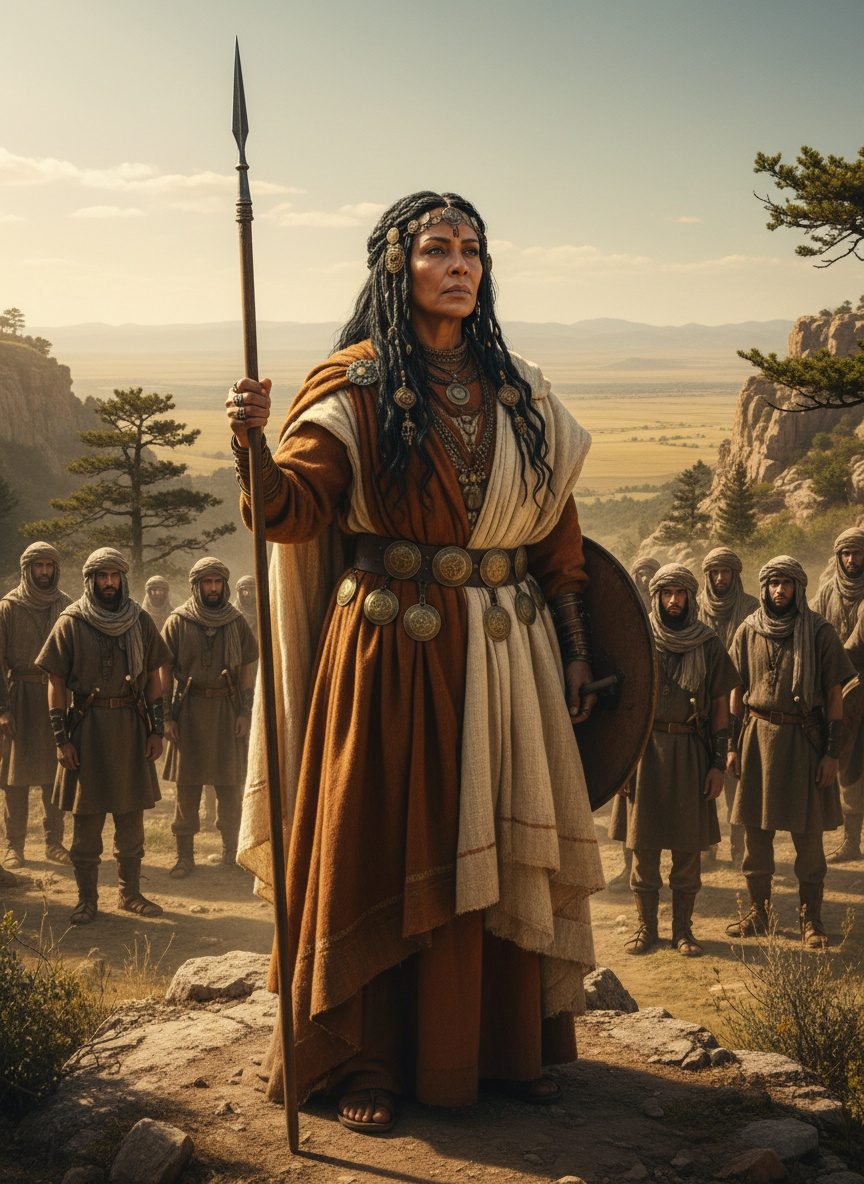
At the forefront of this particular story is Kahina, a Berber warrior-queen whose name has echoed through generations. Little is definitively known about Kahina’s early life; the sands of time have obscured much of her origins. But what is widely agreed upon is the formidable resistance she mounted against an incoming tide of change. Uniting Berber tribes, a task akin to herding the wind, Kahina became a beacon of defiance against the Arab conquerors. Her spirit was as fierce as the African sun and as enduring as the mountains she called home.
Kahina's opposition halted the Arab expansion into North Africa for several critical years. Her name became synonymous with resistance, her image a rallying point for the Berbers who sought to preserve their way of life against foreign dominion. Kahina was said to possess not only martial prowess but also a prophetic gift—earned wisdom, perhaps, from years at the forefront of a land both desolate and divine. This queen did not simply face the Arab army; she collided with it, turning the progression of an empire into a stalemate under the shadow of the Aurès.
Warrior of the Aurès
Imagine the Aurès, strongholds of stone and high-altitude majesty. Here, strategy went beyond battlefield tactics to include a deep understanding of the land—the valleys and ridges, the water sources in times of drought, the hidden paths that twisted like riddles only the local people could solve. Kahina used these to her advantage, commanding raids and ambushes that confounded the more extensive Arab forces unaccustomed to the crags and crevices of the mountainous terrain.
The Arab commanders, seasoned in the art of war, must have been both baffled and infuriated by Kahina's resistance. The stories say she was a formidable warrior in her own right, leading charges not from a distant tent but from the heart of battle—a sword as keen as her resolve flashing in hand. Her presence was said to be commanding; those who followed her were gathered not just by obligation but by loyalty, by a shared resolve to remain the makers of their fortunes.
This drawn-out conflict wasn’t only military but psychological. Kahina’s ability to unite often fractious Berber tribes spoke volumes of her charisma and strategic intelligence. Warriors from disparate clan backgrounds rallied under her banner, setting aside historical grievances to face a greater threat. For a time, they held their lands, leaving Arab forces reevaluating their conquests, buying time for the Berber culture to endure.
These were not merely battles over territory but struggles over identity and self-determination. Kahina's figure, standing firm against the encroaching empire, became a temporary shield against the tide of history, its lessons written not just in shifting boundaries but in the human heart's relentless desire for freedom.
The Enduring Spirit
Despite her efforts, Kahina faced an impossible challenge. No empire could forever withstand the tide of a new age without yielding. When her resistance finally waned, many of the Berbers, including Kahina, were drawn into the Islamic world. The transition altered North Africa’s cultural and political landscape, yet there exists a sense in which Kahina achieved a kind of victory.
Years under her leadership managed to preserve a sense of Berber identity. With her passing, the lands faded from independent defiance into a new era, but the Berbers did not disappear into the annals of obscurity. Instead, they became a vibrant part of the diverse tapestry that is the modern Maghreb. Kahina’s legacy, though perhaps overshadowed by the winds of change, endured in the stories told by her people and the resilience they displayed in adapting and surviving.
Today, Kahina represents not just a figure of historical resistance, but an emblem of the human capacity to fight against overwhelming odds. It is a tale of courage and conviction that echoes through the ages. Kahina’s story matters as a testament to leadership, challenging the often linear perspective of historical progress by reminding us that history’s unsung heroes can wield impossible power—inspiring us to understand the weight of past struggles upon our present.