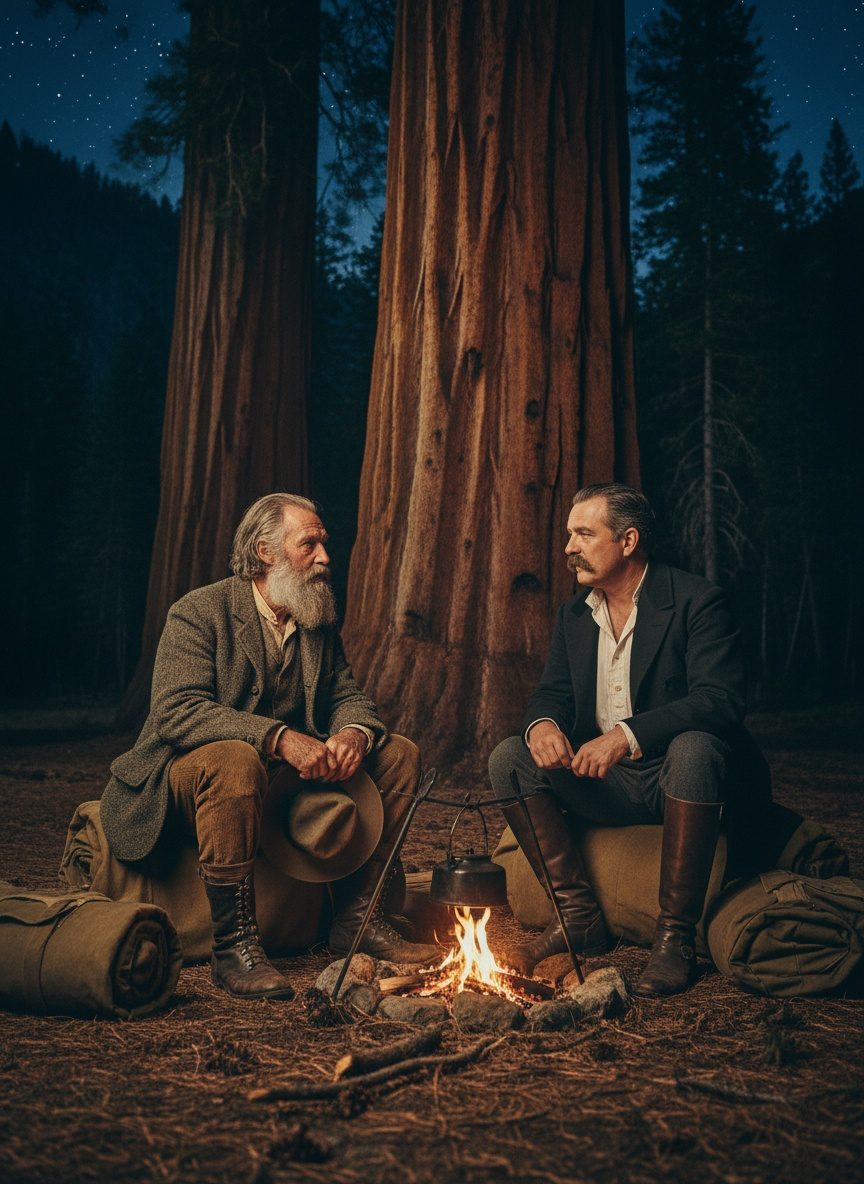
The crackle of the campfire was the only sound amidst the majestic sequoias of Yosemite National Park. The flames danced, casting flickering shadows on the towering trees, as John Muir and President Theodore Roosevelt sat wrapped in blankets, the chill of the night air gently biting at their cheeks. They were deep into their second night of an unusual camping trip that would forever change the trajectory of American environmental conservation. Each man was absorbed in thought under the expansive dome of stars, a silence punctuated only by Muir's hushed, passionate words weaving through the night air.
The Meeting of Minds in the Wilderness
It was the spring of 1903, and what began as a journey with formal stops and perfunctory ceremonies swiftly transformed into an adventure of a lifetime. Muir, the ardent naturalist whose writings had captivated readers nationwide, and Roosevelt, the energetic President known for his progressive views, had both recognized a pivotal moment unfolding. Despite their different backgrounds — Muir, a Scottish-born botanist deeply connected to nature, and Roosevelt, a Harvard-educated leader relishing conquests of political and literal wilderness — they shared a mutual love for the untamed American landscape.
Muir persuaded Roosevelt to abandon the entourage of aides, photographers, and journalists, bringing the leader of the free world into an intimate communion with nature. Here was their opportunity: to truly experience the serenity and raw beauty of Yosemite, unburdened by the trappings of power and bureaucracy. By day, they rode on horseback through the wild valleys, Muir pointing out the crags and crevices bearing tales of ancient times. By night, they huddled by the fire as Muir recounted stories of adventures past, instilling in Roosevelt a profound admiration for the land that stretched unspoiled before them.
The Call of the Sequoias
The massive trunks of the giant sequoias surrounded them, silent sentinels of the vast and varied Californian landscape. Muir spoke of how they thrived best when undisturbed, their roots spreading most effectively across the undisturbed earth. His tales reflected a perspective Roosevelt found striking — these were not just resources to be harvested, but national treasures to be preserved for generations yet to come.
In the thick darkness, punctuated by the campfire's glow, Roosevelt warmed to Muir’s vision of a future where these wild spaces remained as they were: untouched and magnificent. It was said that while leaning against one of those ancient trees, Muir challenged Roosevelt to become the voice of the wilderness, urging him to use his presidential power to preserve natural landscapes across the nation. Here was an undertaking as grand as any political strategy — to safeguard nature from the insidious grasp of industrial expansion and unchecked exploitation.
A Pledge to the Future
As they rode through the awe-inspiring vistas, Roosevelt understood this was more than an escape from Washington's political toil. It was a revelation. Roosevelt the politician was evolving into Roosevelt the conservationist. By the time their three-day journey drew to a close, Roosevelt had committed to expanding America's fledgling national park system, entrusting the land to future generations.
Back in Washington, invigorated by his time with Muir, Roosevelt initiated extensive conservation efforts, determined to protect other natural landmarks the way Muir had advocated for Yosemite. It was a paradigm shift; the land was no longer a mere backdrop to progress but a treasure to be celebrated and preserved. Roosevelt eventually established five national parks and signed the Antiquities Act, allowing presidents to designate national monuments, sowing the seeds of what would become a sprawling national park system.
What Muir Brought to the Table
These three-charmed nights Muir spent with Roosevelt were more than political maneuvering; they were a profound exchange of ideals between two visionaries whose passion for the natural world would drastically influence the environmental policy of an entire continent. The overwhelming serenity and remarkable ecological significance of Yosemite provided the backdrop for momentous decisions and profound commitments.
Today, countless visitors to America’s national parks may not realize their visit was shaped by a fateful camping trip in 1903, where under the ancient sequoias and the open sky, John Muir's eloquent advocacy planted the seeds for a conservation legacy that would endure well into the 21st century. In the whispers of the woods, the rustle of leaves, and the rush of pristine rivers and waterfalls, the legacy of that wilderness meeting and the promise of stewardship continues, reminding us that the wild beauty and sanctity of these majestic places stand in testament to what can be achieved long after the embers of campfires have died.