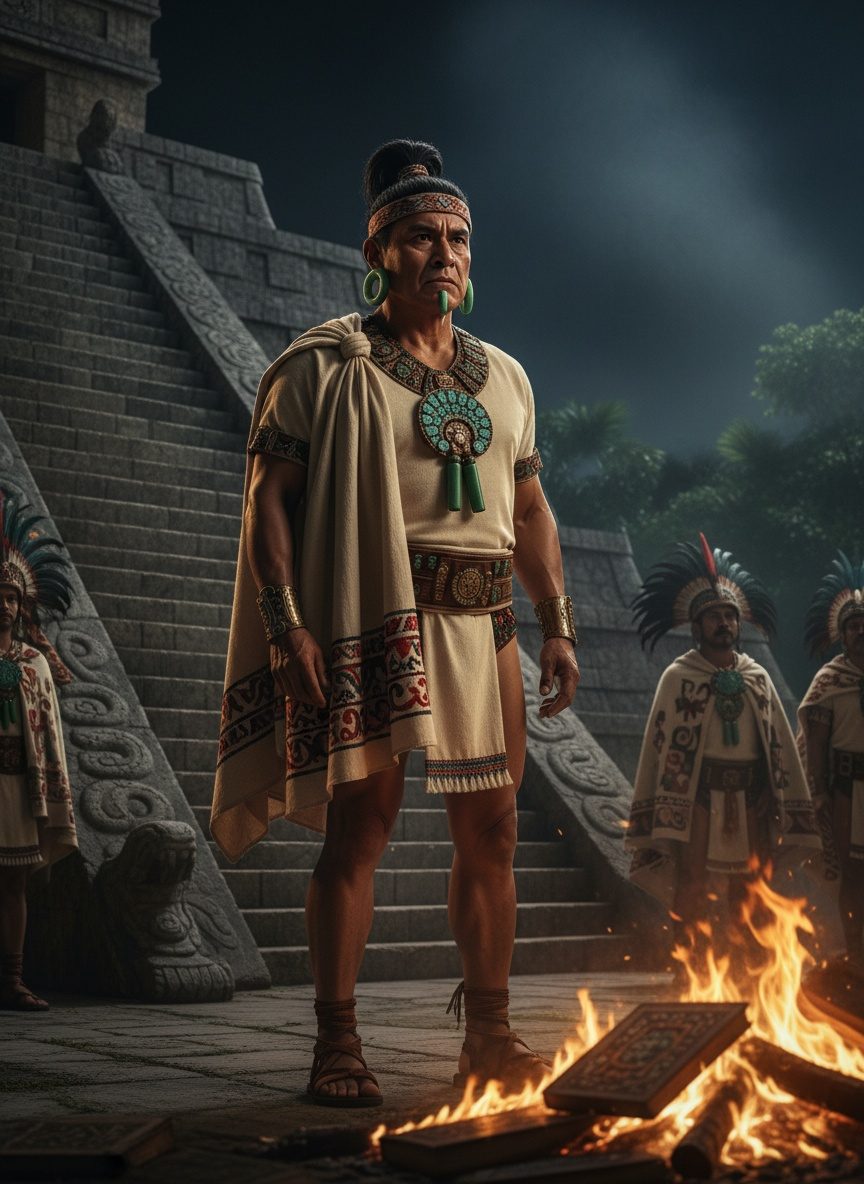
The crackling of the flames filled the air, a relentless devourer, reducing vibrant histories to tendrils of smoke that spiraled into the vast blue sky. In the heart of Tenochtitlan, surrounded by the echoing chants of the priests and the intense heat of the sacred pyres, the old picture-books, the codices that once held the tales of a people, turned to ash. Itzcoatl, the first emperor of the burgeoning Aztec Empire, stood resolute amidst the conflagration, a figure undeterred as ages past disappeared in conflagration. With each book consumed, an old identity was effaced, making way for the forge of a new narrative, one of power and supremacy.
Around the pyre, the priests of the empire chanted their sacred hymns, their voices stirred by both reverence and rebellion—what was lost in these flames could never be recovered. Yet this was the will of Itzcoatl, the ruler who understood that history was not just what happened, but what was told. The Aztec Empire, in its nascent glory, required a history that fit its burgeoning might. The past, with all its inconvenient truths, was a burden that it sought to shed, so Itzcoatl’s mandate was clear: rewrite history and craft a narrative suitable for an empire on the rise.
This act of destruction was not born of casual whims but orchestrated by the mind of Itzcoatl’s chief counselor, Tlacaelel, a figure both revered and reviled across centuries. It was Tlacaelel who envisioned a new foundation for the Aztecs, a foundation that transcended the past and projected a powerful lineage essential for the empire’s aspirations. Under his direction, history would serve to unify and legitimize the Aztecs' dominion over the Valley of Mexico and beyond. And so, as the old stories turned to embers, Tlacaelel set about crafting an epoch written in stone and song, assertive of a destiny that belonged to gods more than men.
Tlacaelel, unlike most men of his time, was acutely aware of the influence of narrative power. He understood that the stories of old, recorded meticulously in the codices, held truths and rivalries that could undermine the cohesiveness of their expanding state. In them were tales of rival clans and past defeats, of compromises and shared power. But for the Aztecs to assert true dominion, their history needed a divine origin story, a god-sanctioned belief in their superiority and their destiny to rule. It was a potent fabrication, but one that required brains of its own, compelling enough to ignite the spirit of its subjects and silence would-be dissenters.
The destroyed books, painted delicately on amate paper, revealed a multifaceted culture, one that had not always nestled at the top of the social hierarchy and indeed once bowed beneath the weight of more eminent forces. Yet such truths mattered little to Tlacaelel, who, with an unwavering hand, penned new codices. These spoke of the gods’ favor upon the Mexica people, rewriting them as chosen rulers birthed by mythical leaders, intent on building Tenochtitlan as the world’s axis. This was a past defined more by prospect and divinity than chronology.
Yet amid the recreating of history, dissent lay. One of Tlacaelel's efforts to solidify the new order involved securing the loyalty—or at least the silence—of those who clung to memories of what was. However often men of power believed that history lay naked and unarmed before them, language and memory remained perennial rebels. And so, some among the old nobility protested quietly, fearful of the future but bound to the past that shaped them. Though the public voice was shackled by imperial decree, in private quarters, whispered tales of dissonant bravery spread, tales of those who believed in the permanence of memory over the impermanence of flames.
In the midst of these murmurings, Itzcoatl’s strategic acumen did not falter. Under his reign, the empire swelled in territory and wealth, conquests legitimized by the new history captured in the freshly written codices. The narrative of an unstoppable people, manifest as an empire, took root deeply, as individuals caught in the thrall of cultural destiny propagated the legends they had been taught. It was a history authored in resplendent mosaics on temple walls, designed to be imperishable even as flesh and faith ebbed and flowed.
As decades slipped past the shadow of Itzcoatl and Tlacaelel, the story they sculpted became the substrate upon which countless generations wove their tales. The burning books’ smoke no longer lingered in the air, replaced by chants in temples and the rhythm of drums resonating across a vast, vibrant city. For the Aztecs, this history became both a prison and a pulpit, compelling villagers to temples and warriors to conquests.
And here lies the enduring paradox: centuries after those masterminds of the past extinguished the flames, the truth both extinguished and preserved. The rewriting of history becomes more than manipulation; it adorns the human heart with the need for understanding and cohesion. For each narrative crafted, rewritten, or erased, lies a fundamental truth about human nature—the urge for narrative, the power it wields over culture, and the indelible impact it leaves on history itself. Itzcoatl’s tale reminds us that the past is often shaped as much by what we choose to forget as by what we choose to remember. The echoes of those lost books are faint but persistent, reminding us that within each of us lies the sacred task of archived memory, of remembering what should never be forgotten.