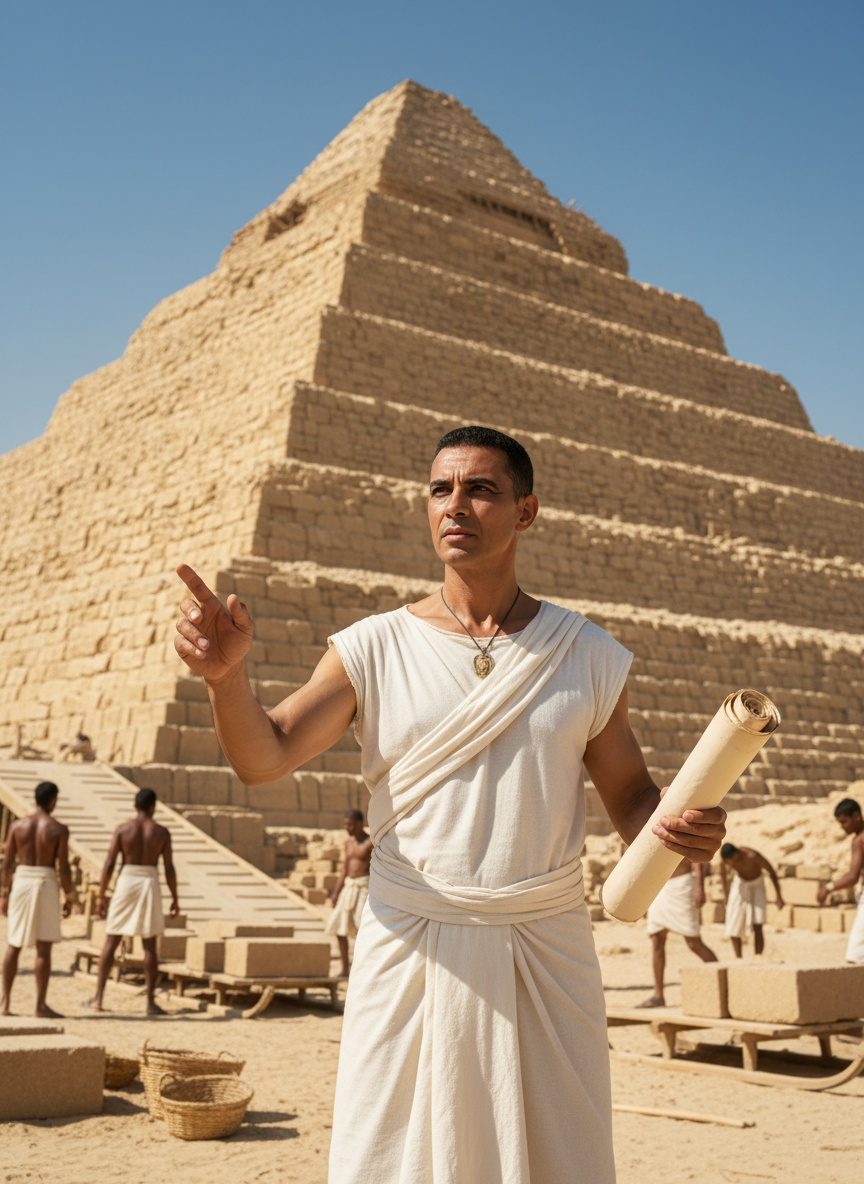
2650 BCE. An expanse of golden limestone block, shining under the Egyptian sun, rose with majestic promise from the sands of Saqqara.
A Commoner's Ascendancy
In the mesmerizing yet merciless land of ancient Egypt, birth determined destiny. Yet Imhotep, born neither into nobility nor amidst the secluded halls of royalty, defied this preordained order through intellect and skill. From the modest station of a commoner, Imhotep's journey is a poignant narrative of ambition and brilliance. A scribe by nature, he was a man of letters in an era that believed literacy to be a conduit to the divine.
Though the scarcity of records from this distant past clouds much of Imhotep's life, one thing is clear: his mind was a treasure of eclectic talents. Before he laid the foundation of his legacy in stone, Imhotep had perhaps already caught the eye of Pharaoh Djoser with his remarkable proficiency as a healer. Equipped with knowledge of medicinal plants and surgical techniques, Imhotep was reputedly among the first to view disease as a condition needing remedy, not divine retribution. The Pharaoh's court needed men like him — thinkers unbound by traditional limitations who could stimulate the leap from superstition to science.
Stacking Stones to the Sky
Imhotep’s true ascent began when he was entrusted with an audacious project that would forever alter the horizons of history: constructing an eternal resting place for Pharaoh Djoser, but not just any tomb. What began as a conventional mastaba, a flat-roofed, rectangular structure, evolved under Imhotep’s direction into something far grander. With visionary insight, he transformed the mastaba into a series of stacked platforms, each smaller than the one beneath, forming a stepped pyramid that reached tirelessly toward the heavens.
The construction of the Step Pyramid at Saqqara was a labor of colossal endeavor. For Egypt, this feat represented an unprecedented architectural leap. Never before had anyone dared to heap such massive stone upon stone, dismissing mudbrick for more enduring limestone. Each carefully placed block bore testament to this ancient civilization’s newfound mastery over materials, as well as Imhotep’s unprecedented inventive spirit. The pyramid stood not only as a grave but as a ladder to the afterlife, linking earth and sky in an everlasting embrace.
Within the Pharaoh's Favor
Imhotep occupied an enviable position beside Djoser, a symbol of intellect and innovation. His development from a mere servant of the pen and herbs to an architect of divine aspirations reflected the growing strain between the human and divine roles in leadership. The Step Pyramid, although silent, proclaimed the undeniable synergy between Imhotep’s ingenuity and Djoser’s ambition.
The striking structure absorbed observers in a powerful narrative: a commoner with the wisdom of the ancients tasked with protecting the Pharaoh’s soul by encasing it in an unyielding fortress. The pyramid’s design not only articulated hope and aspiration but also stood as a fervent promise of heaven on earth. It made tangible the elusive bridge between mortal reign and divine eternity.
Architect of the Impossible
What Imhotep accomplished was far from the last structure he would influence, but it cemented his place in history. Coveted by future kings and priests alike, his example was a milestone for progressive thought. Although few written records survive, myth, and legend argue his impact as founding a precedent for structurally ambitious projects that epitomized the spirit of Egyptian grandeur. His status as one of the earliest architects in recorded history was further solidified through his later deification.
Imhotep’s pilgrimage from the scholar’s desk to the architect’s blueprint mirrored the evolution of society itself. By carving his mark into stone, he elevated the collective consciousness of his civilization, laying a foundation not only of physical blocks but of intellectual and spiritual exploration that would stand long after his death.
Echoes of an Uncommon Legacy
Centuries rolled forward, and Imhotep’s legacy thrived in rarity — he was heralded as a god two millennia after his death, an unparalleled honor for one who began life as a commoner. Within the spiritual and social milieu of ancient Egypt, Imhotep evolved in memory from man to myth, a beacon of what intellect coupled with opportunity could achieve.
Through the lens of time, Imhotep’s story offers a prism to view the power of human innovation over inherited privilege. His life blurs the line between legend and reality, showcasing that though dust and eras may cover a legacy, the echoes of singular achievements resonate through history like the vast and weathered blocks he once commanded to rise skyward.