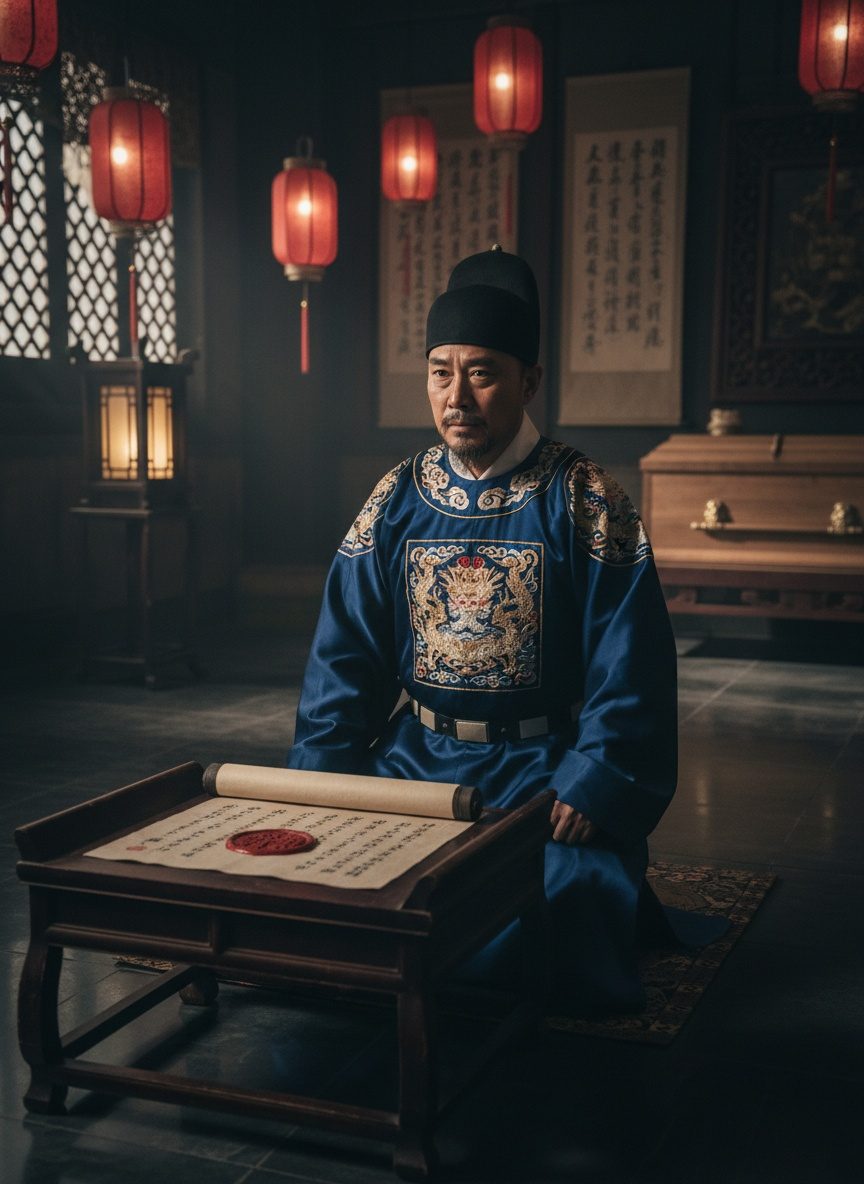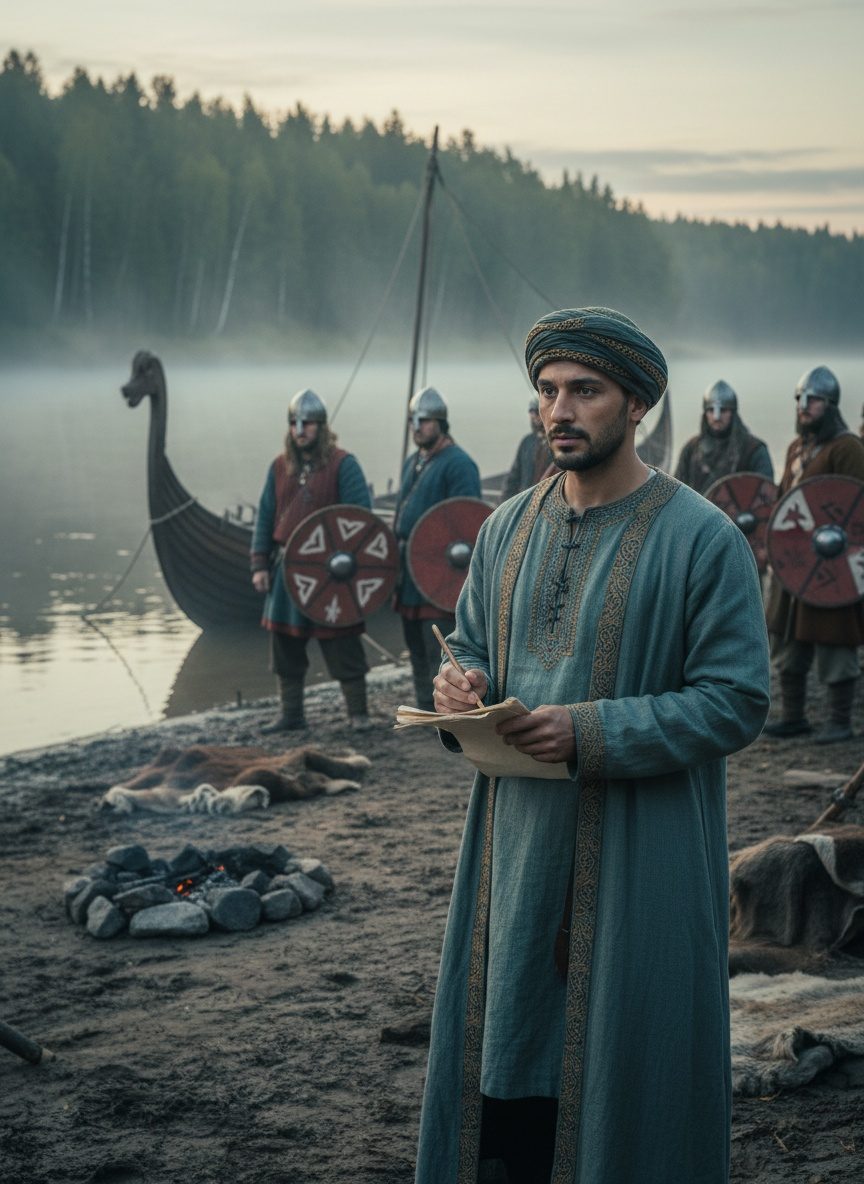
The morning mist clung to the Volga River like a flowing shroud, the air thick with the damp chill of autumn in a land where the sun rose reluctantly, casting long shadows over the dense forests and swirling waters. Nestled within this distant and foreign landscape was a bustling encampment, a cacophony of unfamiliar voices and the harsh clatter of timber against stone—a world far from the warmth of Ahmad ibn Fadlan’s Baghdad. As he studied the scene before him, his mission grew ever more complex. Tasked with diplomacy, yet enthralled by the raw and primal existence of these people known as the Rus Vikings, he took to writing everything down, preserving each detail with an intensity that would echo through the ages.
The Journey North
The journey from Baghdad to the lands of the Rus was neither simple nor uneventful. Ahmad ibn Fadlan had embarked on this expedition in 921 AD, a task entrusted to him by the mighty Caliph of Baghdad. What lay ahead was not merely a voyage of political significance; it was an odyssey into the unknown, fraught with perilous river crossings and endless stretches of unforgiving terrain. Yet, for ibn Fadlan, a scholar of the Islamic Golden Age, the real challenge would be chronicling a world so disparate from his own—a place where the familiar laws of civilization seemed to unravel.
As ibn Fadlan’s caravan wound its way northward, he began to document his encounters with the various tribes and peoples he met along the way, each with customs as varied as the landscapes they inhabited. His accounts serve not only as a testament to his meticulous observation, but also as a bridge across time, inviting readers to witness the convergence of cultures at the crossroads of history.
A First Glimpse of the Rus
Upon reaching the fringes of the Volga River, ibn Fadlan was immediately struck by the sight that met his eyes. Clustered along the riverbank were the notorious longships of the Rus, their sleek wooden hulls bobbing menacingly against the current. The air was suffused with the pungent aromas of smoke and sweat, mingling with the low rumble of voices speaking a guttural tongue unknown to the Arab diplomat. Ethnographic curiosity wrestled with his diplomatic duties, urging him to delve deeper into the lives of these enigmatic warriors.
The Rus, tall and imposing, exuded a raw physicality that was matched only by their unapologetic customs. They were a people intertwined with nature in ways both profound and brutal. Ibn Fadlan observed their ritualistic behaviors with an unflinching gaze, recording details of their personal grooming, diet, and societal organization. These glimpses into everyday life—though seemingly mundane—would come together to form the most comprehensive portrait of the Viking world available to history.
Witness to the Rites of Passage
Among the most vivid observations ibn Fadlan documented were the funerary rites of the Rus—a ceremony as unsettling as it was fascinating. He described with painstaking detail the preparations for the burial of a chieftain, the ritual sacrifices of animals, and the elaborate adornment of the deceased. Yet what made ibn Fadlan’s account truly remarkable was his recording of the human sacrifice, whereby a slave girl was willingly chosen to accompany her master into the afterlife. It was a practice steeped in Viking lore, carried out with a solemnity that belied its inherent violence.
For ibn Fadlan, this was a poignant moment, one that laid bare the sharp contrasts between the world he had known and the one in which he now found himself. It was a world where life and death were woven tightly together, where the boundaries of morality were defined by a complexity that defied easy categorization. His account of this ancient rite offered future generations a window into the spiritual and cultural ethos of the Viking peoples.
Sharing a Story Unheard
Long after ibn Fadlan had returned from his travels, his writings began to resonate far beyond the splendorous halls of Baghdad. They emerged as one of the era’s most extraordinary narratives, a record not only of a singular encounter between East and North, but also of a scholarship that dared to transcend its own cultural confines. Though his account was in many ways unflattering—highlighting the harshness and barbarity he perceived—what emerged was an indelible picture of a society that was as sophisticated as it was fierce.
In reading ibn Fadlan’s chronicles today, we are reminded that history is not merely the story of empires and kings, but also of those like ibn Fadlan who dared to bear witness and record the complex tapestry of human existence. His writings offered insights into the connectedness of medieval worlds that seemed, at first glance, to exist in isolation. As we contemplate his observations, we grapple not only with the specificity of the past, but also with universal truths about curiosity and the remarkable capacity to learn from the other.