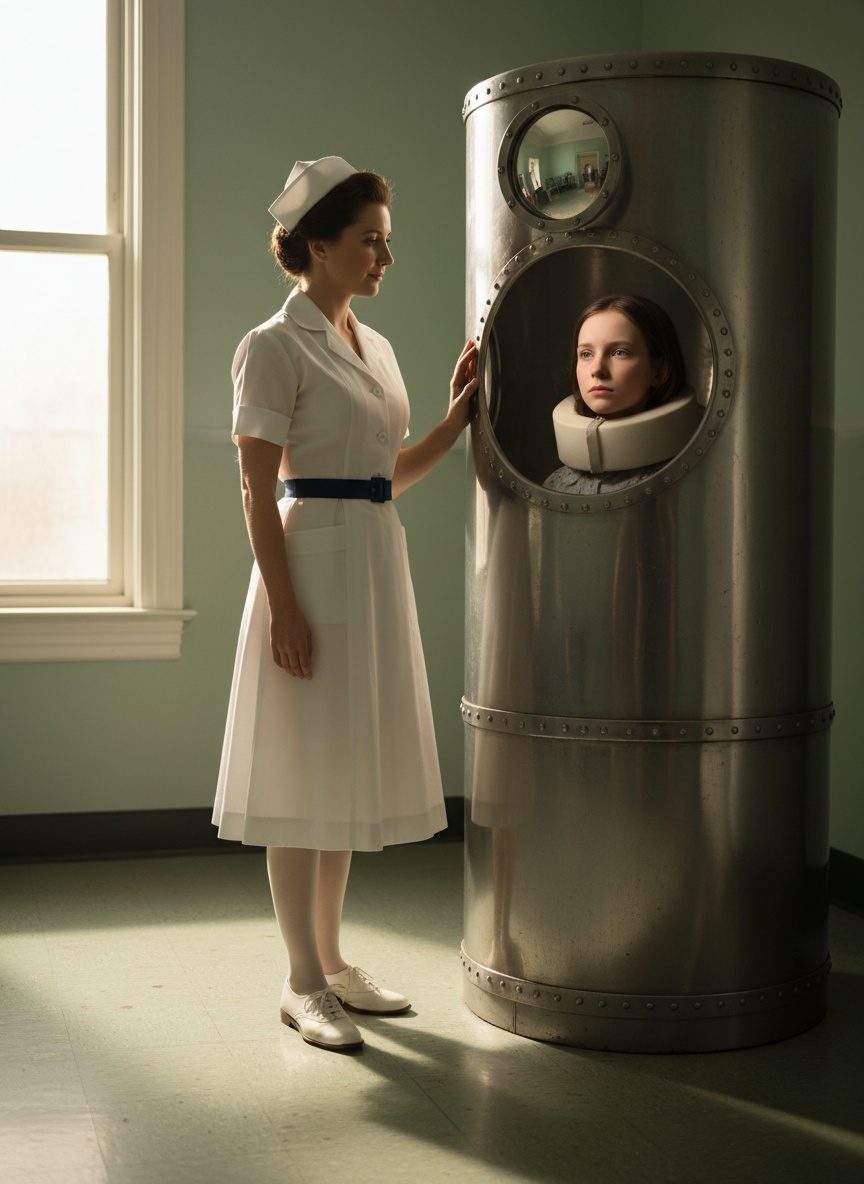
It's a surprisingly tranquil evening in rural Oklahoma, the heavy summer air filled with the scent of wildflowers growing defiantly in the cracks of dry earth. Cicadas hum persistently as the sun dips below the horizon, painting the sky with strokes of orange and pink. Inside a modest home, a rhythmic mechanical sound slices through the stillness: the steady whir of an iron lung, cradling its occupant since childhood. This would be the nightly soundtrack of Martha Lillard's life, a girl who defied medical prognoses and rewrote the narrative of a debilitating disease — all while breathing with the aid of this cumbersome contraption.
The Day Everything Changed
In September 1953, the Lillard family was typical of any in their Norman, Oklahoma neighborhood, living a life rich with the simple pleasures of the post-war era. That all changed when four-year-old Martha came down with a fever that would soon reveal itself as polio. At that time, the poliovirus was a specter casting long shadows across many American cities. Polio, known for ravaging the muscle functions of those it infected, struck fear into every parent's heart. For Martha, it meant being confined to an iron lung, a device critical for her survival as her respiratory muscles could no longer function independently.
Medical professionals were grim in their outlook; the words "no future" hung heavy in the air, dampening the spirits of a family that was told to prepare for the worst. Back then, the polio vaccine was still two years from becoming widely available, and each year, thousands of children would succumb to the disease. Yet in spite of it all, Martha's spirit and determination defied these odds wholeheartedly.
Living within Walls of Metal
Imagine, for a moment, what life chained to a machine — a coffin-like cylinder — must have been. Despite the imposing structure and metal confines, Martha’s life was anything but restrained. She continued her schooling directly from within her iron lung. Through correspondence courses and dedicated tutors, she carved a space for learning and discovery in a world that lay just beyond the polished surfaces of her metallic refuge.
When doctors expected her to relent to life’s limitations, Martha’s resolve propelled her beyond their predictions. Music and poetry became her domains of choice, media in which she could channel a world of imagination unrestricted by physical limitations. Whether through the resonant strings of a guitar or the composition of verse, Martha transformed restrictions into means of expression, crafting a life that reverberated far beyond her mechanical prison.
The Unlikely Independence
As years passed, the world of medicine advanced, with portable ventilators eventually replacing the clunky iron lung for many. But for Martha, nothing quite compared to the security it offered — a relic of technological history yet a vital necessity for survival. By the time she reached adulthood, Martha could breathe without the aid of the machine intermittently, a triumph that belied the warnings from her childhood doctors. Colder yet effective methods were modernized, but Martha, appreciative of the life her iron lung supported, continued to lay her trust in the faded metallic machine of her youth.
Despite the logistical challenges posed by such a dependence, Martha lived independently for years, strong-willed as ever. She arranged her household without constant caregivers, proving that disability was not synonymous with dependency. It was an independent spirit that spoke louder than any spoken tribute, evidenced by her continual participation in community life and the rich social tapestry she wove by keeping in touch with lifelong friends and nurturing new relationships.
An Echo of Innovation and Survival
By the early 21st century, as polio's rampage became a historical memory for many, Martha remained a living testimony to a past era. The very iron lung that sustained her also reminded the world of the relentless spirit and the myriad of lives touched by the disease before vaccines drastically reduced its prevalence. She became a storyteller of the infectious disease era, speaking through interviews and articles about the value of vaccines and the lifetime of determination they had gifted her.
Amidst the hum of her iron lung, Martha wove a story of survival that celebrated innovation, the miracles of medical science, and an unyielding human spirit. Her treasured playlist of life included resonant chords of music and poignant lines of poetry, each note and word lifting slightly the weight of her everyday struggles.
A Life Remembered
Martha Lillard passed away in 2024, marking the end of an extraordinary journey of survival and creativity. She was the last known American breathing nightly with the aid of an iron lung, a testament to human resilience that no doctor could have envisioned when she first lay encased in its confines as a child. Her narrative reminds us of the immense progress humanity has made against illnesses like polio, but more importantly, it showcases the power of inventiveness and the human will to thrive despite overwhelming odds.
Her story challenges us to reframe our perceptions of limitations, not as a barrier to life, but as a unique canvas on which life can be artfully painted. In looking back on Martha’s life, we are beckoned to imagine our own lives beyond borders and definitions, expanding always into spaces of possibility and enduring hope.