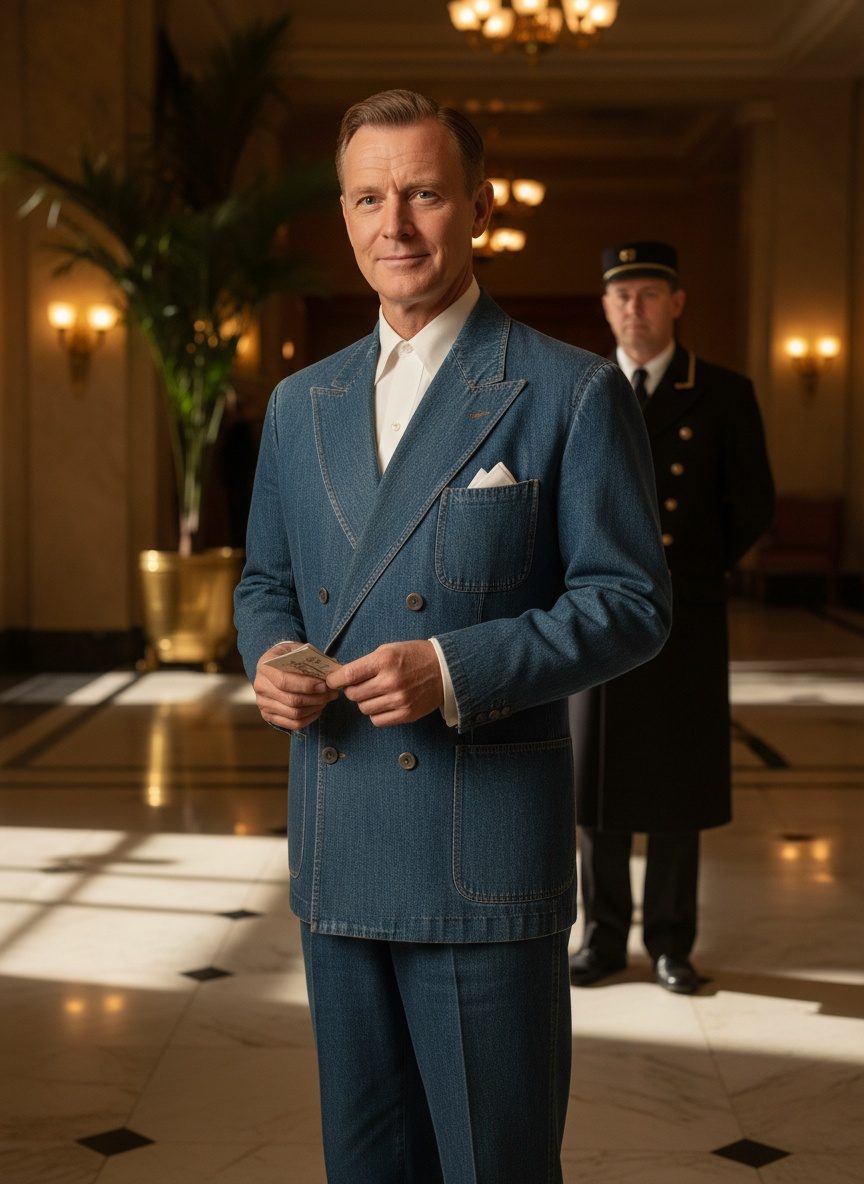
The cool evening air filled the lobby as the hotel's revolving door spun, carrying with it both an unmistakable voice and an unexpected commotion. There, standing amidst a cacophony of murmurs and startled glances, was Bing Crosby, his denim-clad figure causing ripples more than just sartorial. Yet, despite his melodic legend, it wasn't his crooning that captured the room's attention, but rather the faded fabric of his jacket.
The Man in Denim
There he was — Bing Crosby, one of America's most adored crooners, newly arrived at a Canadian hotel. Crosby cut a casual figure in his denim jacket and jeans, a vision of nonchalance stitched from the same fabric that had threaded its way through American hearts for generations. This was no ordinary denim; it was steeped in mid-century charm. But the hotel staff, protocol-bound, seemingly didn’t recognize the aura that accompanied the star. Denim, to them, was a fabric of the laboring man, unsuitable for elite settings such as theirs.
The soft gasps and hushed whispers grew louder as Crosby, visibly amused rather than offended, faced the ultimate snub — the doorway blocked, entry denied. The absurdity of the moment punctuated by the contradiction of a voice universally known, denied by eyes that saw only the blue-collar garb. A fleeting episode destined to become broadcast fodder, captured as a humorous headline, yet beneath it lay a momentary cultural clash between tradition and a changing America.
Levi's Response
The story quickly spread, reaching the ears of Levi Strauss & Co., whose creations had adorned Americans from ranches to rock legends. Observing an opportunity steeped in both irony and potential, Levi’s saw more than a rejected icon; they saw the chance to elevate denim's place in the pantheon of fashion. Using their trademark flair, they set about crafting a piece as audacious as the story itself.
What emerged from their San Francisco workshops was nothing short of revolutionary — a tuxedo jacket crafted entirely from denim. Its lapels were accented with an air that mingled sophistication with the rawness of American frontier spirit, perfectly tailored to carry the wit of Bing's unwitting faux pas. But Levi’s vision extended beyond fabric. Accompanying this unique garment was a note intended for hotel managers, a playful reminder that fashion and fame often share the same thread.
The Birth of the "Canadian Tuxedo"
In Levi's workshop, under the dim light of sewing machines invigorated by innovation, the "Canadian Tuxedo" was born. While the moniker would arise humorously, perhaps even jestingly, it also served as a tribute to the paradox of formality mixed with the casual charm of denim. Its roots, however, went beyond satire; it was a symbol of how cultural icons could redefine the landscapes they touched.
With denim woven into the fabric of Americana, it was only fitting that this new garment mirrored the duality of a country in a state of transformation. The "Canadian Tuxedo" epitomized versatility, emerging as a garment capable of blurring boundaries at a time when post-war America was redrawing its own social lines. Suitable for strutting on stage or dining courtside — that was its genius, tinged with the knowing smirk of Crosby himself.
Legacy of a Legend in Blue
As tales of Crosby’s sartorial escapade circulated, the denim tuxedo became more than a garment or a witty reprieve; it became a conversation born of cultural negotiation. What began as a fashionable rebuttal from Levi Strauss grew into a garment that questioned, even playfully, the lines dividing social classes and wardrobes. It was an embodiment of how the mainstream could channel the working man’s ethos, repackaged in timeless Americana.
In time, the "Canadian Tuxedo" would become ingrained in popular culture, a phrase ensconced in layers of humor and historical reverberation far beyond its origin. It speaks to the power of individual style, transcending boundaries and challenging norms with every wear. But above all, it serves as a reminder that history is often spun on the loom of unexpected moments. The rebuff of Bing Crosby, seemingly inconsequential at the time, illustrated how denim’s informal gallantry could unravel old perceptions, sewing instead a tale of pop culture audacity.