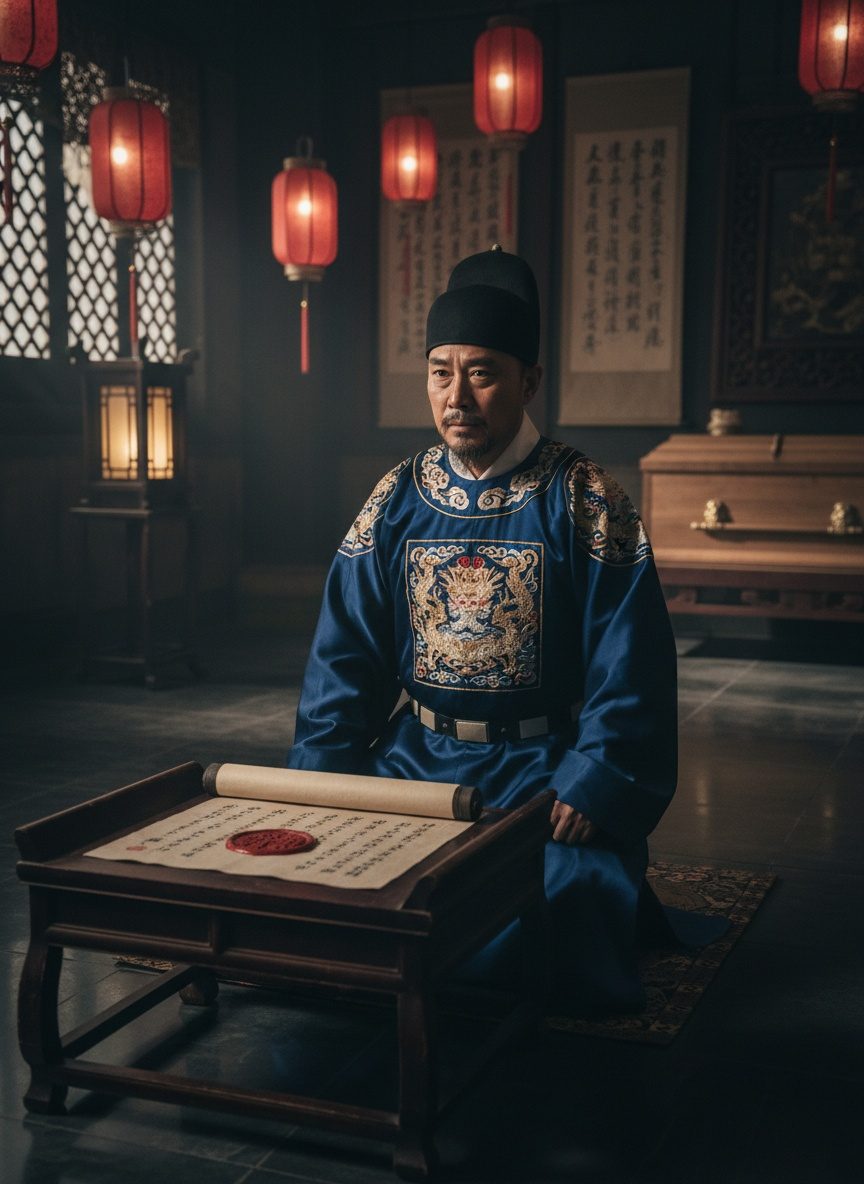
The stone courtyard was veiled in the soft shroud of dawn, its cobblestones glistening with morning dew. The air was crisp, carrying the faint scent of plum blossoms from nearby gardens, while the first rays of sunlight crept slowly over the eaves of the Forbidden City. In the heart of this imperial palace, where power and opulence were woven into every corner, a small wooden box lay open. Inside it was a letter, a humble scroll whose words had the potential to unravel the fabric of a kingdom. This was no ordinary dispatch to the Emperor, but a bold missive from a man whose courage defied the impossible.
The Cloak of Silence
In the Ming Dynasty's splendid capital, Beijing, the imperial court thrived on ceremony and constraint. It was an era where ministers outdid each other in their flattery of the Emperor, draping him in verbal silks as rich as those on his robes. The court's gilded halls resounded with echoes of praise, a relentless cacophony where truth was often the silent absentee. Who would dare to disturb this delicate dance where a single misstep could lead to political oblivion—or worse?
Against this backdrop, Hai Rui, a minor official with an unyielding sense of integrity, stood out like a stone against the current. His was a position within the bureaucracy, admittedly not of great influence, yet his reputation for incorruptibility and forthrightness was firmly established. His peers whispered tales of his moral rigidity, a quality that seemed to border on folly in a world where flexibility assured survival.
The Emperor, young and increasingly detached from the realities of his empire, had become enveloped in the insularity his role provided. Flattery was not just tolerated but expected, forming a cocoon around the sovereign that obscured the struggles of those he ruled. Hai Rui, however, saw his duty with unclouded eyes and an allegiance not to courtly games but to an ideal that transcended personal safety.
An Act of Unspeakable Daring
In 1565, Hai Rui prepared not just a letter but also for what he believed to be his impending end. Fully aware that his words would be seen as treasonous, he went as far as purchasing his coffin, making arrangements for his funeral while still very much alive. It was an act of anticipated martyrdom; the bureaucratic equivalent of stepping onto the executioner’s scaffold with head held high.
The letter, meticulously penned, did not merely question the Emperor's actions but openly criticized them. Hai Rui accused the sovereign of being vain and neglectful, charging him with failures that echoed throughout the realm. The document was as much a mirror as it was a death sentence, reflecting stark truths back at their source.
Hai Rui's convictions were not fueled by self-preservation but by a sovereign obligation to truth. He was perhaps the only official who dared to speak the unspeakable, challenging the complacency that characterized the court's approach to governance. In that one bold stroke, he proved that integrity could shine brighter than the Emperor's gilded thrones, challenging the very ethos of an era rooted in soft lies and subtle deceit.
The Moment of Reckoning
The days that followed the letter's submission were charged with an apprehensive stillness, like a lull before a brewing storm. Beijing's bustling streets continued their daily rhythm, seemingly unaware of the tempest that threatened the quiet corridors of imperial power. Meanwhile, Hai Rui awaited the Emperor's response—or command for his arrest—with a calm resilience born of a clear conscience.
The Emperor’s reaction was more complex than simple retribution. The audacity of Hai Rui's words was alarming, sure, but there was an undeniable bravery in them that even the most jaded courtiers could not ignore. Moreover, the contents of the letter raised genuine concerns that resonated with the empire’s growing discontent. The Emperor ultimately chose not to impose the harshest penalty. Hai Rui was imprisoned, but his life was spared—a testament to the weight of his convictions and perhaps the reluctant recognition of truth's power even in its harshest form.
Many in the hallways of power were left to ponder the implications of such an act of defiance. Here was a man willing to risk everything, set against the monumental backdrop of an empire too often shielded from the woes of the very people it claimed to serve.
A Legacy of Principle
Hai Rui's story lives beyond its immediate aftermath, woven into the fabric of cultural memory and standing as a point of reflection for the pursuit of honest governance. His unexpected survival allowed him to remain a figure of notable influence, his life a narrative of unwavering loyalty to the truth, and a persistent reminder that justice sometimes requires a voice willing to break the stillness of complicity.
The lessons drawn from his actions ripple through history, a testament to how one individual’s courage can inflect the arc of a nation's story in profound ways. The echo of Hai Rui’s boldness serves as both a caution and a commendation—demonstrating that integrity may not always be rewarded, yet it possesses a power that transcends immediate consequence.
In a world where words too often become their own currency, Hai Rui's decision to prioritize truth over personal safety resonates with the timeless appeal for genuine leadership. His story continues to provoke thought, not only about the responsibilities of those in power but also about the courage required to hold them accountable, ensuring that even the loftiest of institutions remember their true purpose.