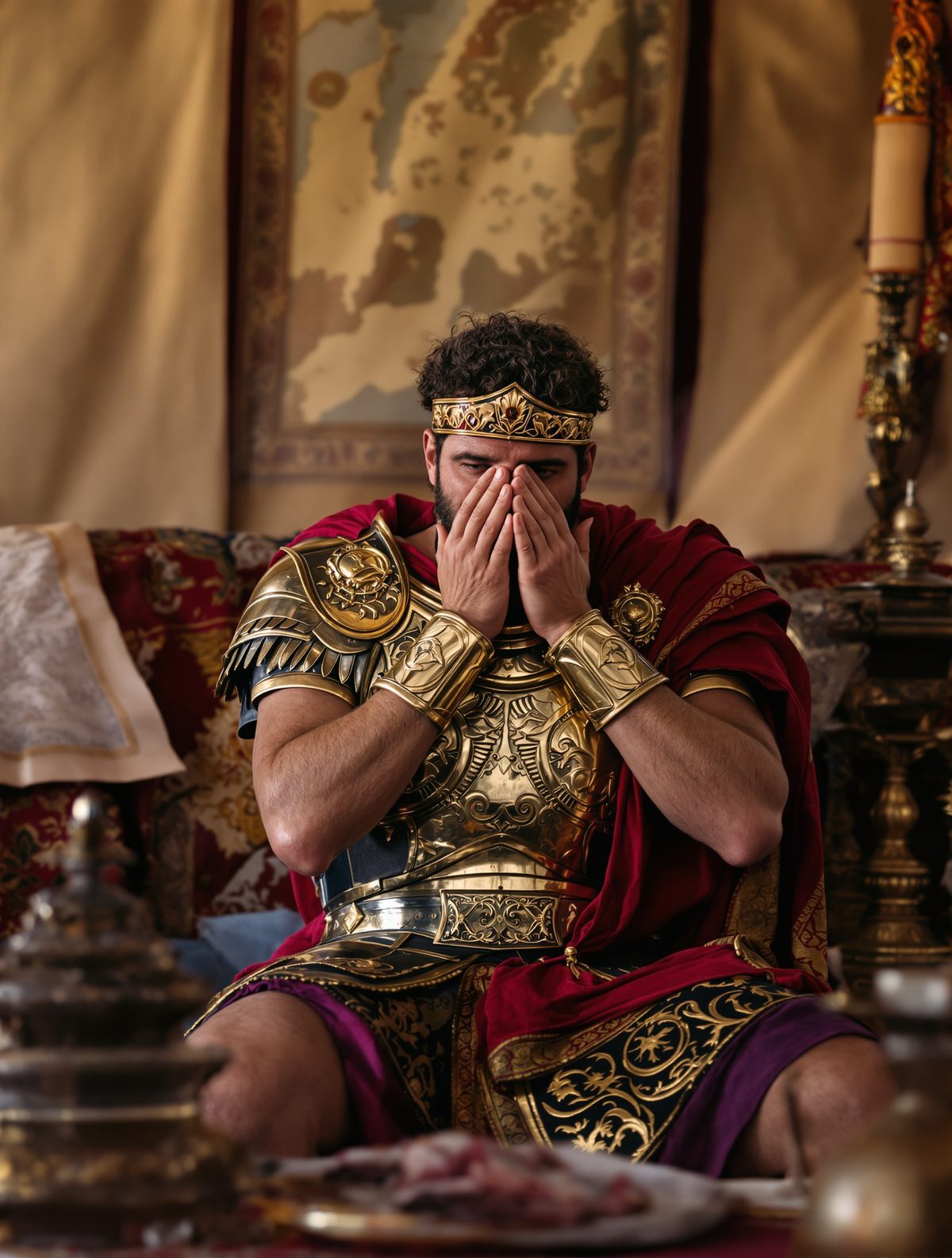
Picture this: A brilliant mathematician stands on the deck of a ship sailing across the azure waters of the Mediterranean, clutching a piece of papyrus covered in geometric proofs. His fellow passengers—men he considered brothers—circle around him with murder in their eyes. His crime? Proving that mathematics itself contained contradictions that shattered their most sacred beliefs about the universe. Within minutes, Hippasus of Metapontum would become history's first martyr of mathematical truth, his body swallowed by the waves for the sin of being mathematically correct.
This is the story of how a single mathematical discovery—that the square root of 2 cannot be expressed as a simple fraction—became so dangerous that it cost a man his life and nearly destroyed one of ancient Greece's most influential philosophical schools.
The Brotherhood of Numbers
Around 530 BC, in the sun-baked hills of southern Italy, Pythagoras of Samos founded what was perhaps history's strangest combination of mathematics school and religious cult. The Pythagoreans, as they became known, weren't just mathematicians—they were mystics who believed that numbers held the key to understanding the divine order of the universe.
To the Pythagoreans, everything could be reduced to whole numbers and their ratios. Music? The harmony of mathematical proportions. The movement of planets? Numerical relationships dancing across the cosmos. The very fabric of reality? Woven from the threads of rational numbers—those that could be expressed as simple fractions like 3/4 or 22/7.
Their motto, "All is Number," wasn't just mathematical philosophy—it was religious doctrine. They lived by strict rules: no eating beans (they believed souls could transmigrate into them), no picking up dropped objects, and absolute secrecy about their mathematical discoveries. Breaking these rules, especially the secrecy oath, was punishable by death.
Into this world stepped Hippasus, a brilliant student from the Greek colony of Metapontum. Gifted with an analytical mind that could slice through mathematical problems like a bronze blade through silk, he quickly became one of the brotherhood's most promising members. But his very brilliance would prove to be his doom.
The Discovery That Shook the World
Sometime around 470 BC, Hippasus was working with one of geometry's most fundamental shapes: the square. Specifically, he was examining a square with sides of length 1. According to the Pythagorean theorem (ironically, the very theorem that made his teacher famous), the diagonal of this square should have a length equal to the square root of 2.
Simple enough, right? But when Hippasus tried to express this length as a fraction—as Pythagorean doctrine demanded all numbers must be—he ran into an impossible wall.
Using a proof technique that was elegant in its simplicity, Hippasus demonstrated that if you assumed √2 could be written as a fraction a/b (where a and b have no common factors), you inevitably reach a logical contradiction. The proof forces you to conclude that both a and b must be even numbers—but this contradicts the initial assumption that they share no common factors.
What Hippasus had stumbled upon was mathematical proof that irrational numbers exist—numbers that cannot be expressed as simple fractions, no matter how hard you try. The square root of 2 was just the beginning. Pi, the golden ratio, and countless other fundamental mathematical constants would later be proven irrational as well.
For a modern mathematician, this would be cause for celebration—a groundbreaking discovery that opened new realms of mathematical understanding. For the Pythagoreans, it was nothing short of heresy.
When Truth Becomes Treason
The reaction within the Pythagorean brotherhood was swift and severe. If Hippasus was correct, their entire worldview crumbled. How could "All is Number" be true if some numbers couldn't even be properly expressed as numbers in their system? How could the universe be rationally ordered if irrationality lurked at the heart of something as basic as a square's diagonal?
The Pythagoreans had two choices: abandon their core beliefs or silence the messenger. They chose the latter.
According to several ancient sources, including the mathematician Proclus and the philosopher Iamblichus, the brotherhood's response was as calculated as it was cruel. They branded Hippasus's discovery as "the unspeakable" or "the unutterable"—literally calling irrational numbers alogon, meaning "unreasonable" or "against logic."
But labeling the discovery wasn't enough. Hippasus had committed the ultimate sin: he had revealed sacred mathematical knowledge to outsiders, breaking the brotherhood's oath of secrecy. Whether he did this intentionally to share his groundbreaking discovery with the wider world, or whether word simply leaked out, remains a mystery. What isn't disputed is the punishment.
Death by Mathematics
The murder took place during a sea voyage, though ancient sources differ on the exact circumstances. Some accounts suggest it was planned from the start—a brotherhood expedition that was really a floating execution chamber. Others imply it was more spontaneous, with tensions finally boiling over during what should have been a routine journey.
What we do know is that Hippasus found himself surrounded by his fellow Pythagoreans somewhere in the waters between Italy and Greece. These men, who had once shared meals and mathematical insights with him, now saw him as a traitor to everything they held sacred.
The Greek historian Iamblichus recorded that they threw him overboard as punishment for "revealing the secret of the irrational." No dramatic speeches, no formal trial—just the cold mathematics of cause and effect. Hippasus had proven that some truths couldn't be contained within their system of beliefs, so they removed him from the equation entirely.
As the waters of the Mediterranean closed over his head, Hippasus became perhaps history's first martyr to mathematical truth—a man who died not for gold, power, or love, but for discovering an uncomfortable fact about the nature of numbers.
The Irony of Mathematical Progress
The Pythagoreans' attempt to suppress Hippasus's discovery ultimately backfired spectacularly. His proof of irrational numbers couldn't be killed along with its discoverer. The mathematical truth he uncovered was too powerful, too fundamental to remain hidden.
Within a few generations, Greek mathematicians had not only accepted the existence of irrational numbers but had begun exploring their properties in detail. Euclid included a refined version of Hippasus's proof in his famous Elements, ensuring that the discovery would survive for millennia.
More ironically still, irrational numbers didn't destroy mathematics—they revolutionized it. They led to the development of more sophisticated number systems, opened up new areas of geometric study, and ultimately helped lay the groundwork for calculus, which would transform science and engineering forever.
The Pythagorean brotherhood itself never recovered from the scandal. Their reputation for secrecy and extremism made them increasingly irrelevant as Greek mathematics evolved beyond their narrow doctrines. The very discovery they killed to suppress ended up burying their entire school of thought.
The Eternal Question of Dangerous Truths
Hippasus's story resonates across the centuries because it asks a question that societies still grapple with today: What happens when objective truth conflicts with deeply held beliefs? The mathematician from Metapontum learned the hard way that being right isn't always enough—sometimes it can be deadly.
Throughout history, we've seen echoes of Hippasus's fate: Galileo forced to recant his support for heliocentrism, Darwin's theory of evolution sparking violent opposition, climate scientists receiving death threats for publishing inconvenient data. The details change, but the pattern remains depressingly consistent—truth-tellers often pay a heavy price for their discoveries.
Perhaps most remarkably, Hippasus died for a mathematical truth so abstract that it might seem irrelevant to daily life. After all, who really needs to know that √2 is irrational? But this misses the deeper point: his discovery represented the triumph of logical reasoning over dogmatic belief, of evidence over faith, of intellectual honesty over comfortable lies.
Today, as we navigate an age where objective facts are increasingly treated as matters of opinion, Hippasus's story serves as both warning and inspiration. It reminds us that the pursuit of truth has always been dangerous, that progress often comes at a terrible cost, and that sometimes the most important discoveries are the ones that make us uncomfortable.
Somewhere beneath the waves of the Mediterranean, the bones of a brilliant mathematician rest in their watery grave—a testament to humanity's eternal struggle between the comfort of certainty and the courage to question everything we think we know.