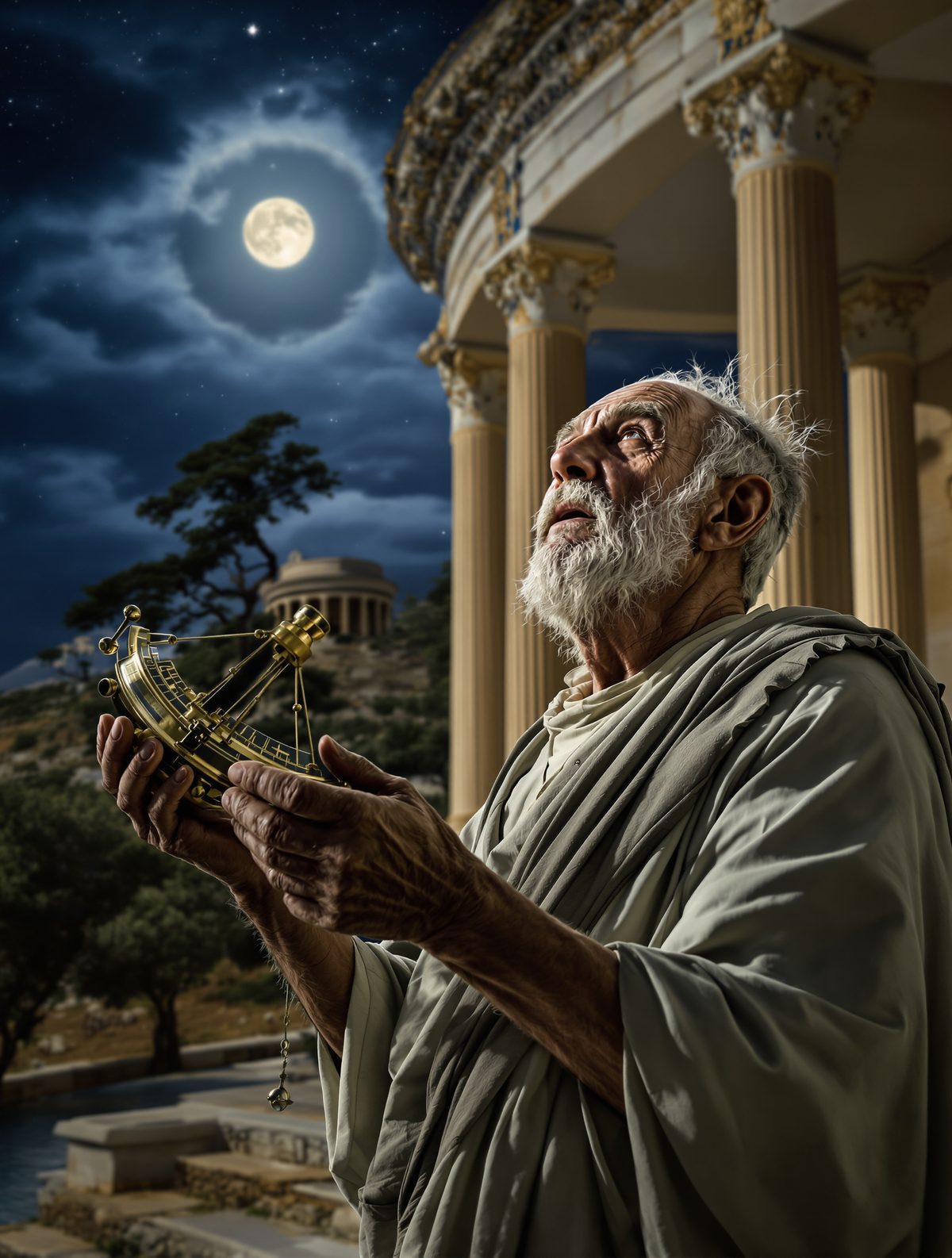
Picture this: you're standing on the island of Rhodes in 134 BC, gazing up at a night sky so clear and unpolluted that the Milky Way casts shadows. You're Hipparchus of Nicaea, one of the greatest minds of your generation, and you know these stars like old friends. You've spent countless nights studying their eternal, unchanging patterns—the very foundation of Greek understanding of the cosmos.
Then suddenly, impossibly, there it is. A brilliant new star blazing in the constellation Scorpius where no star has ever shone before. Your blood runs cold. According to everything you've been taught, everything the great Aristotle proclaimed, the heavens are perfect and immutable. Stars don't just... appear.
But there it was, burning bright as Venus, mocking two centuries of Greek astronomical certainty. In that moment of cosmic shock, Hipparchus made a decision that would change astronomy forever: if the sky could surprise him once, he needed to map every single star to catch it happening again.
The Revolutionary Who Nearly Lost His Name to History
Here's something they definitely didn't teach you in school: we almost lost Hipparchus entirely. Despite being arguably the greatest astronomer of the ancient world, not a single one of his original works survived intact. Everything we know about him comes from fragments quoted by later scholars, primarily the Roman writer Pliny and the astronomer Ptolemy. It's like trying to understand Einstein by reading only other people's book reviews of his work.
What we do know paints a picture of a man obsessed with precision in an age that often settled for "close enough." Working from his observatory on Rhodes around 150-120 BC, Hipparchus didn't just observe the stars—he measured them. Using instruments of his own design, including an improved astrolabe and a sophisticated armillary sphere, he achieved a level of accuracy that wouldn't be surpassed for over a thousand years.
But that mysterious new star in 134 BC—what we now know was likely a nova, a stellar explosion visible from Earth—became his obsession. The Greeks called such unexpected celestial visitors stella nova, meaning "new star." For Hipparchus, it represented either a fundamental flaw in Greek cosmology or proof that the heavens held secrets no one had bothered to systematically investigate.
The Great Star Census Begins
Imagine the audacity of what Hipparchus attempted next. With nothing but his eyes, basic instruments, and an unprecedented dedication to detail, he set out to catalog the position and brightness of every visible star in the sky. We're talking about roughly 1,000 stars visible to the naked eye from the Mediterranean—each one requiring multiple observations to establish its precise location.
His method was revolutionary. Rather than simply noting that stars existed in certain constellations, Hipparchus created a coordinate system that could pinpoint any star's exact position. He divided stars into six categories of brightness—a system we still use today, though we now call them "magnitudes." The brightest stars were "first magnitude," while the faintest visible stars were "sixth magnitude."
But here's where it gets really impressive: Hipparchus didn't just create a star map, he created the first scientific star map. Previous astronomers had made rough sketches or poetic descriptions. Hipparchus made measurements accurate to within a fraction of a degree. He noted not just where stars were, but their colors, their relative brightness, and even which ones seemed to twinkle more than others.
Working night after night, season after season, Hipparchus gradually assembled what would become known as the first star catalog in human history. But as he worked, he stumbled upon something even more shocking than that mysterious new star.
The Discovery That Rocked the Ancient World
While comparing his measurements to older Babylonian records dating back 150 years, Hipparchus noticed something impossible. The stars weren't quite where they should be. Not by much—just a degree or two—but for someone as precise as Hipparchus, it might as well have been a mile.
After months of careful verification, checking and rechecking his calculations, Hipparchus reached a conclusion that must have seemed almost heretical: the entire sphere of stars was slowly rotating around Earth. The "fixed" stars weren't fixed at all—they were participating in a grand, stately dance that took thousands of years to complete.
What Hipparchus had discovered was precession—the slow wobble of Earth's rotational axis that makes the positions of stars shift gradually over time. It's like a spinning top that wobbles as it spins, causing the direction of its axis to trace out a slow circle. For Earth, this cosmic wobble takes about 26,000 years to complete one full cycle.
Think about the intellectual courage this required. Hipparchus was essentially arguing that observations stretching back centuries had all been slightly "wrong"—not because ancient astronomers were incompetent, but because the universe itself was more dynamic than anyone had imagined. He calculated that this precession occurred at a rate of about one degree every century, a figure remarkably close to our modern measurement of one degree every 72 years.
The Man Who Gave Us Modern Star Maps
Hipparchus's star catalog became the foundation for virtually every astronomical map that followed. When Ptolemy compiled his famous Almagest nearly 300 years later—the definitive astronomical text that would dominate European thinking for over a millennium—he relied heavily on Hipparchus's measurements.
But the catalog was more than just a list of star positions. Hipparchus pioneered the use of ecliptic coordinates—a system based on the Sun's apparent path through the sky—that allowed any future astronomer to locate celestial objects with unprecedented precision. He essentially created the first GPS system for the night sky.
His magnitude system for measuring star brightness was so intuitive and practical that modern astronomy still uses it, albeit with some refinements. When you hear astronomers today talk about a "magnitude 3 star" or note that Venus reaches "magnitude -4" at its brightest, you're hearing the direct descendants of Hipparchus's classification system from over 2,000 years ago.
Perhaps most remarkably, Hipparchus understood that his catalog was just the beginning. He explicitly designed it to enable future astronomers to detect changes in the heavens—more new stars, changes in brightness, or shifts in position. He had essentially invented the concept of systematic astronomical monitoring.
The Instruments of Precision
How did one man achieve such extraordinary precision with ancient technology? Hipparchus was not only a brilliant observer but also an innovative instrument maker. He perfected the astrolabe, creating versions that could measure stellar positions to within a fraction of a degree. His armillary sphere—a complex arrangement of rings representing celestial coordinates—became the standard astronomical instrument for centuries.
But his most ingenious innovation might have been his approach to error correction. Understanding that single observations could be flawed, Hipparchus made multiple measurements of each star from different nights and seasons, then calculated averages. This statistical approach to astronomy was centuries ahead of its time.
He also developed new methods for measuring the brightness of stars, using the Moon as a reference point and comparing how stars appeared at different phases of moonlight. His meticulous notes included observations about which stars seemed to change in brightness and which remained constant—laying groundwork for the eventual discovery of variable stars.
A Legacy Written in the Stars
That mysterious nova that appeared in Scorpius in 134 BC was visible for only a few months before fading back into invisibility. But its brief appearance triggered a revolution in how humans understand and map the cosmos. Hipparchus's response to one unexpected star was to catalog them all, creating humanity's first systematic attempt to document the universe.
Today, as the Hubble Space Telescope peers billions of light-years into space and discovers new stars being born in distant galaxies, it's following a tradition that began with one Greek astronomer's shock at seeing something new in his familiar sky. Every modern star catalog, from the basic charts used by amateur astronomers to the massive databases that guide space missions, traces its lineage back to Hipparchus's revolutionary decision to map the heavens with mathematical precision.
The next time you look up at the night sky, remember: someone 2,000 years ago looked at these same stars and decided to count them all, measure them all, and map them all because he refused to let the universe surprise him twice. In doing so, Hipparchus transformed astronomy from ancient mythology into modern science, one star at a time.