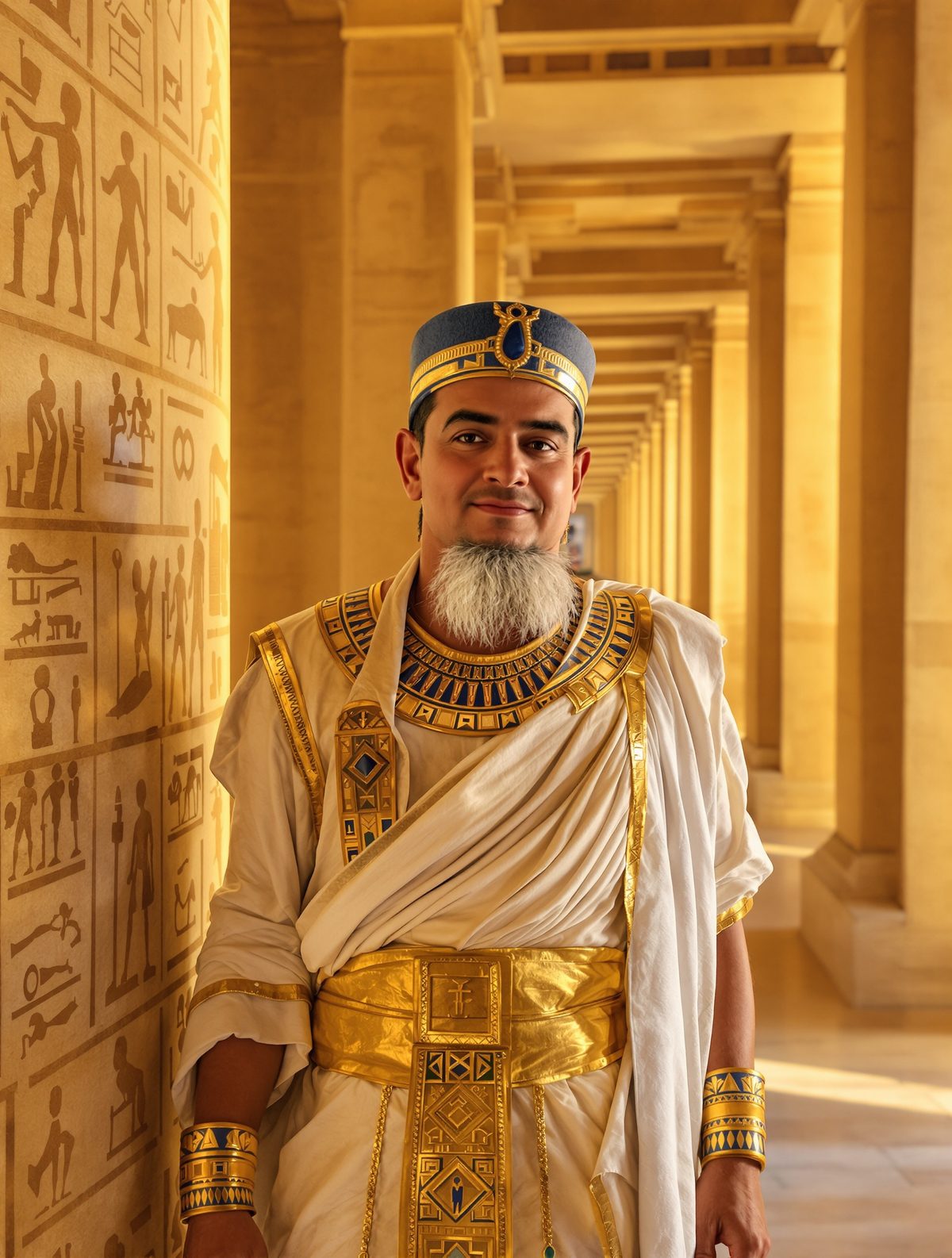
The golden mask gleamed in the flickering torchlight as priests chanted ancient hymns over the wrapped body of the boy king. In the shadows of the burial chamber, a weathered man in his sixties watched with the perfect expression of grief and devotion. Ay, the royal advisor who had served Tutankhamun's family for decades, appeared to be the very picture of loyalty as he oversaw every detail of the elaborate funeral preparations. But behind those sorrowful eyes, the wheels of the most audacious power grab in Egyptian history were already turning.
What happened next would make Machiavelli look like an amateur. Within weeks of placing his young pharaoh in the tomb, Ay would wear the double crown of Egypt himself—after forcing the dead king's teenage widow into a marriage that would legitimize one of antiquity's most shocking betrayals.
The Perfect Servant's Rise to Power
Ay wasn't just any court official—he was the ultimate royal insider. For over thirty years, he had served the most powerful family in Egypt, rising from military commander to become the right hand of the "heretic" pharaoh Akhenaten. When Akhenaten's revolutionary religious experiment collapsed and the capital moved back to Thebes, Ay smoothly transitioned his loyalty to the new regime. Some historians believe he may have even been Queen Nefertiti's father, making him royal family by blood as well as by service.
By the time nine-year-old Tutankhamun ascended the throne around 1332 BC, Ay had positioned himself as the power behind the throne. The boy king's official titles included "Beloved of Ay," an unprecedented honor that revealed just how dependent the young pharaoh was on his elderly advisor. For nearly a decade, Ay essentially ruled Egypt while Tutankhamun played the ceremonial role of divine king.
But divine kings weren't supposed to die at eighteen. When Tutankhamun's mummy was examined in 2005 using CT scans, researchers found evidence of a severe leg fracture that had become infected—possibly the cause of his sudden death in 1323 BC. Whatever killed the boy king, it left Egypt in crisis and Ay holding all the cards.
The 70-Day Window of Opportunity
In ancient Egypt, the mummification process took exactly seventy days—and those seventy days gave Ay the perfect cover for his scheme. While priests removed Tutankhamun's organs and packed his body with natron salt to preserve it, Ay moved to eliminate his rivals with surgical precision.
The most obvious successor should have been Horemheb, the powerful general who controlled Egypt's military. But Horemheb was conveniently campaigning in Nubia when Tutankhamun died, hundreds of miles from the capital. Some historians suspect Ay deliberately kept the general occupied with military duties while he consolidated power at home.
Then there was the international dimension. In one of history's most desperate political gambits, Tutankhamun's widow Ankhesenamun secretly wrote to Egypt's greatest enemy—the Hittite king Suppiluliuma I—begging him to send one of his sons to marry her and become pharaoh. The letter, preserved in Hittite archives, reveals her desperation: "My husband has died and I have no son. Send me one of your sons and he shall be my husband and king over Egypt."
It was an unprecedented request that would have made a foreign prince ruler of the richest kingdom in the world. Suppiluliuma was so shocked he sent ambassadors to verify the offer was genuine. But someone intercepted and murdered the Hittite prince on his way to Egypt. That someone was almost certainly Ay.
The Forced Marriage Gambit
With foreign intervention eliminated and his military rival absent, Ay played his masterstroke. He forced the nineteen-year-old widow Ankhesenamun into marriage, despite being old enough to be her grandfather. In Egyptian law, marrying the previous pharaoh's widow was one of the strongest claims to legitimacy—and Ay knew it.
The evidence for this shocking marriage comes from a small blue ring discovered by archaeologists, inscribed with both their names enclosed in royal cartouches. But this wasn't a love match—it was a political rape disguised as royal protocol. Ankhesenamun had already lost her first husband (who was also her half-brother, following royal custom), and now she was being used as a pawn by the man who had likely orchestrated the murder of her potential Hittite savior.
What makes this even more chilling is the timing. Ay probably approached Ankhesenamun with his "proposal" while her husband's body was still being processed by the embalmers. The grieving teenager had little choice but to accept—refuse, and she might have joined Tutankhamun in death far sooner than nature intended.
The Ultimate Funeral Director's Performance
Even as he plotted in the shadows, Ay maintained his facade of perfect loyalty. He spared no expense on Tutankhamun's funeral, commissioning the most elaborate burial treasure in Egyptian history. The famous golden mask alone weighed over twenty pounds and was decorated with precious stones from across the empire. The burial chamber was packed with everything a pharaoh might need in the afterlife: golden chariots, jewelry, weapons, and even underwear.
But Ay's most audacious move was having himself painted on the tomb walls performing the "Opening of the Mouth" ceremony—a ritual that was supposed to be carried out by the dead king's son and heir. By depicting himself in this role, Ay was literally writing himself into the succession story. Future visitors would see him as Tutankhamun's rightful successor, blessed by the gods to continue the royal line.
The irony is staggering: Ay used Tutankhamun's own tomb as propaganda for his own legitimacy, turning the boy king's eternal resting place into an advertisement for his usurper's divine right to rule.
The Short Reign of a Master Manipulator
Ay's elaborate scheme worked perfectly—for exactly four years. He ruled from 1323 to 1319 BC, long enough to enjoy the fruits of his betrayal but not long enough to secure a lasting dynasty. At around seventy years old when he took the throne, time was not on his side.
His reign was marked by attempts to erase the religious chaos of the Amarna period and return Egypt to traditional values—perhaps his way of positioning himself as a restorer rather than a usurper. He completed several building projects and maintained Egypt's international prestige, proving he was more than capable of actually ruling the kingdom he had stolen.
But Ay's greatest failure was the same weakness that had made Tutankhamun vulnerable: he produced no male heir. When the old schemer finally died around 1319 BC, General Horemheb returned from his military campaigns to claim the throne. In a final twist of irony, Horemheb systematically destroyed Ay's monuments and removed his name from the official king lists—giving the master manipulator a taste of his own medicine.
Legacy of the Ultimate Inside Job
Ay's story reads like a ancient Egyptian House of Cards, complete with political murders, forced marriages, and masterful media manipulation. He understood that in the ancient world—just like today—controlling the narrative was just as important as controlling the army. By positioning himself as the grieving loyal servant while simultaneously orchestrating a coup, he pulled off one of history's most successful inside jobs.
What makes Ay's betrayal so chilling isn't just its success, but its familiarity. The trusted advisor who slowly accumulates power, the convenient absence of rivals during a crisis, the use of legal technicalities to legitimize illegal actions—these are tactics that would be immediately recognizable to any modern political observer. Ay's Egypt was a world where loyalty was performed, marriages were weapons, and even funerals could be turned into propaganda.
Perhaps most remarkably, Ay's scheme worked so well that for over 3,000 years, historians accepted him as Tutankhamun's legitimate successor. Only modern archaeological techniques and the discovery of Hittite records revealed the full extent of his manipulation. It's a sobering reminder that the victors don't just write history—sometimes they write it so convincingly that the truth stays buried longer than the pharaohs themselves.