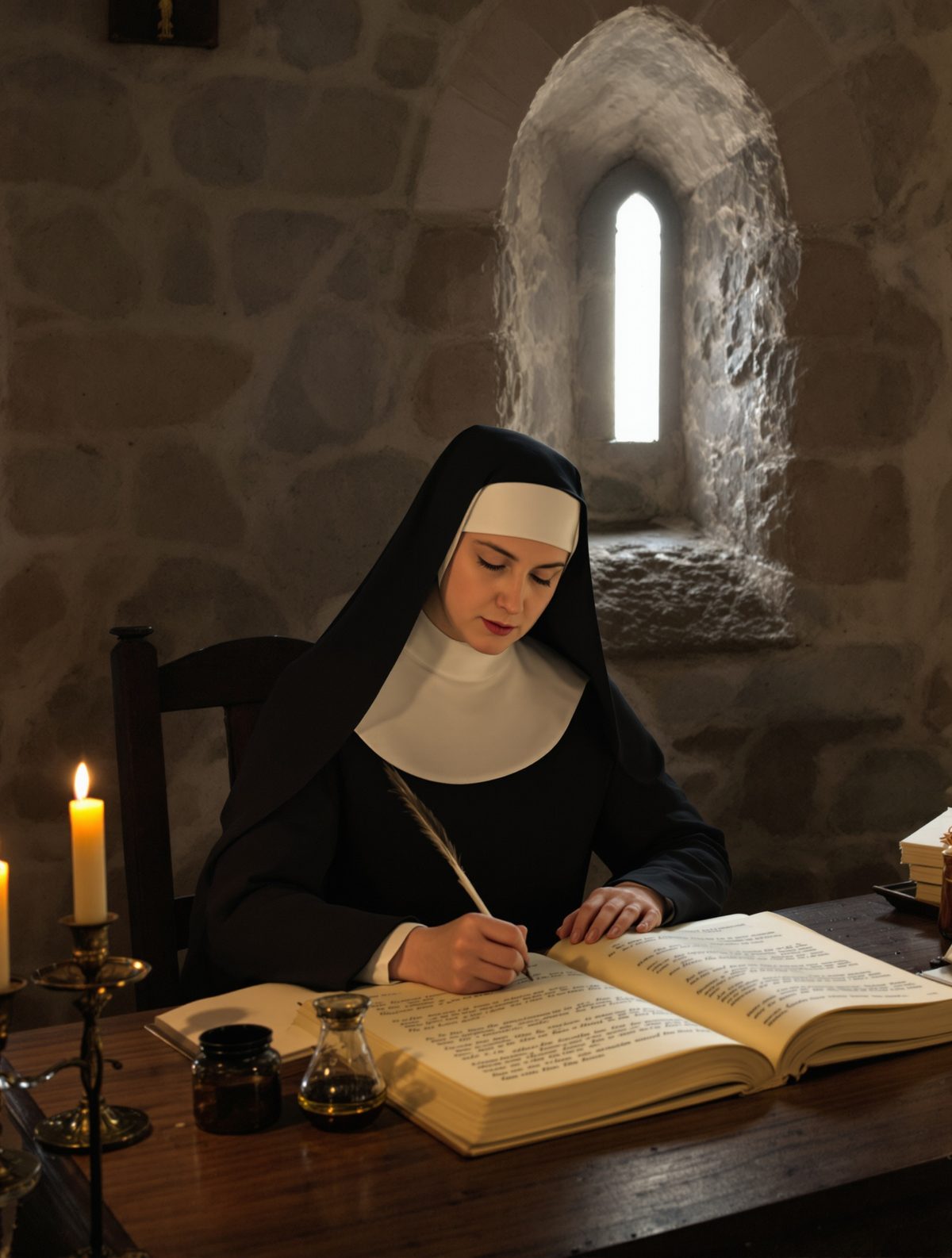
In the heart of the lush Rhine Valley, where the echoes of choral chants resonated through the stone walls of a Benedictine monastery, a single nun sat quietly, her eyes closed, her mind alive with visions. For years, Hildegard of Bingen had been a passive observer to these spectral images, unsure if they were divine whispers or mere figments of her imagination. Yet, at the age of forty-two, she received an omnipotent call - this time, however, it was not to simply observe, but to act. Thus began the journey of a visionary who would pen the enigmatic works that captured the minds of some of the most powerful figures of medieval Europe.
The Silent Years: Hildegard’s Early Life
Born in 1098 in Bermersheim, a small village in the Holy Roman Empire, Hildegard was the tenth child of noble parents. As was custom, she was promised to the Church as a tithe, and at the age of eight, she was entrusted to Jutta von Sponheim, a devout anchoress living at the Disibodenberg monastery. This enclosed environment shielded Hildegard from the maladies of her era, but it couldn’t obscure her natural curiosity and inherent spirituality.
Hildegard experienced her first visions as a young girl. These weren't just fleeting moments of light or shadow; they were vivid, all-encompassing sensory experiences that she described as occurring in the “inward eye of the soul.” Despite their intensity, Hildegard kept these visions a secret for over two decades. The fear of being misunderstood - or worse, accused of heresy - was a constant shadow. In an age where divine encounters were ascribed to saints, a woman claiming such experiences risked being branded as deceitful or mad.
The Celestial Voice: Command to Chronicle
It was during her middle years, amidst the serene yet regimented life of the convent, that Hildegard received a more demanding vision. This divine command was unambiguous: she was to transcribe everything she observed. But the path to obedience wasn't immediate. Overwhelmed by the task and concerned about her capabilities as a writer, it took a severe illness to push Hildegard to action. Interpreting her ailment as divine displeasure for her hesitation, she commenced writing “Scivias” (short for Scito vias Domini or “Know the Ways of the Lord”).
The completion of Scivias was no small feat. Spanning three volumes, it contained twenty-six visionary revelations alongside elaborate theological explanations. With the full manuscript prepared, Hildegard sought validation. She sent it to the archbishop of Mainz, who then forwarded it to Pope Eugenius III. In a surprising twist of fate, the Pope not only acknowledged her work but also encouraged her to continue writing vivid accounts of her divine revelations.
A Female Voice Resounding in a Male World
Hildegard's visions and writings found receptive audiences, not only in religious circles but also within secular powerhouses of her time. The 12th century was predominantly a man’s world, especially when it came to theological discussions. Yet, Hildegard's works transcended barriers. Her writings dived deep into intricate issues from cosmology to medicine, offering insights that were both complex and enlightening.
Her correspondences reveal exchanges with a myriad of influential personalities such as Emperor Frederick Barbarossa, King Henry II of England, and Eleanor of Aquitaine. Hildegard’s advice was sought after and her spiritual authority was acknowledged by those who ruled the medieval world. Her ability to engage in intellectual and theological debates demonstrated a profound depth of knowledge, breaking gender norms and establishing her as a formidable force.
The Polymath of the Rhine: Beyond Visions
While her visions were the genesis of her renown, Hildegard’s intellectual pursuits were vast and varied. She composed music - her compositions, known as the Symphonia armoniae celestium revelationum, remain some of the most expansive collections of medieval music from a single composer. She also penned works on natural history and medicinal practices derived from herbs. In “Physica” and “Causae et Curae,” Hildegard’s approach to natural science was ahead of her time, blending empirical observation with spiritual musings.
Moreover, her writings tackled socio-political issues, where she showed her knack for oratory and believed fervently in speaking truth to power. She embarked on preaching tours, an activity unheard of for women in her time, speaking out against corruption in the clergy and urging reform.
Legacy of a Visionary: Hildegard’s Enduring Influence
So, why does the story of Hildegard of Bingen still resonate today? Beyond her remarkable life narrative, Hildegard's legacy lies in demonstrating the power of the individual voice to transcend societal boundaries. In an era where women were often marginalized, she constructed a platform for female intellectualism and spiritual authority that continues to inspire.
The juxtaposition of a veiled nun turned revolutionary thinker underscores the timeless relevance of embracing one's path, irrespective of societal constraints. Her canonization as a saint in 2012 by Pope Benedict XVI signifies not just a recognition of her spiritual legacy, but an acknowledgement of her contributions to the fields of music, medicine, and theology.
In modern discourse, where voices from diverse backgrounds continue to challenge conventional narratives, Hildegard’s story reminds us of the importance of listening to and nurturing our inner visions, however improbable or unconventional they may seem. Her life exemplifies that even in the most unexpected corners, brilliance can be found, documented, and inspire changes that echo through the corridors of history.