Henry Rawlinson was destined for obscurity. But he defied that fate hanging from a cliff in Persia.
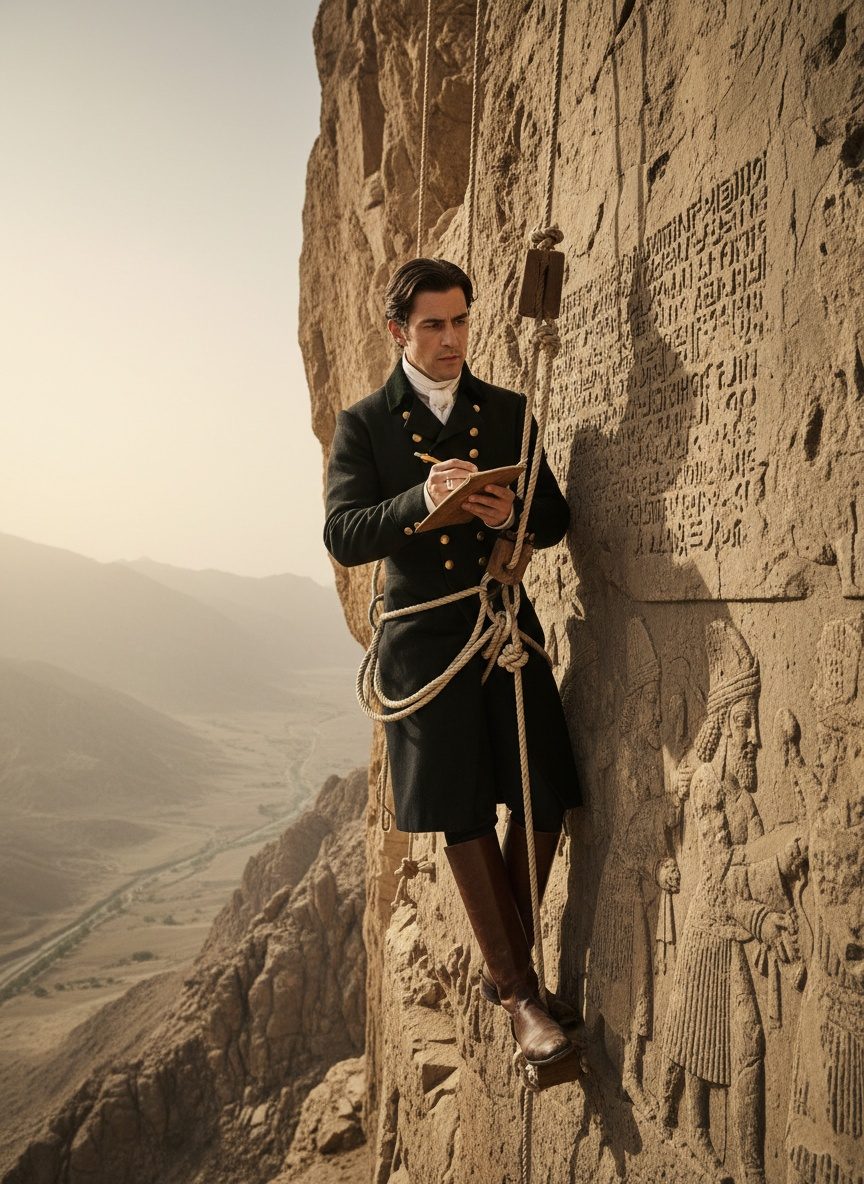
It was 1835, and few would have believed that a British army officer would be at the forefront of a linguistic revolution. Yet, that's exactly where Sir Henry Rawlinson found himself, perched precariously on a sheer rock face at Behistun, now located in modern-day Iran. A dizzying 300 feet below him yawned a chasm, and above, ancient inscriptions had remained cryptic for two thousand years. These were no ordinary rock carvings; they were monumental records engraved by order of Darius the Great, a king of the Achaemenid Empire, intended to proclaim the might and rule of Persia's vast domain.
Rawlinson's fascination with the Persian language and its history was not a recent endeavor. Since joining the British East India Company, he had immersed himself in the study of Persian culture and language, driven by a fervent curiosity that surpassed mere colonial duty. Appropriate assignments in the army eventually led him to the foot of this imposing escarpment, where the inscriptions—written in three languages using cuneiform script—had been inscribed around 521 BCE. He recognized the enormity of the task facing him; no one in contemporary times had successfully deciphered such writings—the key to an ancient civilization locked away in its cryptic symbols.
In an age where adventurers doubled as scholars and scholarship often required adventuring, Rawlinson embodied both. How does one begin to dismantle a puzzle crafted millennia ago, where previous attempts had only met with frustration? With sheer tenacity, Rawlinson approached the Behistun inscriptions as a Herculean challenge, meticulous in his efforts. Dangling by ropes with charred Indian ink in hand, he painstakingly transcribed each enigmatic character, battling wind and vertigo. This was no leisurely historical inquiry but a life-risking voyage into the obscurities of the past.
The specifics of the carvings at Behistun were formidable. The inscriptions were essentially royal proclamations in three different cuneiform scripts: Old Persian, Elamite, and Babylonian. This multiplicity of languages was both a bane and boon to Rawlinson. The multilingual nature echoed the templates set by the Rosetta Stone, which had unlocked the mysteries of Ancient Egypt barely a few decades earlier through the same principle of comparative script analysis. Rawlinson's process would mirror this methodology—a serendipitous accident of history—providing him with a critical strategy to decode the languages.
With the tenacity befitting a true explorer, Rawlinson doggedly pursued the clues offered by the cuneiform inscriptions. The turning point came when he realized that certain recurring patterns and structures in the Old Persian text might reveal the names of prominent Persian kings. Identifying the repeated names of Darius, Xerxes, and Hystaspes enabled him to build a foundational lexicon. Every accurate word gained was a proverbial chisel blow to the stone walls of an ancient enigma, etching out the history of a long-silenced culture.
But to truly decode the language, he needed context and corroboration. Rawlinson turned to Herodotus and other ancient historians, using their references to Persian accomplishments and geography as anchoring points. His remarkable linguistic acumen and patience paid off. Within a few short years, Sir Henry had translated large sections of the inscriptions, composed of more than a thousand lines of cuneiform text.
Marked not only as a triumph of individual scholarship but also as a leap forward for understanding human history, Rawlinson's deciphering yielded groundbreaking revelations about the Persian Empire. The inscriptions spoke of Darius the Great’s accession to the throne and the empire's extensive reach, spanning 23 nations from Thrace and Macedonia in the west to the Indus Valley in the east. They detailed battles and rebellions, shedding light on governance practices and underscoring Persian cultural and political sophistication.
The full translation of the Behistun inscriptions was not the culmination of public excitement for antiquity but rather a catalyst for it. It marked the dawn of Assyriology and the wider study of the ancient Near East. Rawlinson's work had unveiled a forgotten cultural tapestry, inspiring an entire academic field and future generations of historians and archaeologists. The rediscovery of such ancient insight invited a reshuffling of textbooks and a fresh appreciation for the linguistic complexities that had marked early civilizations.
Despite this monumental achievement, Rawlinson's humility and his own words remind us of the larger narrative—of how much ancient history remains untold and still lies hidden across time's extensive canvas. In one of his many reflective moments, Rawlinson acknowledged the impermanence of such insights by recognizing that not every stone-borne letter would ever be translated or understood. His life's work, rather than claiming absolute triumph over the past, served as a beacon encouraging deeper exploration and wider scholarship.
Today's readers might pause to appreciate that nothing unites human curiosity across epochs quite like the unsolved mysteries of the past. Rawlinson's daring, his pursuit of knowledge with unwavering commitment and courage, offered a glimpse into the intricate web of historical consciousness—one often overshadowed by wars and conquest. His work invites us to peer beyond daunting precipices—metaphorical or otherwise—to unravel the codes and languages that define who we are.
Long after Henry Rawlinson dabbled with danger on that Persian precipice, with ropes securing more than just his body but tethering his discoveries to future generations, his accomplishment continues to resonate. It serves as a poignant reminder of how the pursuit of understanding—dangerous, demanding, and dogged—can illuminate the world's lost chapters, turning whispers from the past into the engaging stories they should have taught in school.