He was not some absent-minded old sage. Archimedes was the cutting edge of his time.
The Siege of Syracuse: A Genius at War
As Syracuse teetered on the brink of collapse, its defenses tested by relentless Roman forces, the city's salvation came not from legions of its own but from the prodigious intellect of Archimedes. The Romans, under the command of General Marcellus, had laid siege to the Sicilian city for two arduous years. Yet, despite their superior numbers and might, they found themselves repeatedly thwarted by the ingenious contraptions engineered by this one man.
From formidable catapults to the notorious Claw of Archimedes, his inventions seemed born out of myth rather than mortal ingenuity. Designed to defend against both naval and land assaults, these machines made a formidable opponent of a city rooted in decline. Roman ships, approaching the harbor with conquering zeal, were often met with swift destruction, upended by the mechanical marvels that hurled stones and boulders over prodigious distances or lifted them clean out of the water.
The city wall stood, seemingly impenetrable, as Archimedes turned warfare into a realm of puzzles to be solved rather than brute confrontations. The Romans, time and again, found themselves outmaneuvered not by fighters in gleaming armor, but by the mathematical calculations of a scholar resolute on waging an intellectual war. Syracuse, in its desperation, had transformed into a hub of scientific innovation, all thanks to a singular man who searched tirelessly for solutions in the murmured elegance of geometry.
The Man in the Dirt: Archimedes’ Last Problem
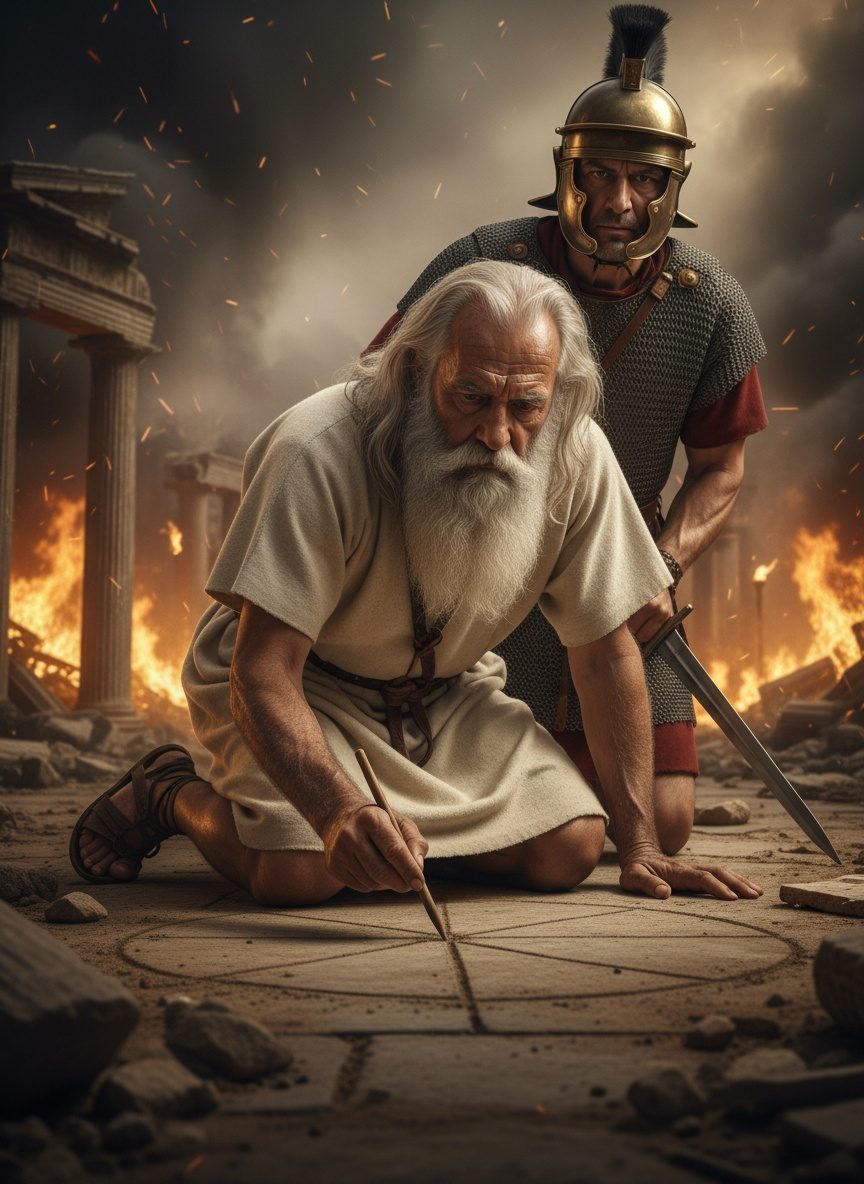
Inside the city, away from the tumult of war machines and the cries of battle, Archimedes knelt in the dirt. The noise of warfare faded into the background as the mathematician focused on a different battlefield — the patterns and symmetries of his beloved circles. He found comfort and clarity in the precision of his calculations, drawing an immaculate geometry in the dust. Here, amid the chaos of life's uncertain dangers, was a certainty in numbers that drew him into deep contemplation.
The Roman army eventually breached the city walls, the force of numbers prevailing where pure intellect had delayed the inevitable. With their familiar discipline, they flooded the streets, swords drawn, orders shouted. Yet, amidst this din of war, one figure remained engrossed in his craft, tracing arcs where others saw only ruin. Archimedes, unperturbed by the clamor, was immersed in solving a problem as if it were a riddle of the gods themselves.
In this moment of profound disconnect between the man and his surroundings, a Roman soldier stumbled upon this peculiar scene. The soldier, lacking the keen eyes for Archimedes' sacred lines, saw only an old man in the dirt, indifferent to the victor. Ignorant of the general's edict to protect the sage, the soldier's impatience and disdain for this incongruous figure manifest in the swift strike of his sword. Thus, the last inquiry of Archimedes came to an abrupt end, a master of logic facing chaos in its rawest form.
The Echoes of a Lasting Impact
The fall of Syracuse and the misguided death of Archimedes would echo through Rome, staining their triumph with sorrow and reflection. Although victorious, the Romans quickly realized the magnitude of their loss. General Marcellus himself is said to have lamented the death of a man whose intellect could have served Rome their empire builders rather than combatants. His unauthorized death served as a reminder of the tensions between war's brutal immediacy and the long-term vision of scientific enlightenment.
In the years that followed, Archimedes' work remained a cornerstone of intellectual pursuit. His treatises on geometry and mathematical principles, laboriously preserved and translated, became vital texts in the annals of learning. Importantly, his legacy molded the relationship between science and civilization, illustrating how intellectual prowess could stand as a formidable fortification — one that material weapons could rarely match in endurance and influence.
Reflecting from the vantage point of modernity, the tale of Archimedes’ demise provokes a sobering meditation on the fragile interplay of knowledge against the tide of human impulsiveness. It's a story not merely of how one of history's greatest minds was prematurely silenced, but a poignant reflection on the relentless advance of human possibility. In his unending quest for understanding, Archimedes stood at the confluence of ancient wisdom and future potential. Even in his passing, he invites us to ponder the resonance of ideas, how they survive wars, inspire change, and perhaps most crucially, draw unseen boundaries that time and circumstance can never erase.