The early morning sun cast a dim glow over the muddy fields of Waterloo, its light slowly creeping across landscapes that had seen far too much war. The air was thick with the musk of churned earth and the acrid bite of gunpowder. As the faint echoes of bugles and the rhythmic stomp of advancing troops reverberated through the ground, an electric tension charged the air, a silent harbinger of the violence yet to unfold. June 1815 marked the turning of a colossal tide in European history, with two great military minds poised to clash in the decisive battle of the Napoleonic Wars. Yet, amidst the carefully laid plans and the teeming hoards of soldiers, one solitary figure would etch his name into the annals of history—not through orchestrated maneuver but by sheer audacity.
As the battlefield came alive with the thunder of cannonballs and the cries of soldiers, Sergeant Charles Ewart of the Scots Greys emerged as an unlikely hero. In the chaos of conflict, where orders shouted over the din could easily be lost, Ewart had received no command to make the charge that would alter the course of the battle. The French infantry, advancing in formidable columns, sought to crush their enemies through sheer mass and momentum. In their midst loomed the emblem of Napoleon's might—the eagle standard—a symbol revered by the forces of the Empire and feared by its foes. For the British troops, its capture would not only be a psychological victory but a crippling blow to French morale.
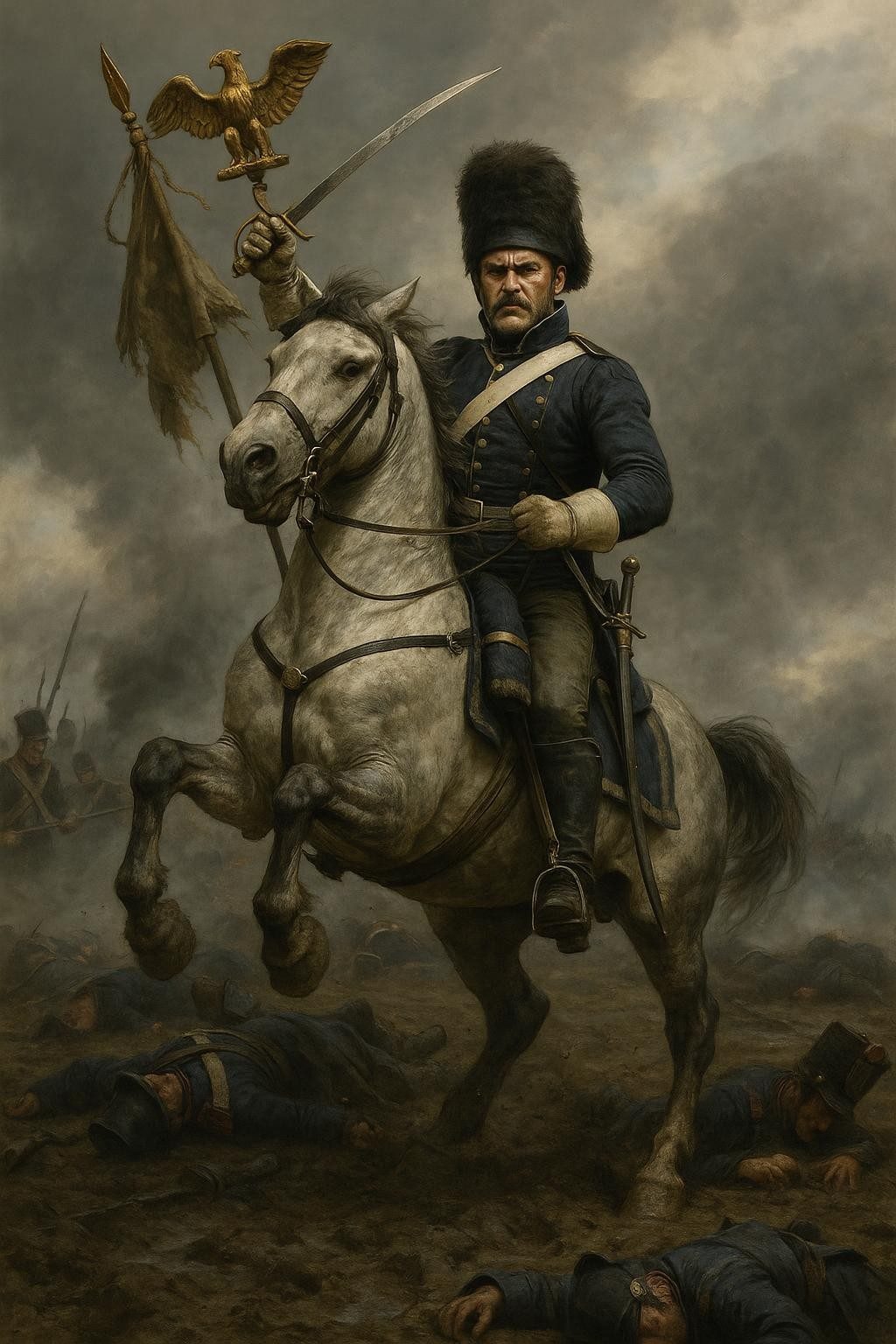
Ewart, a seasoned soldier with years of service under his belt, had his eyes trained on this objective amidst the swirling melee. His senses were honed to a razor's edge, and in a moment of instinctive clarity, he saw his chance. Clad in the grey uniform of his regiment, atop a horse equally imposing, Ewart broke from formation. Alone, he galloped headlong into the surge of French infantry. To onlookers, this solitary rider seemed almost spectral as he slipped like a shadow through the crush of bodies and steel.
The Scotsman was no stranger to the capricious theatre of war. Born in Kilmarnock, Ewart had risen through the ranks, distinguished by his stalwart dedication and unyielding courage. Yet, no prior engagement could match the ferocity of Waterloo, where every decision bore the weight of a continent’s fate. The battlefield was a hellscape; smoke hung thick like a malignant fog, and the cries of the wounded mingled with the dreadful symphony of war. Against this backdrop, Ewart's daring ride appeared both valiant and mad.
His single-mindedness led him into the heart of the French column, a turbulent mass of determined soldiers rallying around their standard in defense. Yet, sheer audacity carried Ewart through. With a mighty heave, he finally wrested the eagle standard from its keeper, the frantic clamor of their ensuing struggle swallowed by the war’s cacophony. Capturing an eagle was no simple thing; it was a feat requiring not just bravery but a brute force honed over years of service. To the beleaguered British lines, its sight became a beacon, a flashpoint rallying them against the surging French forces.
But Ewart’s work was far from over. His return journey was no parade march. French soldiers, incensed by the infamous capture, bore down with renewed ferocity. Every second became a desperate gambit, a perilous ride back through enemy lines—every Frenchman he encountered stood as another barrier to his escape. Yet Ewart’s resolve did not waver. Driven by a loyalty to his peers and the love of his nation, he clove through the chaos with determination forged in fire.
With the standard clutched firmly, Sergeant Ewart’s return to British lines rippled through the ranks like a clarion call. In capturing the standard, he had taken more than just a symbol—he had captured the essence of Napoleon's seemingly implacable force. As French morale wavered, British forces surged, invigorated by this singular act of gallantry. Observers would later recount how this moment sparked a fervor within the coalition ranks, galvanizing their resolve in the pitched battle that defined the day.
The battle at Waterloo resulted in a decisive victory for the British-led coalition, a momentous turning point that sealed Napoleon’s fate and reshaped the course of Europe. Yet, beyond the broader strategies and massive deployments, it was the spontaneous bravery of individuals that injected the lifeblood into such epic tales. In the standoff between nations, it is often on narrow margins that outcomes pivot—where actions unsanctioned by command shape destinies just as profoundly as any grand scheme.
The story of Charles Ewart speaks to the enduring power of individual courage amidst the overarching machinery of history. In a world where overarching strategies and diplomatic designs often dominate the narrative, such acts remind us of the human heart that beats within every soldier. Ewart had no orders. He saw the moment and seized it, choosing action over inaction, courage over caution. And for those who study the annals of Waterloo, it is this spark—the lone rider defying the odds—that echoes through the years, a shining testament to the indomitable spirit of those who dare to carve their own path amidst the fog of war.