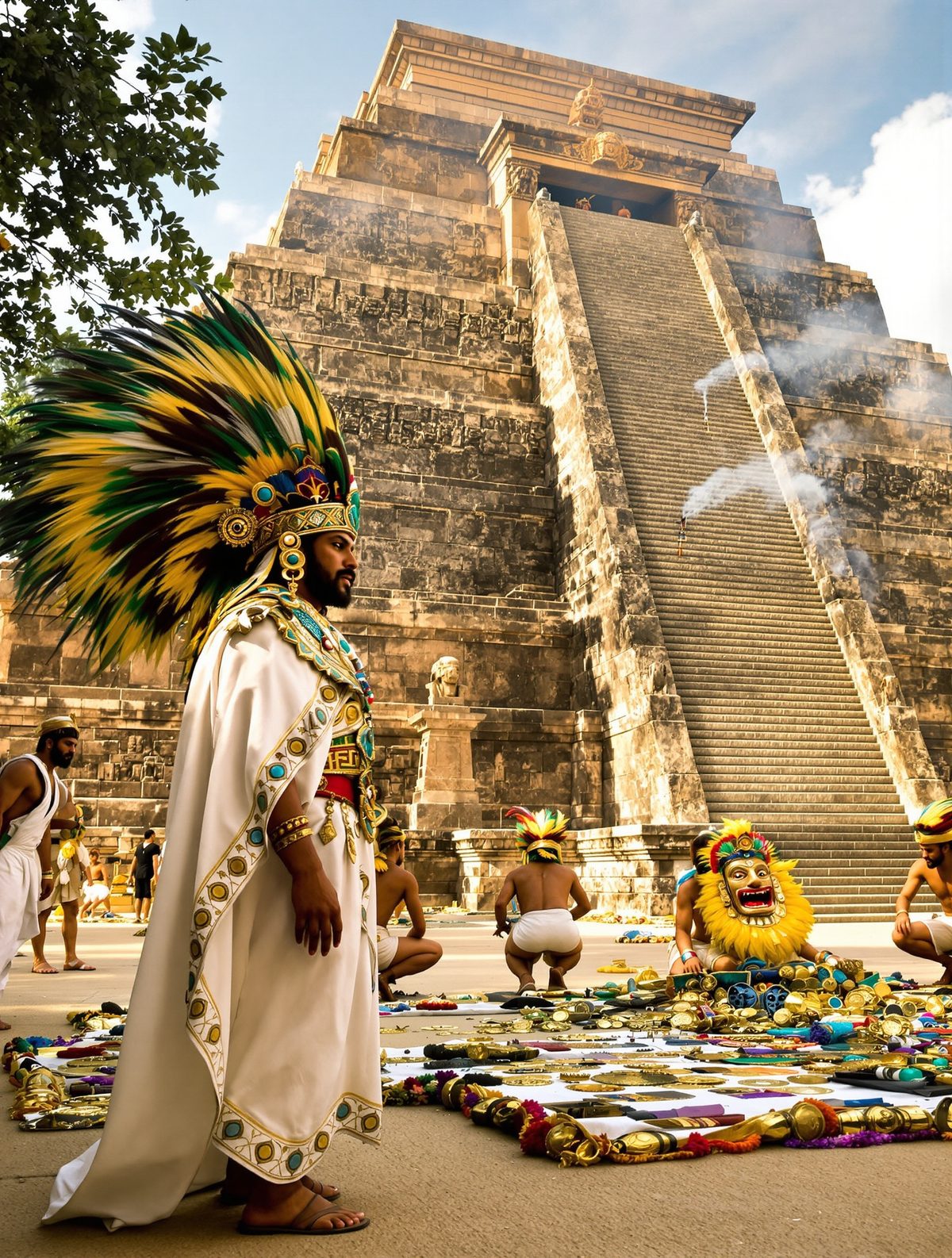
In the year 1519, a new chapter in history unfolded, one that would set the stage for a dramatic encounter between two very different worlds. Imagine the sun rising over the Valley of Mexico, casting its golden hue over the majestic city of Tenochtitlan. High upon its stone temples, priests tended to their morning rituals, while thousands of its residents stirred to life. It was a city like no other—a sprawling metropolis of palaces, floating gardens, and bustling markets. Yet, even within this vibrant society, whispers of unease began to ripple through the streets. Strange omens were reported; a comet streaked the sky, temples ignited without cause, and most unsettling of all, an unfamiliar presence approached from the sea. Montezuma II, the emperor of the mighty Aztec Empire, stood at a crossroads, unknowingly at the dawn of its demise.
The Stranger's Arrival: A World Transformed
One can picture the scene vividly—an Aztec runner, dust-covered and breathless, arriving at Montezuma's palace with tales of bearded men and floating structures off the Yucatan coast. These reports made clear the arrival of Hernán Cortés and his Spanish expedition, though Montezuma could barely fathom the idea of men arriving over a sea he believed an impassable abyss. These strangers, mounted on creatures that seemed the stuff of legends, evoked fear and confusion. Were they gods, perhaps the prophecies of Quetzalcoatl returning to reclaim his earthly domain?
The Gifts of Gold: A Misguided Strategy
Montezuma, a ruler deeply concerned with prophecy and tradition, decided against immediate military action. Instead, he chose a path shaped by the intricate values of his society—the offering of gifts. He dispatched Opoya and Quintalbor, his trusted emissaries, to the newcomers bearing treasures—golden disks the size of wagon wheels, intricately crafted jewelry, and a headdress frilled with vibrant quetzal feathers, befitting only a deity. In Aztec custom, these gifts were a signal—a nuanced warning to turn away as much as it was a demonstration of goodwill. But as Cortés surveyed the priceless offerings, his conclusion differed vastly; he viewed them as an invitation and a promise of unimaginable wealth.
Miscommunication and Misinterpretation: The Downfall
This diplomatic exchange offers one of history’s most poignant reflections on cultural miscommunication. Montezuma's gesture, rooted in Aztec rituals, laid bare an inherent misunderstanding. The Spaniards interpreted the Aztecs’ generous gifts as a symbol of submission. Montezuma's assumptions about the Spaniards—assuming they'd recognize an indirect warning—echo the pitfalls of projecting one’s cultural beliefs onto others.
This misunderstanding wasn’t solely due to language barriers. The Aztecs and Europeans inhabited separate cultural universes. While the Aztecs, despite their vast empire, rarely expanded through slaughter alone, focusing instead on diplomacy enhanced by strategic alliances and imposing tributes, the Spaniards embodied a conquest-driven ideology. To them, the opulence and richness that lay (literally) at their feet were an open invitation to a conquest that would define the next 300 years of Latin American history.
The Unraveling: An Empire's Last Stand
If Montezuma had misunderstood Cortés’ intentions, he soon understood the Spaniard’s ruthlessness. By November of 1519, Cortés marched into Tenochtitlan. At first, Montezuma housed the Spanish in luxury, hoping diplomacy could stifle the growing tension. Yet, just six months later, in what would later be known tragically as *La Noche Triste*, or The Night of Sorrows, Montezuma was dead, whether by assassination by his own disillusioned subjects or the Spanish remains a mystery. The same people who once revered him now cursed his name as a betrayer, leaving Cortés, despite facing fierce resistance, closer to his ultimate prize.
Lessons in Diplomacy: Reflections on Power and Misalignment
This historical episode serves as a stark reminder of the delicate interplay between knowledge and understanding in international relations. Montezuma's story speaks to the complexities that arise when cultural paradigms collide. The misunderstanding between Montezuma and Cortés was not merely a failure to communicate but a tragic misalignment of worldviews. It's a story replicated throughout history—a testament to the unpredictability of human interaction when two vastly different civilizations intersect.
Reflecting on this moment today, we are reminded of the intricacies of global diplomacy and the importance of genuine cross-cultural understanding. The fall of the Aztec Empire was not merely a tale of conquest but a paradigm for what can happen when assumptions supersede genuine comprehension.
As we navigate the complexities of our increasingly interconnected world, Montezuma's fate offers both a cautionary tale and an opportunity to reflect on how we engage with cultures different from our own. It's a story worth retelling—a reminder that history is not just the past but an ongoing narrative that shapes our present and future.