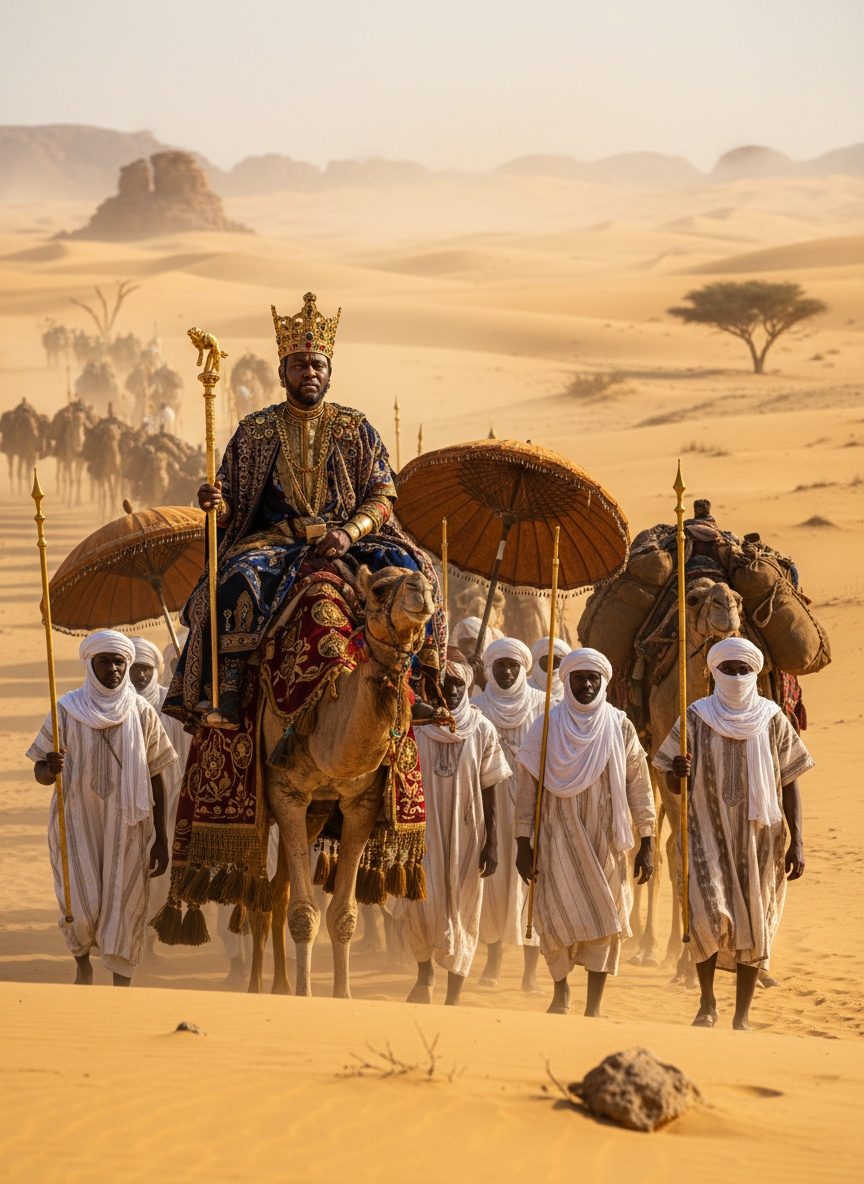
He strode into history with golden dust marking his passage. Few have seen such a spectacle since.
A Migration of Wealth Across the Sands
In the heat of 1324, a parade unlike any other wound its way out of the Kingdom of Mali, shimmering under the sun. At its helm was Mansa Musa, the ruler renowned not for wars or conquest, but for opulence. He had resolved to undertake a pilgrimage from Mali to the heart of Islam, a journey which would be immortalized in time. Yet, this was no ordinary trek: it was a grand migration of wealth, faith, and power, stretching beyond the horizon and for the miles yet unseen.
Musa's entourage comprised 60,000 men, a vibrant display of unity and purpose. Among them were officials, soldiers, merchants, and entertainers, each playing a role in the tapestry of this grand journey. The Sahara, notorious for its merciless expanses and shifting sands, witnessed the crossing of this human river, its chorus echoing tales of forthcoming prosperity and divine resolve.
The Gold That Shook a City
Upon reaching Cairo, Musa's caravan unleashed the full force of its brilliance. Here, the procession's splendor transformed from legend to reality. Reports of his arrival spoke of one hundred camels, each laden with hundreds of pounds of pure gold, as if the heart of Africa had poured out its riches upon Egypt. The streets were awash with the spectacle; merchants, dignitaries, and the common folk flocked to catch a glimpse of the golden pilgrimage.
Yet, Musa's piety was as prodigious as his wealth. With a generosity unbounded, he bestowed gold upon the poor, presented lavish gifts to the court of the Sultan, and funded the construction of mosques in Cairo. It was a gesture of goodwill and religious devotion, but one with unintended consequences. Such was the volume of gold given away that the metal's market value plummeted, plunging the Mediterranean economy into a decade-long spiral.
An Empire Defined by Prosperity
The source of Musa's wealth lay in the soils of the Mali Empire, a realm that possessed some of the richest gold mines on the planet. Mali's reach extended across the West African savannas, dominating crucial trade routes of the era. It was a time of tremendous prosperity, where gold dust became the currency that connected distant lands from Africa to Europe to Asia. Beyond its wealth, the empire was a beacon of cultural and intellectual achievement, with centers like Timbuktu serving as bustling hubs of learning and trade.
Mansa Musa's venture was not merely about his pilgrimage to Mecca; it was a demonstration of the Mali Empire's stature. His journey underscored the interconnectedness of civilizations, as Mali's influence touched realms far beyond its borders and reverberated across continents.
The Silent Legacy of a King
The repercussions of Mansa Musa's journey transcended his era. Though eventually the inflation he induced in Egypt dissipated, the tale of his odyssey spread, seeding legends across the lands. Scholars and traders carried stories of his boundless wealth to Europe, where maps began to feature an African king holding a gold nugget, symbolizing the continent's untapped riches and the allure it held for adventurers and explorers.
While the specifics of Musa’s pilgrimage fade into the shadowy corridors of history, the reverence for his legacy remains potent. His reign marked a golden age for Mali, laying foundations not just in wealth, but in academic and cultural enrichment that persisted for generations. Musa's endeavors etched a complex narrative, entwining faith with ambition, demonstrating that empire might often shine brighter than the sun.
Reflections on a Forgotten Journey
In a world obsessed with tales of Western explorers, the saga of Mansa Musa offers a refreshing pivot. It defies stereotypes, challenging the narrative by flipping the traditional script, showcasing an African leader who wielded influence and inspired awe across continents. His saga is a reminder of Africa’s historical narratives, often obscured in the shadows of time, yet brimming with moments of brilliance and depth.
As we juxtapose our modern world with this chapter of the past, Mansa Musa's journey invites reflection on the true trajectory of wealth, culture, and the annals where they intersect. It's a story that beckons us to re-examine what we know of history and challenges us to view the African continent as a crucible of innovation and grandeur, echoing with the footsteps of a king who once walked the sands draped in gold.