England in the 9th century was secure. It believed so, perhaps more than it should have.
The Silent Arrival
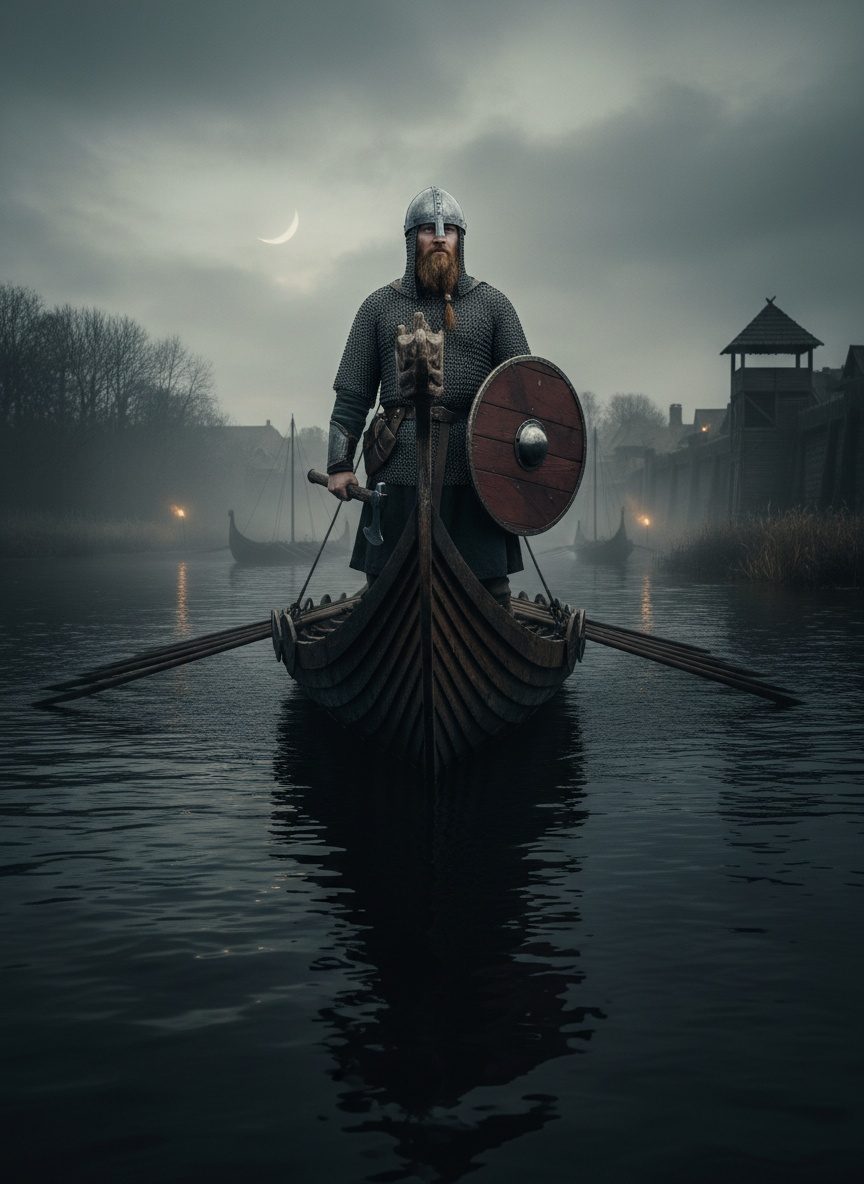
As the crisp September winds swept across the English countryside in 866 AD, few could have fathomed the monumental change stealthily unfurling under the cover of night. In the dead of night, a single Viking longship, its dragon-prow biting into the gentle currents of the Ouse River, slipped through the waters, virtually unseen. At its helm was a figure who would soon etch his name into the annals of history—an enigmatic Norse leader known as Ivar the Boneless.
Ivar's entry into York was as poetic as it was chilling. Unlike the earlier, sporadic raids that had scarred the shores of Great Britain, this was an altogether different venture. A Viking warrior armed with more than just hardened steel, Ivar's weapon was diplomacy—a rare approach in an era of pillage and plunder. His silent arrival and the opening of York’s gates heralded a shift in the Vikings' modus operandi. They no longer came to take and leave; they came to conquer and stay.
The Saxons, who had grown accustomed to intermittent Viking raids, were unprepared for this new strategy. The seamless capture of York was not an act born of violence but of calculated mastery. The city's defenses, formidable to invaders intent on frenzied onslaughts, proved inadequate against this subversive tactic. Unbeknownst to them, the Vikings had arrived not just to raid but to reshape a kingdom.
Reshaping Power
Once inside York’s towering walls, Ivar and his forces systematically began transforming the city into a Viking stronghold. His cunning, far from mere legend, was demonstrated in the way he solidified his hold on the region. The city, with its strategic positioning and rich resources, became a keystone in the Viking efforts to establish dominion over the English territories.
While York had succumbed without a battle on its streets, its conquest rippled outwardly, inciting panic and resistance among the neighboring Saxon kingdoms. Ivar's reign was characterized by strategic alliances and brutal conquests, designed to solidify control and expand influence. As word of York’s fall spread, fear gripped the land. The Great Heathen Army, as Ivar’s forces became known, was soon reinforced by more Viking warriors eager to carve out their destiny in a new land.
This wasn’t merely conquest; it was administration and control. The Norsemen, adaptable and resourceful, began instituting their systems of governance. The laws and customs of the Vikings mingled with Saxon tradition, creating a unique cultural hybrid that would eventually give rise to new societal norms.
The audacious seizure of York signaled a turning point. It was a doorway, opened by Ivar, through which a flood of Norse influence would pour into the heart of England. What began as a swift and silent capture burgeoned into a profound transformation that redrew the borders of power.
The Dawn of a New Era
In the aftermath of the unyielding grip Ivar and his forces held over York, the landscape of England began shifting in ways previously unimaginable. The presence of a Viking stronghold in the north acted as both a barrier and a beacon. To those within the Norse sphere of influence, it was a sanctum of power and protection. To those outside, it was a constant reminder of the impending storm.
It is within these walls that the seeds of a new civilization were sown. Over the following decades, the initially occupying force of Vikings settled deeper into the fabric of English society. The intermingling of cultures cultivated advances in trade, craftsmanship, and navigation. The Viking influence permeated aspects of daily life from language to art and agriculture.
But perhaps most crucially, the takeover of York and the subsequent Norse influence demonstrated the vulnerabilities of a fragmented English kingdom. It catalyzed a period of consolidation among the Saxon kingdoms, which began to perceive the benefits of unity against external threats. The Viking presence, rather than purely destructive, inadvertently laid the foundations for the eventual unification under a single English monarchy.
Ivar the Boneless and his silent arrival in York were more than an audacious chapter in a story of conquest. They were the architects of a new era, indelibly altering the course of English history. The echo of his uncanny strategy resonates through the ages, a reminder that sometimes the pen—not the sword—truly is mightier. Long after the last of his longships left the shores, the influences of that single night in York sailed on, forever embedding themselves in the history of a nation.