He had been written off as a troublemaker. Yet, on that fateful January night in 1879, he would become a hero.
The Shadow of Isandlwana
The Anglo-Zulu War of 1879 had begun inauspiciously for the British. On January 22nd, the British forces met with disaster at the Battle of Isandlwana, where a much smaller British contingent was devastated by the formidable Zulu warriors. Just a short distance away, at Rorke's Drift, a mission station and military post on the Natal side of the Tugela River, the remnants of this conflict were about to play out on a much smaller, yet equally intense stage.
For Private Henry Hook of the 24th Regiment of Foot, the grim echoes of Isandlwana were the backdrop to a fight for survival that would become legendary. Known more for his indiscretions than his heroics, Hook was a man who had often found himself on the wrong side of military discipline. But history sometimes finds great worth in the most unlikely figures.
Flames and Fury: Into the Hospital
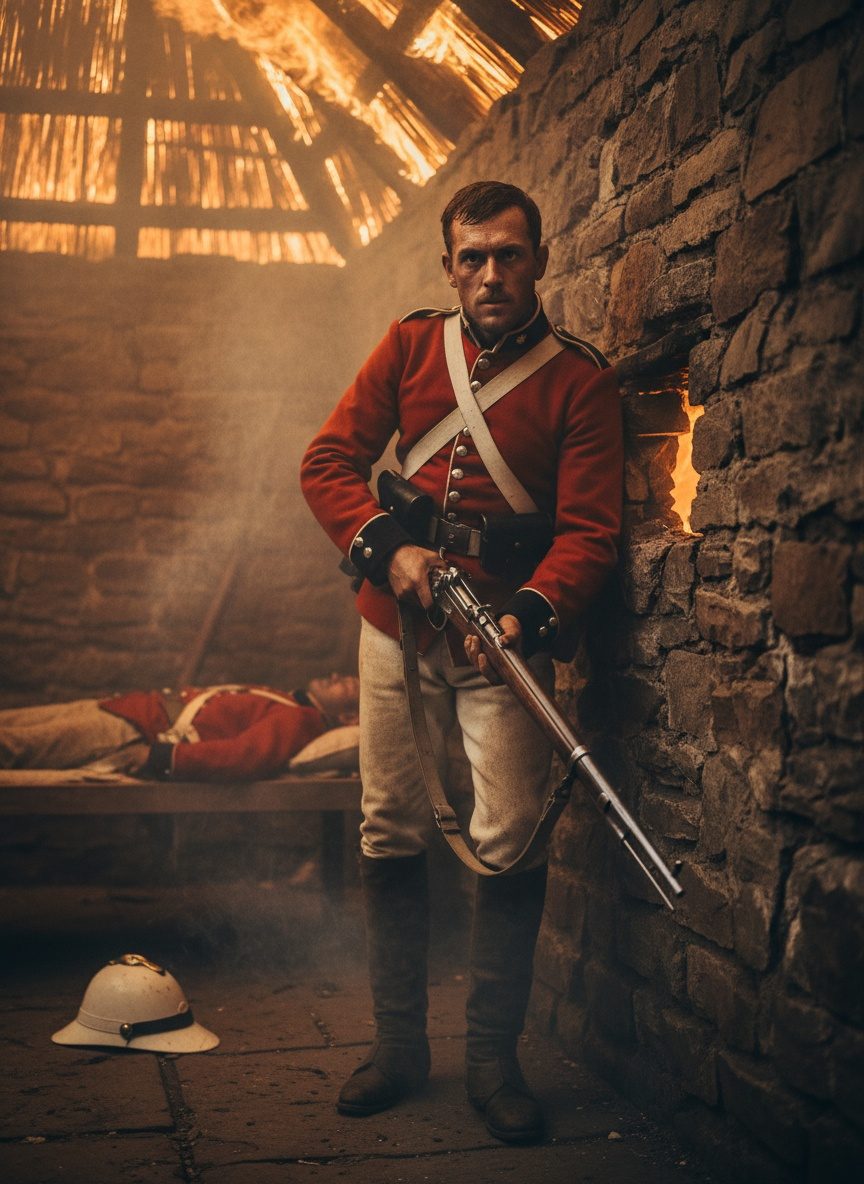
As darkness descended on January 22nd, the men at Rorke's Drift were under siege. The hospital became the scene of some of the most desperate fighting. Caught amidst the chaos was Private Henry Hook, tasked with tending to the wounded within the hospital's walls. Yet, instead of providing care with a gentle hand, Hook was thrust into a role no one could have anticipated – that of a defender armed with a rifle and a bayonet.
The Zulus pressed hard against the makeshift fortifications of Rorke's Drift, and the hospital was soon ablaze. The flames danced ominously, casting flickering shadows against the stone walls, as Hook moved from room to room. Determined to rescue the incapacitated men under his care, Hook's focus was as sharp and unyielding as the bayonet he wielded. Smoke choked his lungs and blurred his vision, but his resolve never wavered.
The hospital's corridors and wards became a fiery gauntlet. With the constant crackle of rifle fire interspersed with the cries of the wounded, Hook pushed back waves of Zulu attackers, each encounter more harrowing than the last. Room by room, he fought not just against the Zulu forces, but against the fire that threatened to consume them all. In the crucible of battle, fate had forged Henry Hook anew.
Room by Room, Man by Man
Private Hook's battle on that scorching night reverberated with acts of intense bravery. As the Zulus breached the walls and forced their way into the hospital, Hook evacuated the patients with a tireless energy born of desperation. It was a feat of physical endurance and mental fortitude that few could muster.
One by one, the soldiers became entwined in Hook's unwavering determination. Each wounded man was guided, sometimes dragged, to what little safety could be found beyond the burning confines of the hospital walls. Despite the pressing danger, Hook's sense of duty never faltered. As adrenaline coursed through his veins, fear transformed into ferocity, and ferocity into determination.
Descriptions of the Battle of Rorke's Drift often focus on the hospital and its transformation from sanctuary to battleground, but the story within those walls is singularly defined by Hook's relentless presence. He stood alone more often than not, a solitary defender in a perilous theatre of war. In the aftermath of their survival, those who had been mere patients became witness to the extraordinary bravery of a man they had been led to underestimate.
A Troublemaker's Testament
When the first light of dawn finally broke across the embattled post, the incongruity of the scene was staggering. The Zulus had withdrawn, beaten back by a handful of resolute souls, united in a night of defiance against seemingly impossible odds. In the cold light of day, the wreckage of the hospital stood as a stark reminder of the battle just fought, yet it was also testament to a heroism that defied conventional expectations.
Private Henry Hook emerged not just as a survivor, but as a soldier of legendary courage. Awarded the Victoria Cross for his actions at Rorke's Drift, Hook's legacy transcended the labels of "troublemaker" and "rascal" that had shadowed him throughout his military career. Instead, his story became emblematic of the raw human resolve to protect and persevere, even in the most dire of circumstances.
The tale of Hook's heroics is a poignant reminder that valor often finds its home in unlikely souls. As we reflect on the story of Rorke's Drift, it serves to remind us that history's true power rests in the narratives of courage and conviction that endure long after the smoke has cleared and the battles are done.