He lost his right arm in the mountains of Italy. It didn’t stop him from continuing the charge up the ridge.
Daniel Inouye was a man whose life defied the very odds stacked against him. His story begins in an era of strife, when America grappled with its own contradictions and prejudices. Born to Japanese immigrant parents, he was classified as an "enemy alien" during World War II, a label that would have embittered many. Yet, Inouye was cut from a different cloth. The moment Japanese Americans were allowed to enlist, Daniel stepped forward, not with the weight of resentment but with a fierce determination to defend the very nation that had wronged his family. It was a decision emblematic of his profound belief in the ideals of America, even when those ideals seemed to elude the people who purported to protect them.
In 1943, young Japanese-American men were finally permitted to join the fight, and Inouye did so, eventually becoming part of the 442nd Regimental Combat Team. This unit, composed almost entirely of Japanese Americans, went on to become the most decorated in U.S. military history. The courage of these men was forged in battle, tested against the towering odds of prejudice and the brutal reality of warfare. The 442nd managed to carve its name into the history books by fighting valiantly across the bloodied soils of Europe, proving not only their worth as soldiers but also challenging the deeply held racist notions back home.
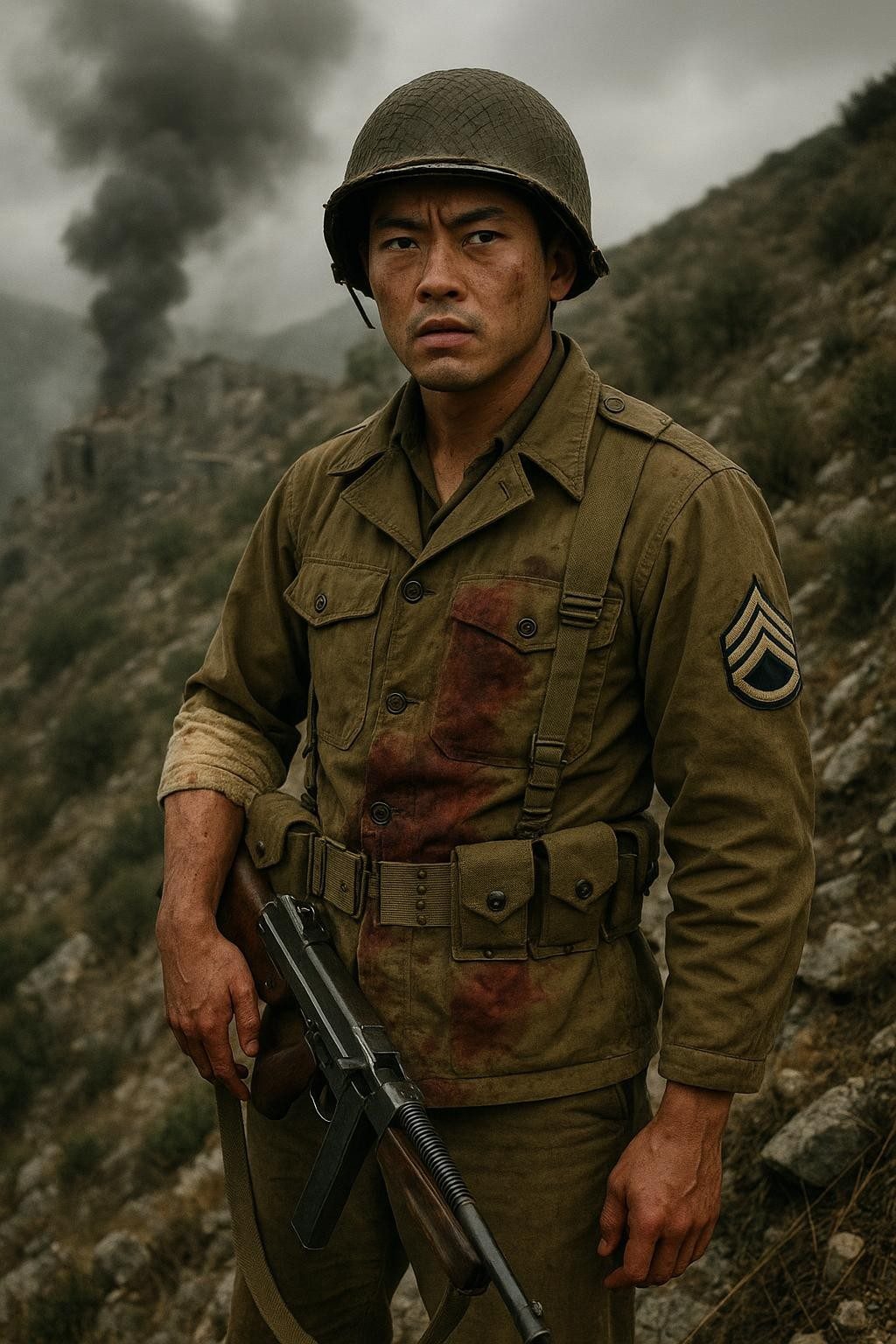
As the war raged through 1944 into 1945, Inouye found himself deep in the Italian mountains. It was there, on a ridge in April 1945, that his mettle would be tested in a crucible of fire and blood. Leading his platoon, Inouye faced the daunting task of taking a heavily fortified position held by entrenched German forces. The air was thick with the acrid smell of gunpowder and the cries of his comrades. As machine-gun nests rained down a lethal hail of bullets, Inouye pushed forward, his heart and mind steady with the kind of resolve that becomes legendary.
With his men pinned down, Inouye took the initiative. He charged the first machine-gun nest, taking it out with a burst of grenades and fierce close-quarter combat. Just as victory seemed within grasp, a bullet pierced his abdomen, the pain searing through him as though the very fires of hell had been unleashed in his belly. But Inouye would not stop. Ignoring the blinding pain, he destroyed a second machine-gun position. He then attempted to lob a grenade into the third but as his arm flew back to release it, a German rifleman hit him with a grenade, nearly severing his right arm. Reflexively, his fingers released the grenade, which still clung to his shattered limb. With a fortitude that seemed to echo the heroics of ancient legends, Inouye used his left hand to pry the object from his failing fingers and hurled it at the enemy, neutralizing the threat.
Despite this horrific injury, Inouye pressed on, continuing to lead and inspire his men until the ridge was secured. Only then did he relent, succumbing to the mercies of his shattered body. The indomitable spirit shown that day did not end with the battle. Instead, it marked the beginning of a new fight — a battle for recovery, reinvention, and renewed purpose.
When Daniel Inouye returned home, it was without the arm that had served him so well on the battlefield, yet his spirit was undiminished. His wartime valor earned him the Distinguished Service Cross, a recognition that was later upgraded to the Medal of Honor. But Inouye's story wasn't destined to be one of war alone. The decades that followed saw him emerge as a principal figure in American politics. He broke into the political arena where his voice resonated as one of integrity and commitment to service. From the halls of the United States Senate, where he was elected in 1963 as Hawaii's first full-fledged senator, Inouye dedicated his life to public service, advocating for civil rights, healthcare, and the welfare of veterans.
Inouye's journey is one wrapped in layers of irony and profoundly human contradictions. The soldier who marched against enemy forces also contended with his American identity, fighting not only to protect but to redefine what that identity meant in a country yet to reconcile its fractured ideals. Over more than five decades in the Senate, he became a stalwart of ethical governance, striving always for equity and justice, hoping to shape a better America. Inouye’s story immerses us in a narrative that is painfully reflective yet humblingly hopeful, a poignant reminder of the human capacity to overcome adversity with resilience, dignity, and a heart full of unwavering devotion.
Daniel Inouye died in 2012, having served his nation for the majority of his 88 years, a testament to the belief that service knows no bounds of physical or cultural limitation. In the quiet moments of history, his life and legacy shine brightly, not just for what he accomplished on the battlefield, but for what he built in the long peace thereafter. His tale is a passionate ode to duty, offering a perspective woven from courage, sacrifice, and the unyielding pursuit of the American dream. It compels us to reflect not just on the imperfections of our shared history, but on the enduring potential for redemption and progress.