Lucius Quinctius Cincinnatus saved Rome. Then he did the unthinkable.
The Call From the Fields
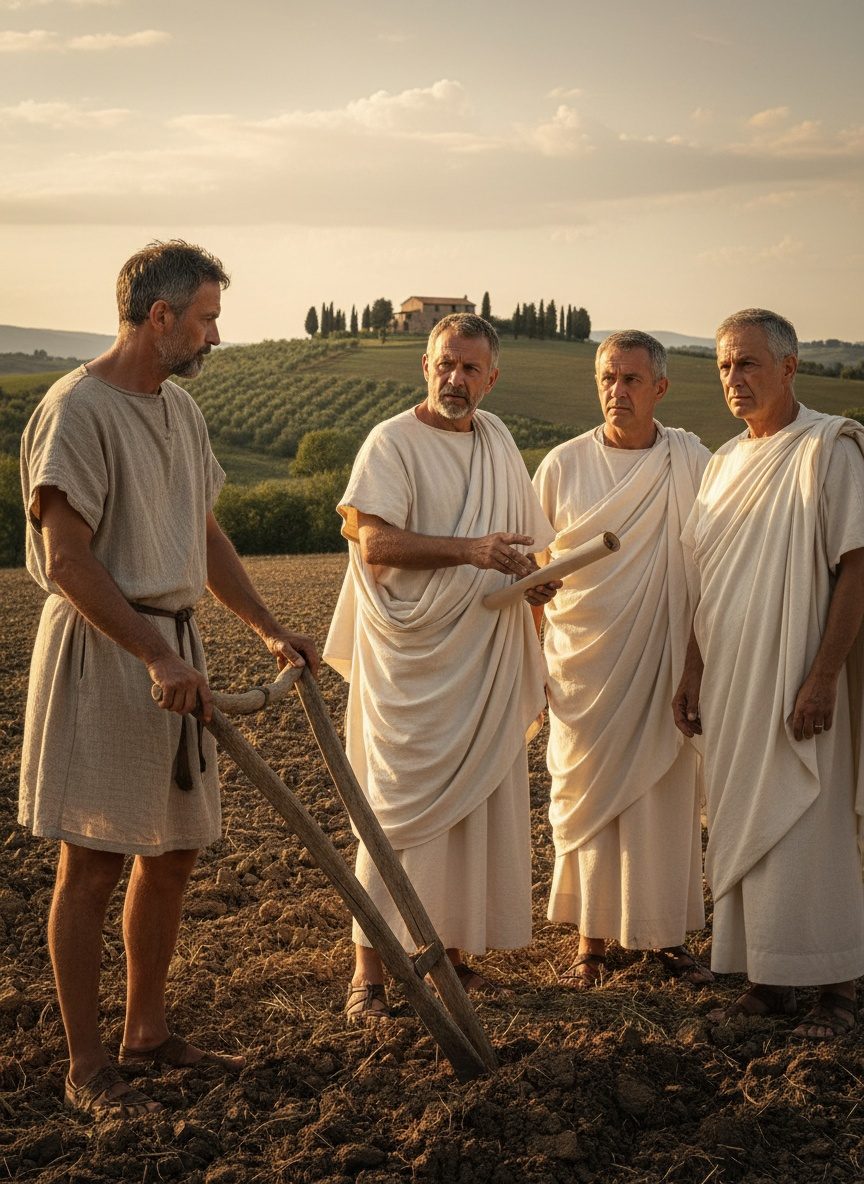
In the year 458 BCE, Rome was a fledgling republic, yet to flex the full muscles of the empire it was destined to become. Nestled on the banks of the Tiber River, the city faced an existential threat. The Aequi, a fierce mountain tribe, had trapped a Roman army on Mount Algidus, looming perilously over the fate of the Republic. As the crisis escalated, so did the desperation in Rome. And so, a delegation of senators crossed the Tiber, venturing beyond the city walls, their destination a humble farm.
There, they found their man: Lucius Quinctius Cincinnatus. A senator by past duty, now a farmer by choice. Cincinnatus was ploughing his field, a simple and rugged image—a stark contrast to the Roman elites pleading for his leadership. Despite the enormity of their request, Cincinnatus took only a moment's pause. He cleaned the grime from his hands, donned his toga, and accepted the mantle of dictator, a role offering absolute power for a limited time, tasked with saving Rome from its mortal predicament.
This scene, a tableau of juxtaposition, reflects both the simplicity and gravity of Roman values. Cincinnatus embodied the idea of service above self, epitomizing humility and duty. His acceptance of power was not gleeful but laden with the burdens of necessity. Rome called, and he answered with an obligation to his city and a calculated resolve to restore its dignity.
He moved swiftly. The Senate empowered him to levy troops and rally the republic for military action. Cincinnatus, with the Roman state transformed momentarily into a single-minded military operation, gathered new recruits overnight, molding farmers and artisans into a disciplined force. He knew time was of the essence, a luxury enjoyed neither by Rome nor its besieged soldiers.
The Battle at Mount Algidus
The march from Rome to Mount Algidus was relentless. Cincinnatus led an unyielding Roman legion across the landscape. The Aequi, fierce but unprepared for the sudden counterstrike, underestimated the renowned Roman efficiency. Cincinnatus's men moved with precision, a tangible manifestation of their leader's unwavering resolve. When they reached the encamped Aequi, Rome's phoenix unleashed true military ingenuity.
The trapped Roman soldiers were buoyed by the arrival of reinforcements; hope had returned. Cincinnatus deployed his troops strategically, encircling the enemy under the cover of darkness. By dawn, the trap had been sprung—a double line of trenches fenced in the Aequi. With the Romans digging in and cutting off all hopes of retreat, the mountain became the arena for a decisive standoff.
Engulfed, the Aequi realized their fate. Cincinnatus, playing the role of both tactician and showman of military might, offered terms of surrender that were sheer humiliation—with captives forced to march between the executed line of Roman troops, laying their weapons to the earth. It was a total and swift victory achieved with astonishing rapidity, completed in a mere 15 days.
The triumph secured, Cincinnatus could have capitalized on his newfound power, potentially extending his dictatorship with promises of expansions. But unlike the countless leaders intoxicated by command, his gaze was fixed not towards immortal glory but earthly lineage, on a path that led back home.
The Return to His Plow
Having rescued Rome, Cincinnatus calmly entered the city to a raucous welcome. His triumph, a epitome of tactical brilliance and resilience, had woven a narrative that generations would remember. Yet, as the Senate and citizenry prepared to feted a new potential overlord, Cincinnatus surprised all by abdicating his powers and returning the emergency authority vested in him. The dictatorship was meant for six months, yet after only 16 days, he relinquished it.
The celebration of a city's renewal quickly intermingled with a tale of voluntary decency. Here was a man who did not cling to the trappings of power, who turned away from the allure and potential corruption it invited. His reputation strengthened, elevated beyond power's reach not by grasping for more, but by gracefully walking away.
Cincinnatus did not seek accolades nor did he stay on for political elevation. Instead, he returned quietly to his fields. The simple man met authority head on, made use of it for the collective good, and retreated into anonymity once his duty was done—a lesson in leadership and restraint.
Why does Cincinnatus matter, a figure plucked from an era shrouded in myth? Because his story remains a pivotal testament to the virtues of leadership—of turning power not to one's own benefit, but towards those he led and loved. As future leaders sought inspiration, as the United States' own Society of Cincinnati was born, Cincinnatus's life became an embodiment of civic virtue, challenging the tides of time with tales that whisper through history: that true greatness lies not in seizing power, but in knowing when to let it go.