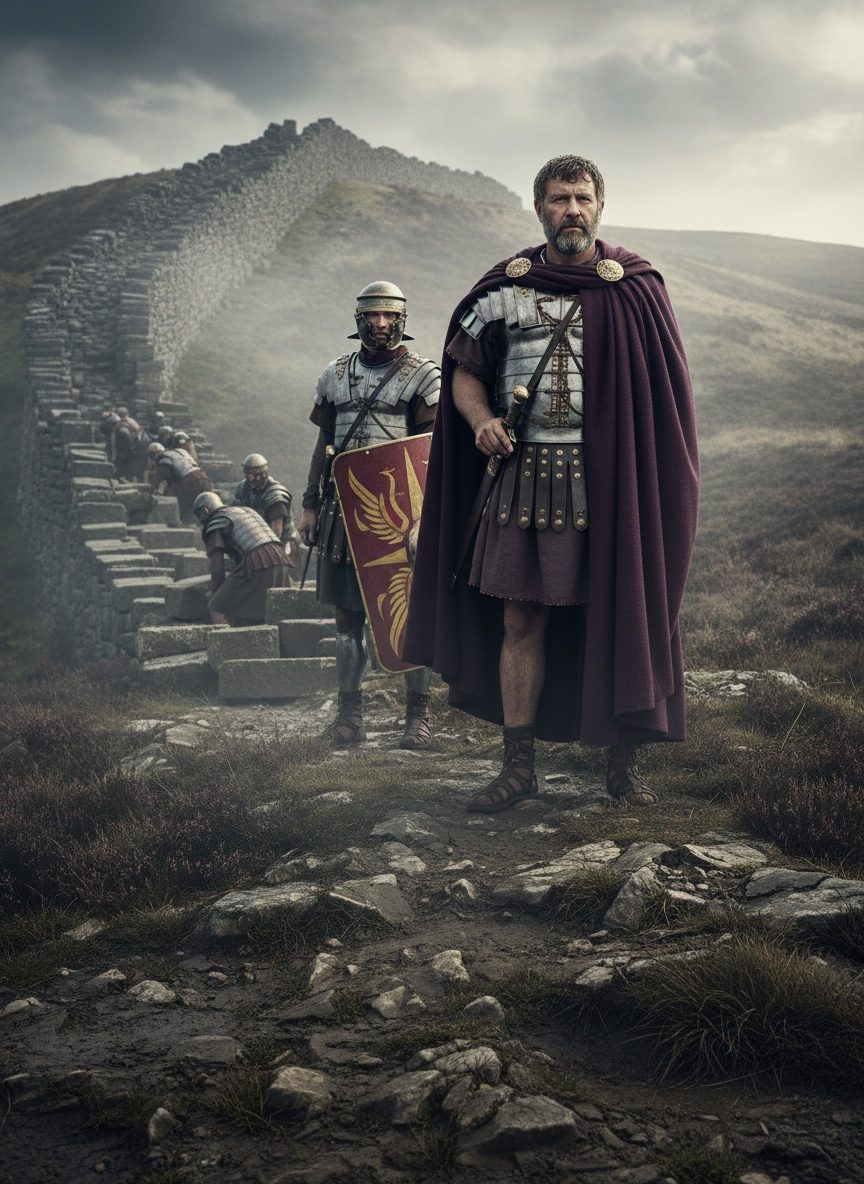
Emperor Hadrian had an imposing legacy. For an emperor where power spoke volumes, he said, "Here, I will write in stone." What history often skips is that he then walked where he wished his mark laid, traversing the uncertain edge of his empire himself.
The Vision of an Emperor
It was 122 AD, and Hadrian found himself staring out across the untamed and unpredictable Scottish landscape, a place few Romans had braved to explore. The Emperor of Rome, raised amidst the grandeur of civilization, was now at the precipice of civilization itself. As the winds whipped around him, carrying the raw essence of nature, Hadrian made a groundbreaking decision that would permanently engrave his name into the annals of history.
Known for his travels throughout the Roman Empire, Hadrian didn’t rule from a luxurious villa within Rome’s hallowed walls. He traveled vast distances, learning, witnessing, experiencing. But it was here in Britain, on a windswept northern hill, that his observant eye saw the potential danger posed by the fierce tribes living beyond the Roman borders. He envisioned a great barrier, a wall covering seventy-three miles of Britain’s rough terrain, a physical and psychological boundary to safeguard his territories from the unyielding wilderness and the people it harbored.
Hadrian’s Wall was more than just stone and mortar; it was a bold statement of Roman engineering and might. It was a living testament to his belief in fortification rather than reckless expansion. Strategically placed fortifications dotted every mile. Within eight years, 16 forts sprang up along this robust structure, interspersed with smaller milecastles and watchtowers, forming a contingent that was ever vigilant. Every stone placed by local laborers and Roman soldiers, each fort raised, and every deep trench dug was a manifestation of Hadrian’s vow to solidify Rome's presence in the north.
The Walk of Defiance
While history often glorifies leaders commanding from afar, Hadrian broke the mold. After commissioning the wall’s construction, he walked its length, a journey not merely of supervision but a pilgrimage of power. With each step through the rugged hills and across the placid riverbanks, Hadrian set out to understand the magnitude of the task he had imposed on this land.
His journey was filled with encounters that both mirrored the diversity of the Empire and emphasized the stark contrast with the people beyond the wall. Roman officers flanked him, while auxiliary troops, often from distant provinces, manned the cumbersome formations. Alongside them, local Britons, whose lives and lands had been upturned by this massive military endeavor, tried to grasp this new reality the Emperor had orchestrated. As Hadrian observed, he gained insights not from ornamental marble banisters but from the very earth where these men trod, where his wall rose as a defiant testament to Rome’s ingenuity.
This walk was unprecedented; emperors did not inspect their borders like ordinary men. Yet, Hadrian, no ordinary emperor, used his journey to symbolize Rome’s genuine commitment to Britannia and its fate. During this solitude, he dialogued with centurions and artisans, seeking the whispers of unheard voices, finding courage in their stories and strength in their resolve.
The Lasting Monument of Stone
Hadrian’s Wall was an engineering marvel of its age. From its inception, it wasn’t merely a barricade but a fully operational frontier, acting as the empire’s northern sentinel. Running from Wallsend on the River Tyne to Bowness-on-Solway on the Solway Firth, the wall slices across a span of Britain, a ribbon of defense amidst an often hostile, unyielding environment. Its stones were quarried locally, carefully hewed to fit seamlessly against harsh landscapes that would otherwise heed no master save the elements.
The design was so elaborate and well-thought that even today, remnants of the wall speak to the Roman commitment to permanence. Continuous ditches and valums acted as secondary defenses, while roads running along its length enabled quick troop mobilization. The wall was a living structure, inhabited by a legion of soldiers and bustling with life's miscellanies. Civil settlements mushroomed near its forts, culminating in a melting pot of cultures — Roman, Briton, and beyond, a mosaic akin to Hadrian's widespread empire.
Beyond its physical form, Hadrian’s Wall was symbolic, delineating not just land but identity, a fulcrum around which Roman life in Britannia pivoted. It curbed hostilities not so much by the power of deterrence but by demand over power, order over chaos, civility over chaos — a Rome in miniature stretching wide into oblivion.
The Relics of an Ambition
Time has ravaged Hadrian’s Wall. Where Roman troops once stood guard, fields now stretch undisturbed. Yet traces remain visible, a weathered line that beckons the curious to ponder the tales of toil, ambition, and intrigue embedded between its stones.
Hadrian’s Wall may have been an answer to uncertain times, a pause button on unchecked expansionism. Its lessons resonate even now, echoing across the centuries. The nature of empire building, the clashes of cultures, and the timeless quest for security confront modern eyes that look upon it today. In every cobblestone pathway leading from a forgotten fort, in every tale of sentries who peered into the Scottish unknown, Hadrian’s vision echoes down the corridors of time.
As we pause to consider this stone-spoken history, our contemplation leads us to an insightful truth: The wall never served solely as a barricade against barbarians. Instead, it was Hadrian’s bid to ensure a legacy built not just on conquests but on the consciousness of safeguarding what was already Roman. In its enduring presence lies an invitation — to walk the wall of our own questions, listening to the whispers of stones that once marked the utmost borders of civilization.