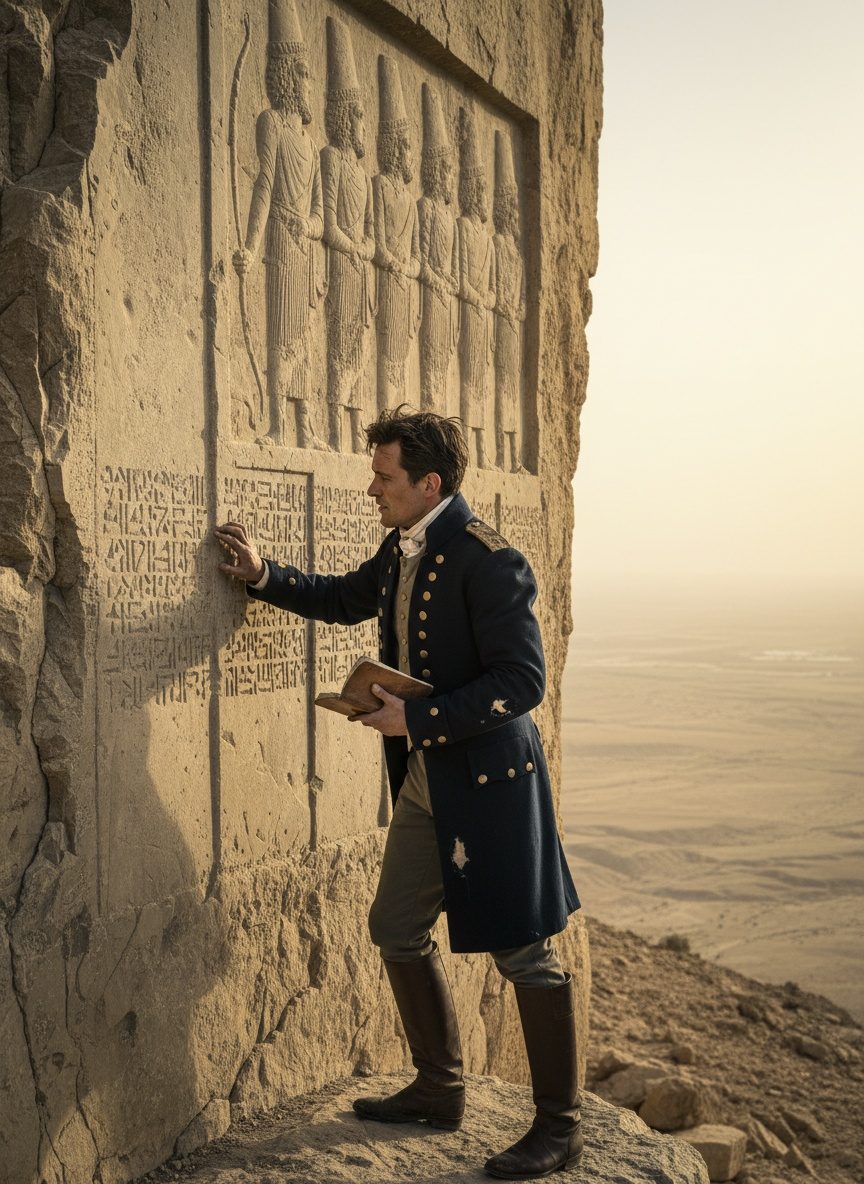
The first rays of dawn crept over the jagged Persian cliffs, painting the awakening world in hues of gold. Clad in his dusty uniform, Henry Rawlinson squinted upwards, the ancient carvings high above him barely discernable in the early morning light. With a deep breath that filled his lungs with the cool, sharp air of the barren landscape, he began his ascent. There were no ropes to steady his climb, no guarantees of safety. Yet, driven by the whispers of history, Rawlinson pushed upwards, his fingers scrambling for footholds among the rocks, desperate to solve a 2,300-year-old mystery.
The Silent Stones of Behistun
Behistun, now a part of modern Iran, was once a vital artery of the ancient Persian Empire. In 480 BC, Xerxes the Great, empowered by visions of empire, commanded the most formidable army assembled to etch a testament to his might. High above, on an impossibly sheer cliff, stonemasons carved into the solid rock the triumphs and glories of Persian kings. Written in three scripts that had fallen into silence — Old Persian, Elamite, and Babylonian — the inscriptions remained a puzzle, hidden in plain sight.
For centuries, travelers gazing at the inscribed rock wall speculated about the tales held secret by the stone. The great empires that rose and fell around it left the inscriptions untouched, an enigma suspended above the world. Those initial markings served not only as a monument to ancient power but also as a defiant message for the ages. Yet they remained unreadable, their true voices stilled by the passage of time and the loss of language.
The Cradle of a Linguistic Revolution
In the early 19th century, the mystery stood enticingly intact, a scholarly puzzle few dared to attempt unraveling. But in 1835, a young British officer stationed in Persia named Henry Rawlinson dared to venture where others had not. A linguist and soldier, he looked upon the cliffs with a gaze that saw both the past and the possibilities it held for the future of understanding human history. Equipped with the tenacity of youth and curiosity of a scholar, his ambition was nothing less than to break the silence of Behistun.
Choosing an audacious route, Rawlinson's approach to the cliffside inscriptions was as bold as it was dangerous. They rose precipitously 300 feet above the ground, barely accessible even to the most sure-footed. Yet, with little more than his bare hands and determination, he climbed. Hands bloodied from the jagged ascent, he pressed paper onto the stone's surface, meticulously copying the symbols etched in ancient tongues. Each character, carefully traced by his fingers, was a step closer to resurrecting the voices of long-dead kings.
Deciphering the Whisper of Kings
Returning time and again to copy and study the inscriptions, Rawlinson's efforts bore fruit in a most spectacular way. In his perseverance lay the seeds of discovery, the deciphering of Old Persian — a key stepping stone to understanding the remnants of related scripts. His tenacity unlocked the gates that had long kept the words of Darius I from the modern world, shedding light on Assyrian and Babylonian history too. These deciphered texts linked the tales of wars won and territories conquered, transforming ancient Persian rulers from myth back into historical reality.
The Behistun Inscription, as it came to be known, was not merely a foreign curiosity but a Rosetta Stone of the Mesopotamian languages, enabling a breakthrough in our understanding of ancient Near Eastern cultures. Through the transcription work of Rawlinson and the collaborative efforts of scholars following in his footsteps, the inscription gave breath back to the stories that had been lost to time. What the Persians had inscribed upon the rock face was a chronicle of power, an indelible mark of Xerxes' imperial majesty.
An Eternal Dialogue with History
The audacity of Rawlinson's climb marked more than a personal triumph; it sparked a renaissance in the study of ancient civilizations nowhere less significant than the deciphering of Egyptian hieroglyphs. It was a reminder of how texts, ancient or forgotten, have the power to connect us to our human past in unprecedented ways. As modern historians and students of history look back at Rawlinson's chapter in history’s grand narrative, they see not just a soldier, but a man who dared to climb into the annals of time itself, wedging open a window to the echoes of antiquity.
This episode resonates deeply with the lessons of history — that understanding the past requires patience, courage, and a relentless quest for knowledge. In scaling the cliff, Rawlinson not only dared gravity but also defied the weight of centuries-old silence. As his hand brushed against the cold inscribed stones, he bridged millennia, allowing the words of emperors long gone to echo loudly once more. The message from a cliff in Persia became a dialogue with history itself, a testimony to the endless human quest to uncover, to learn, and to share the stories that were never taught in school.