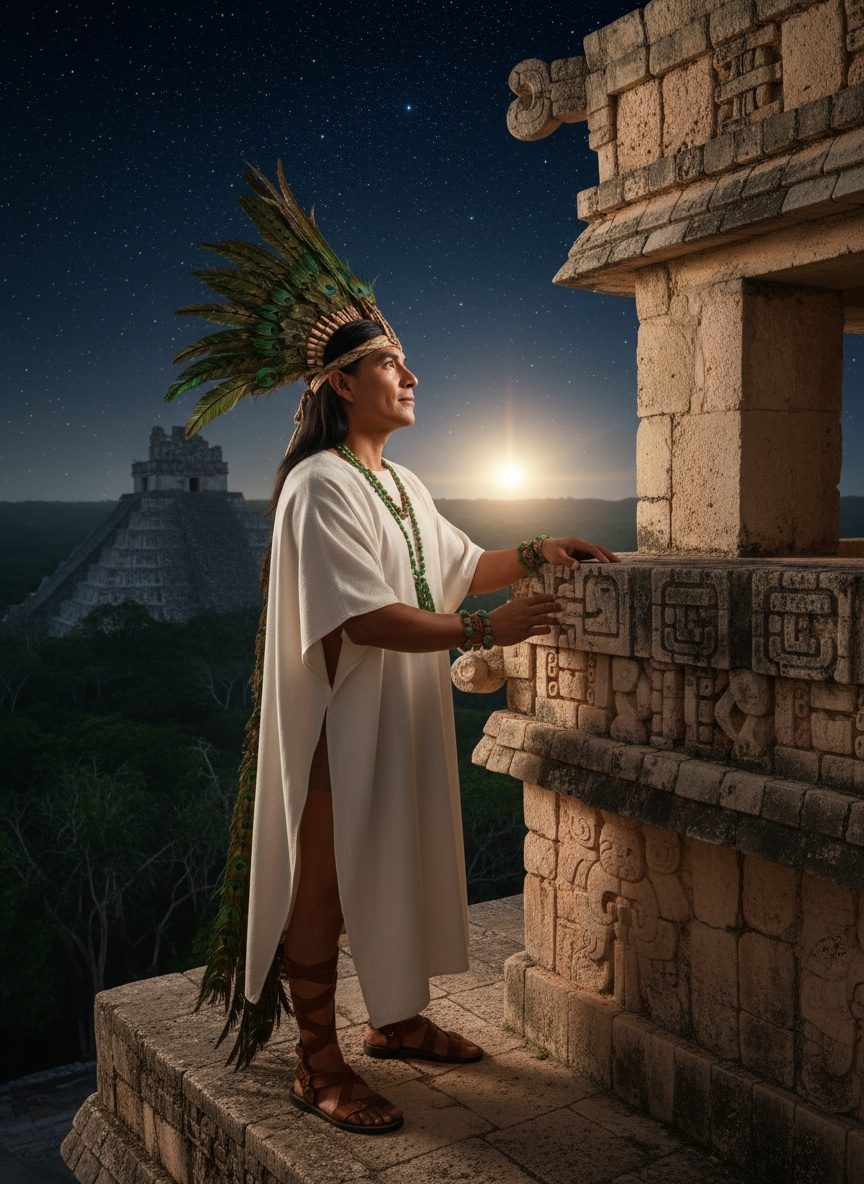
The stone beneath his bare feet was cool, sending a shiver up his spine as he stood atop the ancient tower of Palenque. A thick veil of the jungle's hum surrounded him, intertwined with the distant calls of nocturnal creatures. He leaned forward, squinting slightly, his weathered eyes tracing the night sky. This Maya priest needed no telescope, just clarity of sight sharpened by years of studying the celestial dance. Tonight, his attention was solely on Venus—the evening star—soon to emerge in radiant brilliance.
The Knowledge Written in Stone
In the Classical Maya city of Palenque, around 800 AD, the priests who served as astronomers possessed a breathtaking understanding of the cosmos. The Maya celestial observations were carved onto temple walls and codices, one of the most famous being the Dresden Codex, which much later astonished modern scholars. These ancient records not only charted Venus but did so with a precision that seemed almost impossible for a civilization without telescopic technology.
Venus was more than a bright light in the sky to the Maya; it held a sacred significance tied to their gods, calendar, and even warfare decisions. The priests painstakingly noted the planet’s rising and setting, creating records that mirrored Venus’s synodic period—a cycle of 584 days during which Venus completes one full circuit through its phases relative to Earth. The intricacies found in the calculations often matched our current scientific measurements to within minutes, showcasing a calendar cycle and system that was the pinnacle of astronomical studies.
Centuries of Celestial Tracking
The Maya’s capacity to chart Venus's path across the night sky was the result of generations of meticulous observation. In Palenque and other great cities across Mesoamerica, the Maya constructed observatories. Often pyramid-like and reaching into the canopy of the jungle, these towers offered unparalleled views of the heavens. Without instruments, the Maya astronomers depended solely on their eyes and the rich tradition of records passed through generations to correct for errors and refine their system.
The Maya excelled at the long game; they didn't build their calendars based on short-term observations but crafted them using cycles spanning decades. Their profound insight into the celestial sphere was intertwined with their religious and agricultural life. Venus, in particular, was closely tied to the god Kukulkan and was feared and revered in equal measure. The planet’s cycle influenced both agricultural practices and the timing of war; knowing precisely where Venus would be was part of an intricate balance between divine favor and natural rhythms.
Decoding the Dresden Codex
The Dresden Codex, one of the few surviving pre-Columbian books created by the Maya, was crucial in revealing the sophistication of Maya astronomy. When 19th-century scholars began to decipher it, they were astounded by the detailed Venus tables. Amidst intricate images and glyphs, the precision with which the Maya tracked celestial bodies emerged unmistakably. Here was evidence of a society that had not only watched the stars but had effectively created one of earth’s first written records of astronomy.
The Codex confirmed what had long been visible in stone reliefs at places like Palenque: that accurate astronomical knowledge was carved into the cultural and literal stonework of the Maya civilization. The priests' use of Venus cycles to harmonize their calendar and religious events indicated a level of sophistication that stood toe-to-toe with European knowledge attained through telescopic study many centuries later.
The Stars as Cultural Compass
As the priest watched the starry sky from his stone observatory, he likely pondered the immense responsibility cast upon him by his ancestors. He wasn't just recording the movements of Venus—he was aligning divine mandates with the mortal world, a cultural compass that guided the Maya's every step. In those moments of solitude, beneath the canopy of stars, the power of his observations wasn't just about knowing where Venus would appear but understanding the broader dance of time and destiny.
The Maya dedication to astronomical research served as a reminder of humankind's ancient fascination with the stars. Their knowledge, interwoven with myth and practicalities of life, acts as a profound testament to the creativity and intelligence of the human spirit. In recognizing the achievements of the Maya, we see the rich heritage and ingenuity that laid foundational tracks in astronomical sciences long before the advent of modern tools.
The night sky observed from a Maya observation tower and the delicate glyphs etched into their stoneworks resonate with a timeless message: that the universe is an intricate puzzle, waiting for minds willing to unlock its secrets. It’s a story that urges us to look beyond the immediacy of our own tools and consider the enduring power of patient observation and the legacy we too might leave carved in stone for future generations.