Hallfred the Troublesome Skald was about to meet his end. But he didn't.
The Storm Bringer: King Olaf Tryggvason
King Olaf Tryggvason was a man known for wielding his faith as fiercely as his weapons. With a heart burning with zeal for the new Christian god, he ventured into the stormy seas of Norway around 996 AD, sword and scripture in hand, converting the Nordic people by force when necessary. The man believed that the old ways were relics of a past best forgotten, for in his mind, Christianity’s light could lift even the darkest of worlds. Olaf expected his will to be the voice that echoed across valleys and fjords alike.
Under King Olaf’s reign, the flicker of bonfires where Norse gods were praised grew dimmer, replaced by the sound of church bells. Christ the White had become the new cornerstone of faith, and Vikings accustomed to pagan rites found themselves caught in a mandatory march to the baptismal font. But amidst this sweeping tide, a voice stood still in the face of compulsion—Hallfred Ottarsson, a skald of unparalleled craft.
The Reluctant Convert: Hallfred the Troublesome Skald
If Olaf was the storm, Hallfred was the solitary rock daring it not to strike him down. Known as Hallfred the Troublesome Skald, his reputation for being unyielding as the granite cliffs of the Norwegian coast had not gone unnoticed. Hallfred's words were his weapon, carving verses that intimated divine grace as much in Odin as they might in the Virgin Mother. Yet his loyalty to tradition was not merely stubbornness; it was a genuine devotion to the old gods, a stance he contained within lines of poetry that became a rallying cry for many.
To be a court poet was a position of deep respect—a skald could sway opinions with elegance or inflame tempers with a carefully chosen phrase. And for Olaf, Hallfred was expected to be among those who would lead the charge in extolling the virtues of Christianity. But when asked to spread the new religious rhetoric through his revered verses, Hallfred refused outright. In a court where disagreement often met the unforgiving edge of an axe, the upcoming conflict seemed inevitable.
The Showdown: A Poem or a Peril
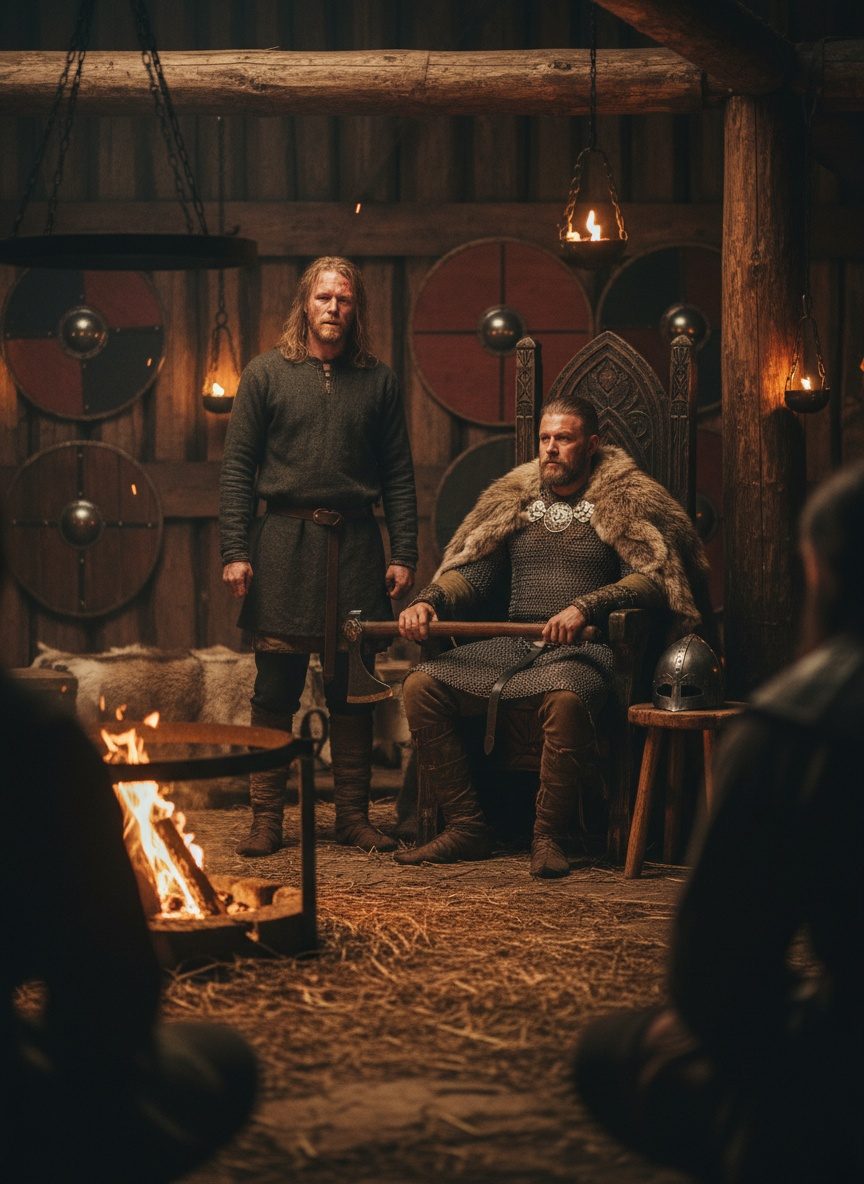
A hush fell over Olaf's court like the silence preceding a snowstorm. Eyes turned as the powerful king called forth his skald, challenging him directly to renounce his allegiance to the pantheon of old in favor of Christian devotion. The request hanged heavy in the air with unspoken menace. Olaf's grip on his battle-worn axe tightened with the weight of the boiling tension.
In those key moments, Hallfred's freedom, possibly his life, depended on a single verse. The quiet intensity of the chamber was punctuated only by the heavy breathing of the men present, each acutely aware of the king's proven propensity for decisive acts. The king demanded allegiance through art, but Hallfred's heart could not sing a foreign tune, not even in trade for survival. With no other recourse and under a gaze fixed as the unblinkable eye of Odin himself, Hallfred did what he was known for—he spoke poetry.
The verse he recited is lost to time, a mystery wrapped in history's tapestry. But its impact is whispered in sagas: the king's brutal ire broke, laughter spilled forth melting Olaf's collected rage like thawed ice. In the brilliance of a few lines, Hallfred managed not only to humanize the furious king but to engrain himself deeper into Olaf's court fabric. The axe was lowered, the threat dissolved, and Hallfred found a place not as a convert to the King’s god, but as a participant in a broader dialogue—the court poet with words sharp enough to stay the blade of conversion.
Bard Beyond the Baptism
Why does Hallfred's story resonate today? It exists as a reminder of individuality standing firm against a tide of change, a story of human resilience in maintaining integrity against a backdrop of monumental shifts. It’s the testament to the power subtlety wields over brute force—what one heart cannot be compelled to renounce, no decree can truly take. Hallfred’s tale of steadfastness expands beyond his lifetime; it embodies the clash of paradigms intrinsic to the human experience.
In the end, Hallfred the Troublesome Skald walked a fine line between two worlds—his verses unified the echoing halls of Norse mythology with the new dawn of Christianity, without losing his unique voice. Instead of diminishing him, the tension between past and future propelled him into the living memory of a people between gods. His story is a historical mosaic, crafted with care by the words he dared to keep, a legacy defying submission and celebrating the unyielding power of words.