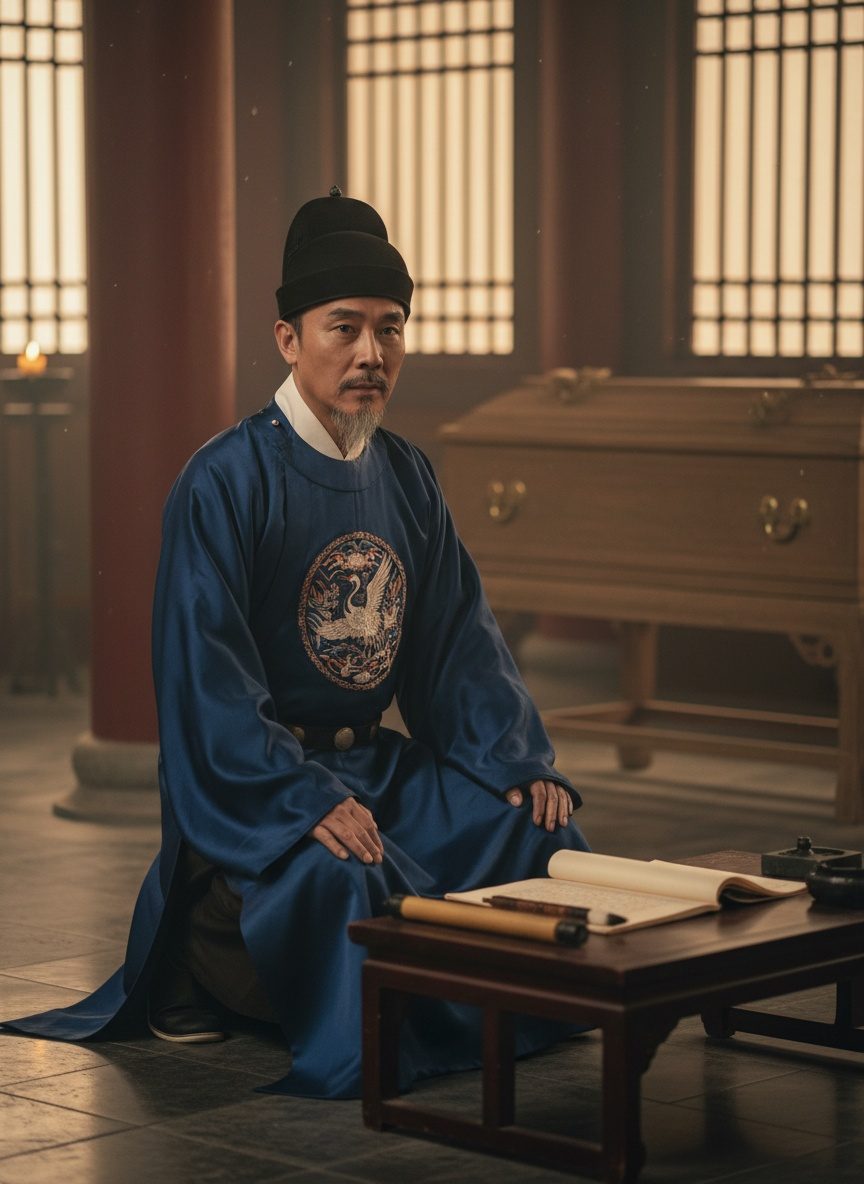
The dimly lit room was silent, save for the soft shuffling of silk garments. Hai Rui, a mid-ranking official of the Ming Dynasty, knelt reverently before the imperial throne. Sweat trickled down his spine as he presented the emperor with a carefully folded document. His heart pounded with the weight of what he knew it contained: a bold denunciation of the emperor himself. The air was thick with the pungent aroma of incense, a scent meant to soothe, yet it did nothing to calm the tumult within him. Hai Rui had already said his farewells to his family and purchased the crude wooden coffin for his impending fate. What happened next would ripple across the vast span of China.
The year was 1565, and the Ming Dynasty was a realm of both grandeur and discontent. The ruling emperor, Jiajing, had grown increasingly detached from his duties, ensconced in a life of luxury and seclusion. Known more for his pursuit of alchemical immortality than for effective governance, his court had become a hotbed of corruption. Yet while officials across the land turned blind eyes to the emperor’s failings, Hai Rui, a man of incorruptible integrity, resolved to stand alone against the tide.
Hai Rui's journey to this day had been anything but ordinary. Born in 1514 to a humble family, his path to the imperial court was defined by diligence and an unyielding moral compass. While others in his position might have opted for sycophancy, Hai Rui chose the thorny path of truth. His reputation for honesty and uprightness was both his shield and his peril. In a time when criticism of the sovereign was tantamount to ordering one's own execution, Hai Rui's actions were audacious — unprecedented even.
The letter he submitted was a daring soliloquy of truth. Not merely a criticism, it was a comprehensive indictment of the emperor's neglect and cruelty, laid out with poignant clarity. His words did not dance around the truth; instead, they pierced the veil of imperial infallibility like arrows, taking aim at corruption, at negligence, and at the suffering imposed upon millions by the disengaged hand of Jiajing. It spoke of droughts ignored, of tax burdens exacerbated, of the heavy yoke of suffering borne by the poorest subjects.
Hai Rui could almost hear the clatter of the imperial seal as his document was opened. This was no ordinary grievance; to deliver such an audacious message was to challenge fate itself. As he awaited his summons, he pondered the history etched into the vast edifice of the Forbidden City. Each tile, each imposing pillar, bore witness to the struggles of countless others who had dared to speak truth to power — some had triumphed, but most were swiftly silenced.
Days passed in agonizing expectation. The sun rose and set over the imperial courtyards, casting long shadows that mirrored Hai Rui’s uncertainty. Every footstep echoing in the corridors seemed to carry with it the specter of impending doom. Yet, as his days of waiting stretched on, a clarification from the emperor came, but not in the feared form of an imperial edict of death.
The halls of the court buzzed with disbelief when a decree finally arrived, not of execution but of dismissal and exile. There was no beheading, no public disgrace upon a scaffold, bird picking at his bones. Was it mercy, or was it a calculation by the emperor? Jiajing, unpredictable as ever, spared Hai Rui the terrible fate many had anticipated. The emperor's decision was a tacit acknowledgment that the official had a following — not of political allies, but of admirers who saw in him the embodiment of an ideal long since tarnished.
Although relegated from court and stripped of rank, Hai Rui's stand inspired discourse across the empire. His boldness had cracked open a space for dialogue on governance and moral responsibility, pinpricking the consciousness of even the most detached courtiers. His letter became something of a manifesto among scholars and bureaucrats, a whispered symbol of integrity and courage.
The story of Hai Rui did not end with his exile. Years later, he found himself recalled to serve again under a different emperor, his stature unstained and his reputation burgeoning into that of a folk hero. His dismissal became almost a badge of honor, a testament to the enduring potency of truth spoken to power. Historians and storytellers would recount his tale as an emblem of the Confucian ideal of a principled official — one who dared to put the people and the state before his own safety, challenging the moral decline he viewed rampant in his time.
Hai Rui's actions reverberate even today, not only in historical texts but in the cultural memory of China. In an era dominated by compliance and silence, he showed that it was possible to steer the winds of change, however gently, against the overpowering gales of authority. His letters survive as whispers from the past, teaching generations about the complex interplay of governance, morality, and courage.
In the end, Hai Rui knelt, not in submission, but in defiance. His tale is one that questions the very nature of power: Is it unchallengeable simply because it is almighty, or does true power lie in the courage to speak when others will not? He reminds us that the ripples of a single act of defiance can reach far beyond its immediate echoes — altering the course of history in silent, profound ways.