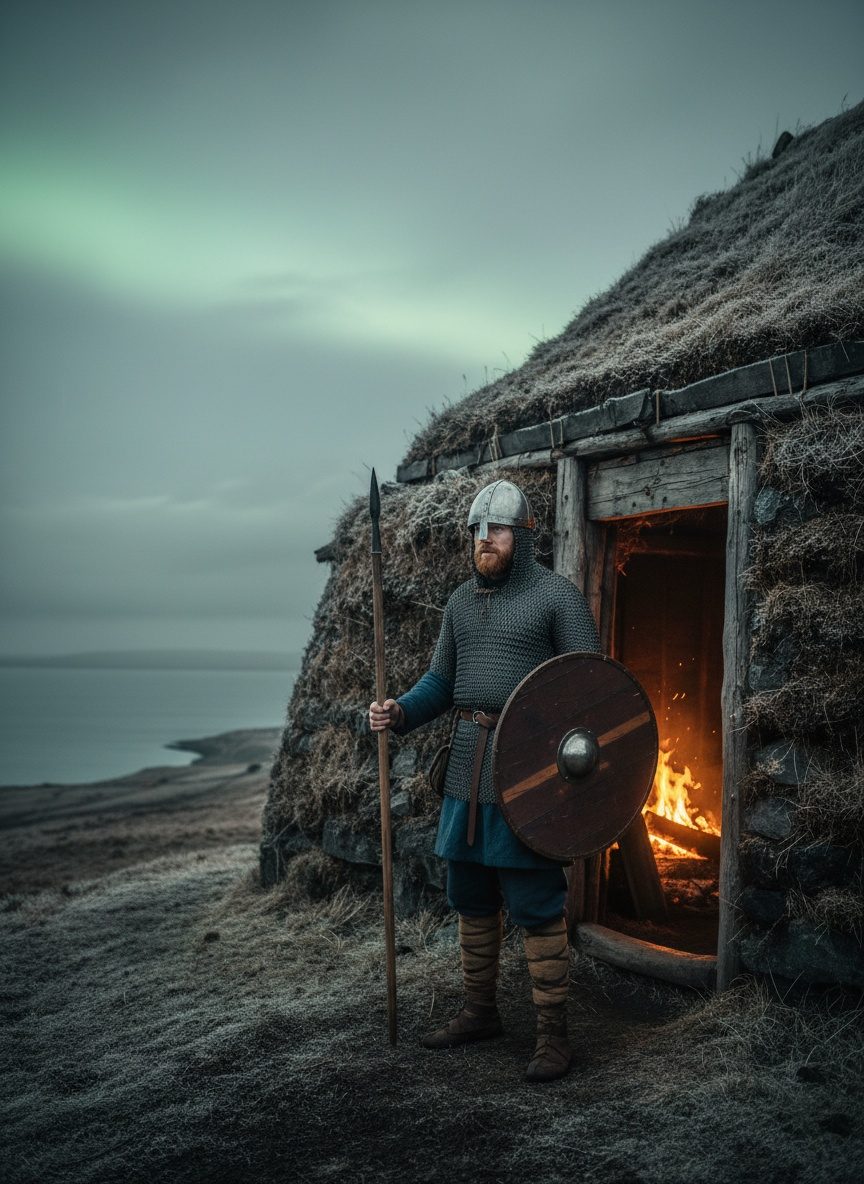
The cold wind bit at Gunnar's face as he rode, the clatter of his horse's hooves echoing against the rocky Icelandic terrain. The ocean lay ahead, a tale of freedom waiting to unfold across distant waves. But as he reached the crest of the hill, something pulled him back. It wasn't just the harsh realities of exile — it was the sight of Hlíðarendi, his homestead spread like a tapestry of peace, warmth, and memories against the stark landscape. In that moment, Gunnar knew he wasn’t sailing to new lands. He was going home.
In the Iceland of 990 AD, a land both young and fierce, the Althing served as the island's cornerstone of justice and order. Meeting on the plains of Þingvellir, chieftains and farmers alike gathered to settle disputes and pass decrees. For Gunnar Hámundarson, the Althing had spoken in the harshest tones of the law: outlawry. Deemed an enemy of the state, he was sentenced to either live in exile or face death upon sight. Yet here he was, retracing his steps to the place that nestled within his very bones.
Gunnar’s story is one of legend, a tale that breathes life into the sagas that chronicled the exploits of Viking Age Iceland. But what led to this fateful decision? Known for his fair hair and unmatched skills in battle, Gunnar of Hlíðarendi was not a man one would forget easily. Liked as much for his warm heart as for his strength, his decision to stay speaks volumes of his character, much like the Norse narrative tradition itself — rich, layered, and complex.
The events that precipitated the Althing's judgment stemmed from a series of feuds and rivalries, typical of the Icelandic sagas. Gunnar had, like many of the sagas' heroes, been swept into a cycle of vengeance and counter-strikes, each action leading inexorably to the next. Yet his defiance of the Althing’s decree wasn’t just about contrariety; it was about the draw of his homeland, the whispered call of turf and fjord that no exile could silence.
Evening came quickly in that season, the sun’s fall hastened by the weight of gathering clouds. The bitter winds brought with them the deep scent of the earth, mixed with the salt of the sea. As darkness descended, it wasn’t long before Gunnar’s adversaries arrived. They did not come quietly; the twang of bowstrings and the harsh clash of steel heralded their arrival outside his door. Yet, Gunnar didn't wait for their attack.
The sagas recount that Gunnar fought with a resolve better translated as unyielding spirit. Alone in his corridor, with only the hallowed echoes of his ancestors to stand with him, he drew his sword. The lone warrior met his foes, his mastery of combat earning admiration even in that tense standoff. Arrows flew, each glimpse of flight a flash of mortality; swords clanged with an intensity mirrored only by Gunnar's heart. And as dawn crested the horizon, the inevitability of the end drew near.
What truly set Gunnar apart was not merely his prowess as a warrior, but his unwavering spirit and the calm acceptance of his fate. The sagas capture a moment of serenity amidst the chaos — as his enemies pressed harder, Gunnar, looking out across his beloved land one final time, was said to have smiled. It was not a grin of defeat, but rather an acknowledgment of destiny and the choice he had embraced with arms wide open.
The tale of Gunnar of Hlíðarendi reverberates throughout the annals of Icelandic folklore, epitomizing the values and the stoic fatalism embraced by his culture. Gunnar’s choice to die defending his home rather than live in defeat elsewhere, spins a larger yarn about identity and belonging, principles close to the hearts of the Viking Age Norsemen. It serves to remind us of the period's ethos — not all battles are won on the field; some are fought and won within.
Though centuries have passed, the hills of Hlíðarendi still whisper his story. To those who wander its paths, the memory of his defiance echoes as a tribute to the rugged endurance of those who once lived on this wind-swept isle. Gunnar’s narrative lingers in the air, a compelling thread woven into the rich tapestry of Iceland’s past — one that challenges our perceptions of valor, sacrifice, and the places we call home.
Why does this tale endure? Perhaps it speaks to a universal truth that transcends centuries: the courage to choose our path, no matter how difficult, is the essence of legacy. In a world constantly grappling with change, where the path of the familiar is often at odds with the uncertain voyage, Gunnar’s choice is a powerful reminder of the strength found in standing one’s ground, and the peace that can be found in return, however fleeting that might be.