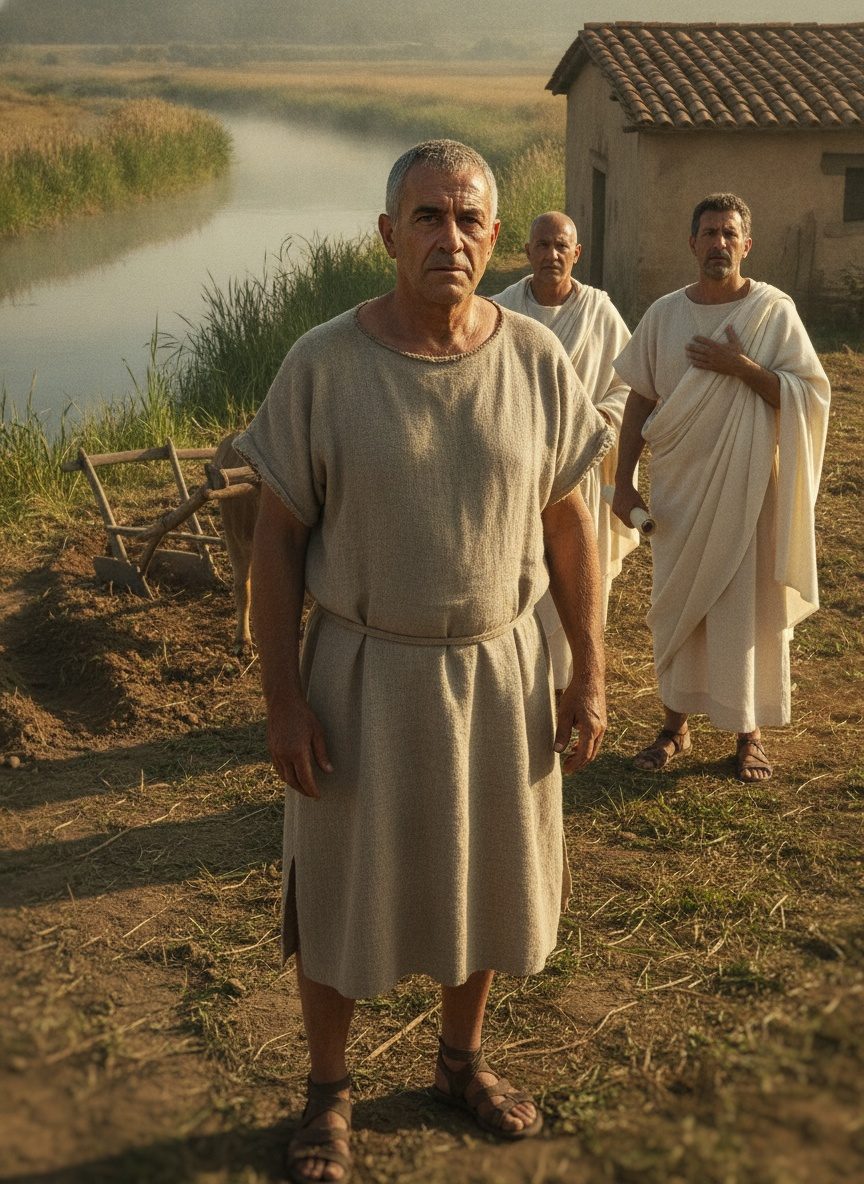
The sun was just beginning to dip below the horizon, casting long shadows across the fertile fields near the Tiber River. The rhythmic clinking of iron against soil was the only sound, save for the distant calls of nature settling into the evening. It was in this tranquil scene, among the rows of furrowed earth, that a messenger found Lucius Quinctius Cincinnatus, his weathered hands guiding the plow. Beyond the horizon, however, the city of Rome stood on the brink of despair, surrounded and squeezed by enemy forces. This was no ordinary eve; it was a time when the very fate of the Republic hung by the thread of a single decision.
The Man Behind the Plow
Stories of Lucius Quinctius Cincinnatus as the ultimate figure of civic virtue are plentiful in Roman history. Here was a man who, despite holding immense power and influence in Rome's political arena as a former consul, chose a life of simplicity and labor on his modest estate far from the intrigues of Senate halls. Known for his integrity and strength of character, Cincinnatus embodied the Roman ideal of humble, selfless service.
The Senate, faced with an unprecedented threat from hostile tribes encircling Rome in 458 BC, looked to Cincinnatus as their last hope. The enemy's numbers were grimly reported, and panic had begun to seep into the city's very foundation. Yet, it was the quiet resolve in Cincinnatus's heart, as steadfast as the land he tilled, that offered Rome a glimmer of hope in its darkest hour.
A Paramount Call
In the crisp evening air, with the cool touch of twilight, the urgency of the Senate's messengers was palpable when they rode up to invite Cincinnatus to lead as dictator. Relinquishing his plow, he wiped the sweat from his brow and listened intently to the desperate plea of his countrymen. Such a position, wielding absolute power, had the potential to corrupt even the stoutest hearts; however, Cincinnatus accepted the burden, not for personal gain but out of duty to his people.
His task was daunting: to break the siege and lift the threat confronting Rome, a mission fraught with perils on all sides. It was under these exceptional circumstances that Cincinnatus exhibited extraordinary leadership. With a strategy as clear as the skies above him, Cincinnatus set to work assembling forces, the likes of which were driven by a leader whose personal values inspired trust and unwavering loyalty.
Awakening a Republic
Under the soft glow of campfires and amid the clash of spears, Cincinnatus's legions were mobilized with an efficiency that seemed to defy the passage of time. From his small farm to the battlefield, Cincinnatus's transformation was nothing short of legendary. Encased in armor, the seasoned general led a rapid and relentless campaign that swiftly outmaneuvered and overwhelmed Rome's adversaries.
Within sixteen days—a mere slip of time in the grand chronicles of Rome—Cincinnatus achieved what seemed impossible. Forces that thrummed with Rome's enduring spirit flanked the enemies, creating a pincer that closed with decisive force. Rome was liberated from the encroaching siege, its lands free from the tangible fear that had pressed against its heart.
His victory was not only in defense of the city but also in the preservation of the ideals upon which the Roman Republic built its identity. Cincinnatus had not just defended soil; he had safeguarded the principles that elevated Rome above tyranny and chaos.
The Return to Plow
Cincinnatus could have wielded unchecked power, but after Rome had danced upon the brink of ruin, he did what many could not fathom: he relinquished his dictatorship. With the same quiet dignity with which he had accepted the role, he returned the reins of power to the Senate, sparing the Republic a crisis of governance.
The story of Cincinnatus, stoic amid adversities, has survived millennia as a beacon of civic virtue—a symbol of moderation and service over ambition. In his decision to return to his plow, he demonstrated what many would lose sight of in history: a leader's true strength lies not merely in conquest but in restraint and the ability to walk away once the need has passed.
In a world where power often obscured purpose, Cincinnatus's legacy endures as a testament to freedom's custodianship. The tale of Cincinnatus evokes a question relevant for all ages: what is the true measure of success—is it the taking of power, or in knowing when to lay it down for the greater good?