Exile was meant to be a fate worse than death. Gunnar of Hlíðarendi chose death instead.
In the waning days of the 10th century, amid the rugged and isolated landscapes of Iceland, a tale unfolded that would capture the imagination of many for centuries. Gunnar Hámundarson, known to his peers and posterity as Gunnar of Hlíðarendi, exemplified the heroic ideals that wove through the fabric of Viking lore and Icelandic sagas. Yet, his story isn't just about valor or warfare, but of an undeniable bond to the land that rippled through his blood, ultimately becoming both his sanctuary and his doom.
Iceland in 990 AD was a harsh but fiercely independent society governed not by kings but by chieftains who settled disputes through the Althing. This proto-parliamentary system acted as a communal courtroom where feuds could evolve from legal battles into blood-stained fields. Gunnar, renowned for his unmatched skills in battle and his remarkable physical prowess, walked into this fraught world like thunder at sea—a force of nature that could not be ignored.
Gunnar's life was the stuff of legend even before it met its poignant end. Decorated for his exploits, he had experienced triumphs well beyond his years at sea and in skirmishes. But it wasn’t his martial abilities alone that marked him as unique; it was a deep sense of honor and justice that stirred both admiration and envy. Friends and foes in equal measure spoke of Gunnar's striking looks and extraordinary talents: an agile warrior with a poetic soul, who could leap his own height in full armor and cut down any foe with a single stroke.
But in Gunnar’s Iceland, heroism was a double-edged sword. If his abilities earned him devotion, they also cultivated an array of jealousies and vendettas. His many feats, while legendary, hatched simmering feuds. Gunnar had, on more than one occasion, demonstrated his skill at outmaneuvering these threats through the art of compromise. Yet, the Icelandic sagas suggest a man whose diplomatic talents were equal only to his pride and passion, a combination with the potential to ignite and consume like wildfire.
These hostilities reached a boiling point following one such mediation, misjudged as lack of resolve by his enemies. As dictated by Icelandic law, Gunnar was sentenced to exile—a sentence that typically equated to a loss of honor. Stripped of his place, a man might roam the seas like a wraith, haunted by disgrace. To leave Iceland was to sever one’s connection with family, ancestors, and the earth itself—a fate almost unthinkable in Gunnar's mind.
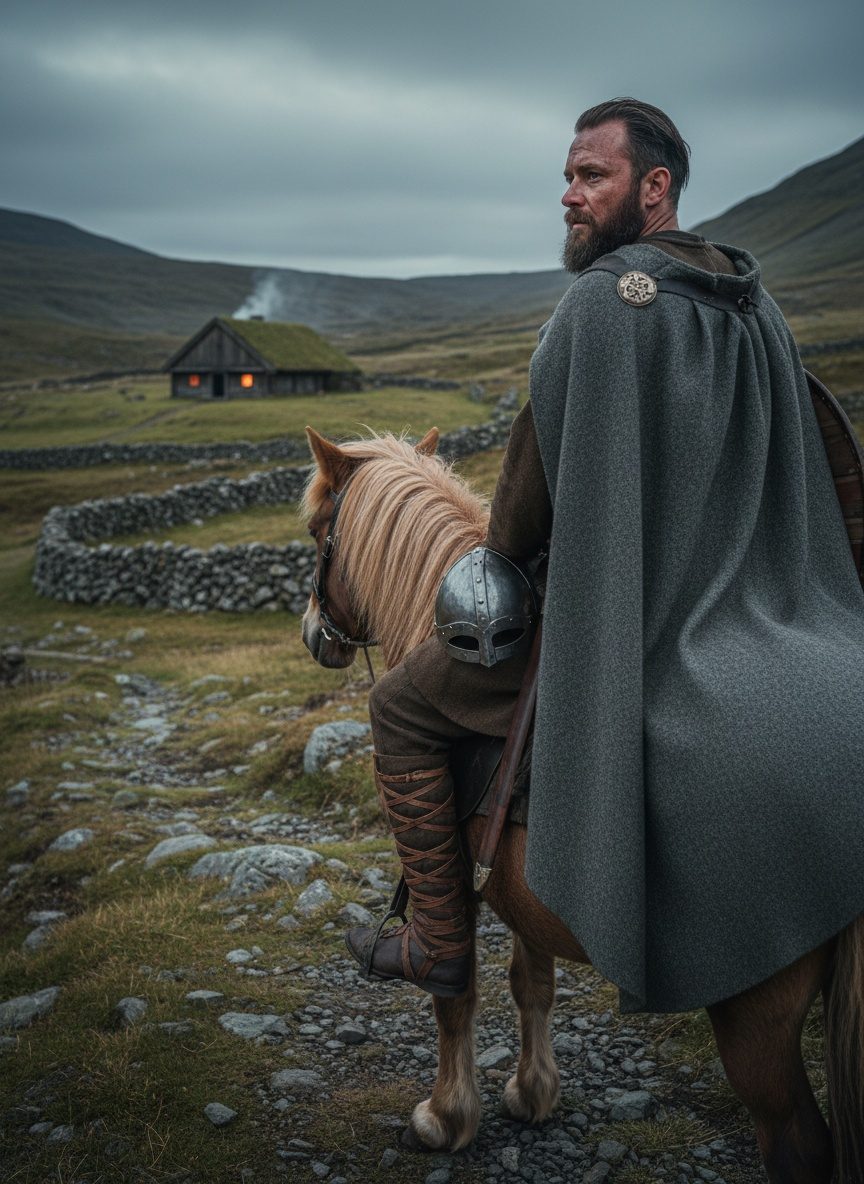
The decision to depart from the beloved valley he called home must have weighed heavily, a burden visible to those who watched his somber procession to the waiting ship. His departure was neither alone nor undramatic. Friends escorted him, doubtlessly sharing in his nostalgia and silent farewell to a life never to return. He was almost to the vessel that would carry him from all he cherished when, spurred by an impulse both unforeseen and irresistible, he pulled the reins and turned his horse.
What could compel a man to choose almost certain death rather than flee to safety? Gunnar had arrived at a ridge that offered a final view of Hlíðarendi. There, gazing down at the silver-threaded streams and the verdant patchwork of meadows, a realization took root. Iceland, with its sharp winds and luminous summer nights, was his life force. Gunnar famously stated, “Fair is the hillside. Never has it seemed fairer to me than now, with its pale fields and mown meadows.” In the moment, the beauty of his home outweighed the horrors that awaited him.
No one knew of his decision until darkness grayed the horizon and Gunnar was seen again at the threshold of his homestead. The world around quaked with uncertainty as friends and kin sought to shelter him from the inevitable. But Gunnar’s enemies were swift. Under the cover of night, they laid siege to his home. Though his prowess was legendary, the numbers overwhelmed. Gunnar fought valiantly, honor intact, until the very end, when the morning light revealed the falls of one who dared to challenge fate.
The saga of Gunnar Hámundarson is more than an account of a valorous Viking. It reflects the pull of identity and land, themes still resonant today. Through Gunnar’s poignant decision, future generations glimpse the strength of existential ties to one’s heritage and roots. In choosing his Iceland, Gunnar chose authenticity, leaving a story marked by unswerving conviction and the tragic beauty of a hero who could not leave behind the essence of his being.